Irish Home Rule Bill passed but immediately suspended
On 18 September 1914, the Government of Ireland Act, also known as the Third Home Rule Bill, received royal assent. However, the implementation of home rule was immediately deferred as a result of the passage of a second law, the Suspensory Act.
The postponement, coupled with the outbreak of revolution in Ireland, meant the home rule scheme set out in the 1914 act never came into force.
***
Following the defeat of the first two Gladstonian home rule bills in 1886 and 1893, the Conservative and Unionist governments under the Marquess of Salisbury and Arthur Balfour pursued a policy of “killing home rule with kindness”. The demand for devolved Irish government was met with a programme of social legislation.
The 1906 general election returned the Liberals to government after an extended period in the wilderness. The January 1910 and December 1910 general elections, which resulted in hung parliaments, placed home rule firmly on the political agenda. The Irish Parliamentary Party (IPP), led by John Redmond, once again held the balance of power.
The Parliament Act 1911, the controversial subject of the 1910 general elections, meant that Irish self-government was now a realisable prospect. The legislation replaced the House of Lords “veto”, which had thwarted the Second Home Rule Bill, with a power to delay bills for a maximum of two years spread over three parliamentary sessions.
The Lords, dominated by Conservative and Unionist peers, had thwarted Gladstone’s Second Home Rule Bill by 419 votes to 41.
H. H. Asquith’s Liberal government introduced the Third Home Rule Bill on 11 April 1912 – to predictably implacable opposition from Conservative and Unionist parliamentarians.
The bill provided for limited Irish self-government by way of a Dublin-based bicameral parliament, consisting of a 164-member House of Commons and a 40-member senate. The proposed legislature would be invested with powers to deal with most national affairs, but the UK parliament would also retain authority “over all persons, matters, and things in Ireland”.
Under the scheme set out in the bill, Irish representation at Westminster would be reduced from 103 to 42 MPs.
Speaking at the bill’s first reading, Asquith referred to the ‘Irish obstruction’ and home rule as “increasingly vital to the efficiency of parliament itself”.
He noted the “between 20 and 30 self-governing legislatures” already in existence across the British Empire, which had “solved… the problem of reconciling local autonomy with Imperial unity”.
He asked: “Are we going to break up the empire by adding one more?”
The bill, he insisted, retained the “supremacy, absolute and sovereign, of the imperial parliament”.
Edward Carson, the charismatic spokesperson for unionism, rejected the scheme as “absolutely unworkable and ridiculous”. He dismissed the legislation as the product of a “disreputable bargain” in which the government had “sold the constitution” to the IPP in exchange for its support.
Moreover, Carson argued that the government had passed the Parliament Act “for the purpose of passing home rule while the constitution was suspended”.
James Craig (later the first prime minister of Northern Ireland) declared: “I say that under no circumstances whatsoever shall we who have control of certain parts of Ulster accept this bill, or submit to it when it is passed under a shattered constitution.”
John Redmond, in his contribution, stated that only a “very small section” of the Irish population desired separation. He argued that “if you change the present system and give into the hands of Irishmen, the management of purely Irish affairs even that small feeling in favour of separation will disappear”.
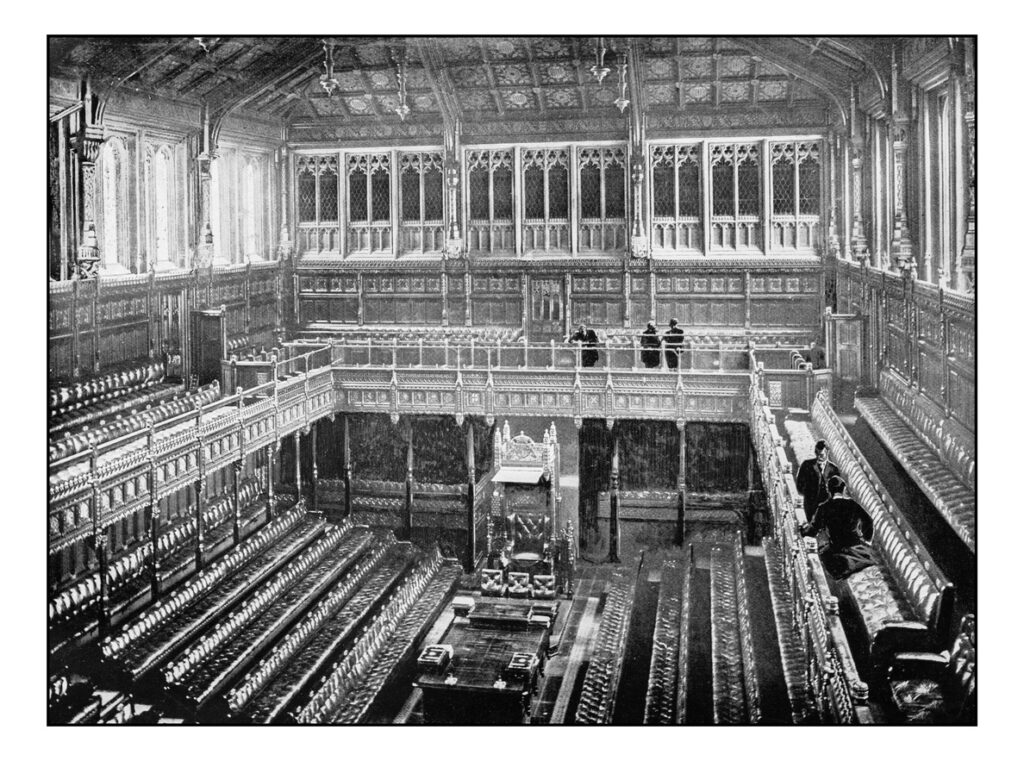
The bill was passed by the commons – which boasted a pro-home rule, Liberal-IPP majority – by 10 votes.
The Lords rejected it by 326 votes to 69.
This pattern was repeated for two further sessions. Asquith proposed his solution to the ‘Irish question’ – only for the Lords to exercise the extent of its (recently limited) powers. On the second attempt, peers rejected the bill by 302 votes to 64.
On 1 January 1913, Carson moved to amend the first clause of the Government of Ireland Bill.
According to his proposed formulation, the bill would read: “On and after the appointed day there shall be in Ireland except in the province of Ulster an Irish parliament consisting of His Majesty the King and two Houses, namely, the Irish Senate and the Irish House of Commons.”
Carson argued for the exclusion of the nine counties of Ulster from any home rule scheme. He maintained that unionism was “grimly in earnest, and grimly determined at whatever hazard and cost to themselves, never to submit to the degradation of a parliament set up in Dublin”.
He told the House: “It is not a bill to enable the nationalists of Ireland to govern themselves. It is a Bill to enable the nationalists of Ireland to use British force in order to compel a great homogeneous community to submit to a government which they detest.”
Carson’s amendment secured the support of Conservative Party leader Bonar Law, who argued that the difference “between Ulster and the rest of Ireland is far deeper than that between any part of the United Kingdom and Ireland taken as a whole.”
Law threw himself and his party behind Carson’s cause.
Redmond was adamant that any partition of Ireland was unacceptable, referring to partition as a “measure to that we as Irish nationalists can never submit”.
Asquith condemned Carson’s proposals as a “wrecking” amendment. It was subsequently rejected by 294 votes to 197.
In May 1914, the bill passed the House of Commons for the third time (by a majority of 77), triggering the Parliament Act’s provisions.
According to the 1911 act, on 18 September 1914, the Government of Ireland Bill landed on the statute book.
***
The news of the 1911 Parliament Act was received in Ulster with grim foreboding. The legislation’s implications for home rule were widely recognised.
Unionism had begun to mobilise in the early 1900s, symbolised by the creation of the Ulster Unionist Council (UUC). But the introduction of another home rule bill in 1912, the first since the 1911 Parliament Act, shifted unionist agitation into a new radical phase.
The 1912 to 1914 period had a transformative effect on the character of Irish unionism. The opponents of home rule had largely retreated to the nine counties of Ulster, where the island’s protestant minority was most heavily concentrated.
On 28 September 1912, ‘Ulster Day’, over 500,000 unionist (218,206 men and 234,046 women) signed the Ulster Covenant, vowing to use “all means which may be found necessary to defeat the present conspiracy to set up a Home Rule Parliament in Ireland”.
In January 1913, the Ulster Volunteer Force (UVF) was established by the UUC – providing the covenant with paramilitary support.
Nationalism responded with the Irish Volunteers in November 1913.
At this time, Redmond referred to the unionist mobilisation as a “gigantic game of bluff and blackmail”.
Carson responded: “Why does Mr Redmond think that 90,000 men are enrolling themselves as volunteers, and are proclaiming to the world – if his theory is true – that they are a pack of hypocrites and liars?
“You will get an occasional liar anywhere. Would you get 90 000 men in Birmingham to meet together for bluff?”
In March 1914, the government’s authority and ability to manage the crisis was curtailed by the “Curragh incident”, when British army officers stationed in Ireland threatened to resign rather than move against the UVF.
In April 1914, the Larne gun-running armed the UVF with a further 25,000 rifles and 3-5 million rounds of ammunition – all smuggled from the German Empire.
From 21-24 July 1914, representatives of nationalism and unionism were invited to Buckingham Palace to consider the crisis. The Buckingham Palace Conference, convened by George V, was attended by Asquith (Liberal), David Lloyd George (Liberal), Redmond (IPP), John Dillon (IPP), Carson (Unionist), James Craig (Unionist), Bonar Law (Conservative) and Lord Lansdowne (Conservative).
In an address to delegates, George V observed that “today the cry of civil war is on the lips of the most responsible of my people.”
The exclusion of Ulster was discussed. But delegates departed after three days of disagreement.
***
The Buckingham Palace Conference, and indeed the Home Rule Crisis as a whole, was overtaken by developments on the continent. Carson responded by committing his Ulster Volunteers to the war effort.
In a historic address to the commons on 3 August, Edward Grey, the foreign secretary, declared that the “peace of Europe cannot be preserved”.
But he added, in an optimistic aside: “The one bright spot in the whole of this terrible situation is Ireland.
“The general feeling throughout Ireland – and I would like this to be clearly understood abroad – does not make the Irish question a consideration which we feel we have now to take into account.”
Redmond, speaking in the same debate, stated his belief that “the democracy of Ireland will turn with the utmost anxiety and sympathy to this country in every trial and every danger that may overtake it.”
He declared: “Today there are in Ireland two large bodies of Volunteers. One of them sprang into existence in the North. Another has sprung into existence in the South…
“I say that the coast of Ireland will be defended from foreign invasion by her armed sons.”
Redmond hopefully inquired: “Is it too much to hope that out of this situation there may spring a result which will be good not merely for the Empire, but good for the future welfare and integrity of the Irish nation?”
Asquith sought to codify this political truce with the Suspensory Act.
The legislation, which postponed the enactment of two controversial acts of parliament (the Government of Ireland Act and the Welsh Churches Act), was passed by the commons in a single day.
The session of 15 September, taking place just six weeks after the outbreak of the First World War, was nonetheless tense and acrimonious.
Asquith argued that the proposed legislation was needed to preserve the political situation as it stood before the war began, while fulfilling the commitments made by the government. To deny royal assent to the Government of Ireland Bill and the Welsh Churches Bill, he argued, would put them “at the mercy of a chapter of accidents”.
He called for a compromise, a suspensory bill, whereby the proposed legislation would proceed to the statute book, but “no effective steps should be taken to bring them into practical operation” for at least 12 months, or the duration of the war.
Asquith, hailing his proposition as “practicable… reasonable [and] equitable”, also promised that his government would bring an amending bill in the next parliamentary session to deal with the Ulster question. He hoped that the “new conditions created by the war” could lead to a “satisfactory and permanent settlement”.
The prime minister told the House: “Things have taken place which no one anticipated, but I give the assurance that in spirit and substance the Home Rule Bill will not and cannot come into operation until Parliament has had the fullest opportunity by an Amending Bill of altering, modifying, or qualifying its provisions in such a way as to secure, at any rate, the general consent both of Ireland and of the United Kingdom.”
Bonar Law accused Asquith of breaking his “definite promise of a truce”, in confirming the controversial acts would receive royal assent.
He declared: “The prime minister told this House, in language as plain and unambiguous as our language permits, that he would not present the Home Rule Bill to His Majesty for royal assent until the amending bill had been finally disposed of in the House of Commons.”
Law said Asquith was exploiting the loyalty of the Conservative/Unionist opposition bloc at a time of war. “When I have finished we shall leave the House, and we shall not return to it till this subject is ended”, the opposition leader stated.
“We leave them to do whatever they like… We leave it because in my belief to have forced us to debate this subject at all under present circumstances is indecent, and we shall take no part in that indecency.”
The entire opposition party thus staged a mass commons walkout, leaving the government and its allies to pass the bill alone.
Redmond indicated his acceptance of the suspensory proposals as a “reasonable” compromise.
He denigrated the “absurd” idea that a new government and parliament could be erected in Ireland “when everybody is preoccupied by the war”. However, he rejected the suggestion that Asquith’s bill was a “party triumph”, insisting: “It inflicts a severe disadvantage upon us.”
Redmond then echoed Asquith’s belief that this “moratorium may… be of great good to Ireland”.
The IPP leader declared: “During that interval, Catholic nationalist Irishmen and Protestant unionist Irishmen from the North of Ireland will be fighting side by side on the battlefields on the continent, and shedding their blood side by side.
“And at home in Ireland, Catholic nationalists and Protestant Ulstermen will, I hope and believe, be found drilling shoulder to shoulder for the defence of the shores of their own country.”
He added: “The result of all that must inevitably be to assuage bitterness.”
The bill passed through all its commons stages without opposition.
The Suspensory Act contained a single substantive section.
It provided that “Notwithstanding anything in the Government of Ireland Act, 1914, no steps shall be taken to put that Act into operation, and notwithstanding anything in the Welsh Church Act, 1914, the date of disestablishment under that Act shall be postponed, until the expiration of twelve months from the date of the passing of those Acts respectively, or, if at the expiration of those twelve months the present war has not ended, until such later date (not being later than the end of the present war) as may be fixed by His Majesty by Order in Council; and the provisions of those Acts shall have effect accordingly.”
As Asquith indicated in his contribution on 15 September, an understanding had been reached that a later amending bill would provide for the exclusion of Ulster. But this proposition remained ill-defined. No agreement had been reached on either the shape of Ulster or whether exclusion should be temporary or permanent.
***
Irish nationalists celebrated the day of 18 September 1914. Self-government had been granted; the European war that justified its deferral was not expected to drag on.
Parliament was formally prorogued mere moments after the deputy speaker’s declaration that the Government of Ireland Act 1914 had received royal assent.
Will Crooks, a Labour MP, responded: “Would it be in order to sing ‘God Save the King’?”
The deputy speaker voiced no objections as members in attendance, including Redmond and the IPP, sang the national anthem.
Crooks added: “God save Ireland.”
Redmond responded: “And God save England, too.”
But delay would prove a fatal blow for the home rule cause – and, in the immediate term, constitutional nationalism. This insecure “truce” the Suspensory Act provided for would not last the length of the conflict.
***
Redmond, like Carson and the UVF, committed the Irish Volunteers to the war effort.
But a breakaway grouping, which retained the Irish Volunteers name and numbered around 13,500, were not of the same opinion. Revolutionary republicans, hostile to constitutional nationalism’s concessions, sensed England’s difficulty would be “Ireland’s opportunity”.
The Easter Rising (24 April 1916), planned by the Irish Republican Brotherhood (IRB), was initially met with bemusement and even hostility from many Dubliners. However, the week of fierce fighting, the destruction of much of central Dublin by artillery fire, and the British government’s hardline response – including large-scale arrests, the killing of civilians and the execution of rebel leaders – radicalised public opinion.
The IPP’s mode of constitutional nationalism did not survive the Easter Rising.
The insurrection created the conditions for Sinn Féin’s effective replacement of the IPP as the spokesperson for Irish nationalism at the 1918 general election. The new republican party, founded in 1905, won 73 out of 105 Irish seats.
The IPP secured six seats, down 74.
The formation of the Dáil Éireann, composed of those Sinn Féin representatives elected in 1918, coincided with the beginning of the Irish War of Independence (1919-1921).
***
The Third Home Rule Bill was successively suspended in a series of six month periods until 1920, when it was repealed by new home rule legislation.
The Government of Ireland Act 1920, or Fourth Home Rule Bill, recognised what would become Northern Ireland (six north-eastern counties in Ulster) and the south of Ireland (the 32 counties that would later constitute the Irish free state). The act envisioned that both polities would exercise self-government in the United Kingdom as “Northern Ireland” and “Southern Ireland”.
Elections were held on 24 May 1921 to these assemblies. Irish republicans used the elections collectively to constitute the second Dáil.
Irish nationalism had now evolved beyond the decades-long campaign for home rule.
The Irish War of Independence (1919-1921) resulted in the Anglo-Irish Treaty 1921 and the Irish Free State Constitution Act 1922. Instead of a sovereign republic, the treaty provided for dominion status, which meant Ireland would remain in the British Empire. Members of the Dáil would be required to swear allegiance to “King George V, his heirs and successors”.
With the republican cause divided over the settlement, Ireland was plunged into civil war.
Northern Ireland had the option to opt in or out of the Irish Free State. The unionist government, led by James Craig as prime minister, chose the latter option.
On 7 December 1922, the parliament of Northern Ireland agreed on the wording of the following message: “We, your Majesty’s most dutiful and loyal subjects, the Senators and Commons of Northern Ireland in Parliament assembled, having learnt of the passing of the Irish Free State Constitution Act, 1922… do, by this humble Address, pray your Majesty that the powers of the Parliament and Government of the Irish Free State shall no longer extend to Northern Ireland.

Politics.co.uk Newsletters
DAILY
Politics@Lunch
WEEKLY
Week in Review