Unionists sign Ulster Covenant, pledging resistance to Home Rule
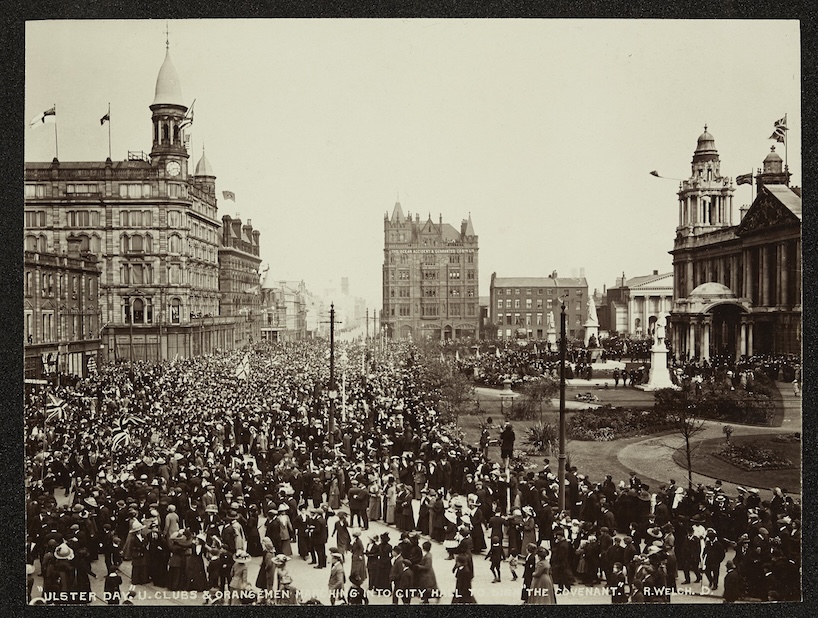
On 28 September 1912, almost half a million Ulster Unionists signed the ‘Solemn League and Covenant’, pledging to resist Irish home rule by “all means which may be found necessary”.
This covenant, orchestrated by the Unionist leader Edward Carson, demonstrated the depth of Ulster’s opposition to a Dublin-based parliament.
***
The event was a direct response to the Third Home Rule Bill (Government of Ireland Bill), which had been introduced by H. H. Asquith’s Liberal government in April 1912. The bill – which the government was poised to force through using the new powers of the Parliament Act 1911 – would have placed the Protestant-majority counties of Ulster under the authority of a parliament in Dublin.
Ulster unionists feared home rule would threaten their cultural and social position. This anxiety was captured by the slogan, first articulated by radical MP John Bright, that home rule would mean “Rome rule”.
The signing of the covenant in Belfast City Hall followed a series of religious services throughout Ulster. The document itself, first drafted by unionist businessman Thomas Sinclair, was displayed on a table draped in a Union flag. Carson stood forth as its first signatory.
The employment of the term covenant carried conspicuous theological connotations, suggesting an unbreakable divine contract. Its initiators did not resile from this logic. The document’s title also deliberately invoked 16th and 17th century Scottish covenants.
The covenant was effectively formed of two parts: a declaration for men and a corresponding declaration for women.
The 237,368 male signatories of the covenant pledged to use “all means which may be found necessary to defeat the present conspiracy to set up a home rule parliament in Ireland”.
The declaration described the prospect of home rule as “disastrous to the material well being of Ulster as well as of the whole of Ireland”. It added: “And in the event of such a parliament being forced upon us, we further solemnly and mutually pledge ourselves to refuse to recognise its authority.”
The parallel ‘Ulster Women’s Declaration’ was signed by 234,046 women. They pledged to support the men “in their uncompromising opposition” to home rule.
All together, the covenant amassed a full 471,414 signatures.
The Ulster Unionist Council, founded in 1905 to guard against home rule, pledged itself to the covenant on 23 September.
28 September is today celebrated as ‘Ulster Day’ by unionists.
***
The covenant solidified Unionist opposition to home rule and directly precipitated the formation of the Ulster Volunteer Force (UVF) in January 1913. The Ulster volunteers, a 100,000-strong force, provided the covenant with paramilitary support. It marked the first step in the signatories upholding their vow to resist home rule by “all means which may be found necessary”.
The covenant and surrounding theatre effectively triggered what is now known as the home rule crisis, which brought Ireland to the brink of civil war.
It established a new mode of militant unionism.
Nationalism responded to the developments within unionism with the Irish Volunteers in November 1913.
At this time, Irish Parliamentary Party (IPP) leader John Redmond referred to the unionist mobilisation as a “gigantic game of bluff and blackmail”.
Carson responded: “Why does Mr Redmond think that 90,000 men are enrolling themselves as volunteers, and are proclaiming to the world – if his theory is true – that they are a pack of hypocrites and liars?
“You will get an occasional liar anywhere. Would you get 90 000 men in Birmingham to meet together for bluff?”
On 1 January 1913, Carson moved to amend the first clause of the Government of Ireland Bill.
According to his proposed formulation, the bill would read: “On and after the appointed day there shall be in Ireland except in the province of Ulster an Irish parliament consisting of His Majesty the King and two Houses, namely, the Irish Senate and the Irish House of Commons.”
Conservative Party leader Bonar Law threw himself behind Carson’s cause.
Eventually, with the situation in Ulster continuing to deteriorate, the Liberal government was convinced that any home rule scheme should provide for some form of exclusion or partition.
From 21-24 July 1914, representatives of nationalism and unionism were invited to Buckingham Palace to consider the crisis. The Buckingham Palace Conference, convened by George V, was attended by Asquith (Liberal), David Lloyd George (Liberal), Redmond (IPP), John Dillon (IPP), Carson (Unionist), James Craig (Unionist), Law (Conservative) and Lord Lansdowne (Conservative).
In an address to delegates, George V observed that “today the cry of civil war is on the lips of the most responsible of my people.”
The Buckingham Palace Conference, and indeed the home rule crisis as a whole, was overtaken by developments on the continent.
***
The implementation of the Government of Ireland Act was deferred by the Suspensory Act. Both pieces of legislation received royal assent on the same day, 18 September 1914. Asquith also pledged that the home rule scheme would be subject to an amending bill to provide for the exclusion of Ulster.
The Third Home Rule Bill was successively suspended in a series of six month periods until 1920, when it was repealed by new home rule legislation.
The Government of Ireland Act 1920, or Fourth Home Rule Bill, envisioned that Northern Ireland (six north-eastern counties in Ulster) and the south of Ireland (the 32 counties that would later constitute the Irish free state) would separately exercise self-government in the United Kingdom.

Politics.co.uk Newsletters
DAILY
Politics@Lunch
WEEKLY
Week in Review