Hilary Benn applauded after speech supporting Syria airstrikes
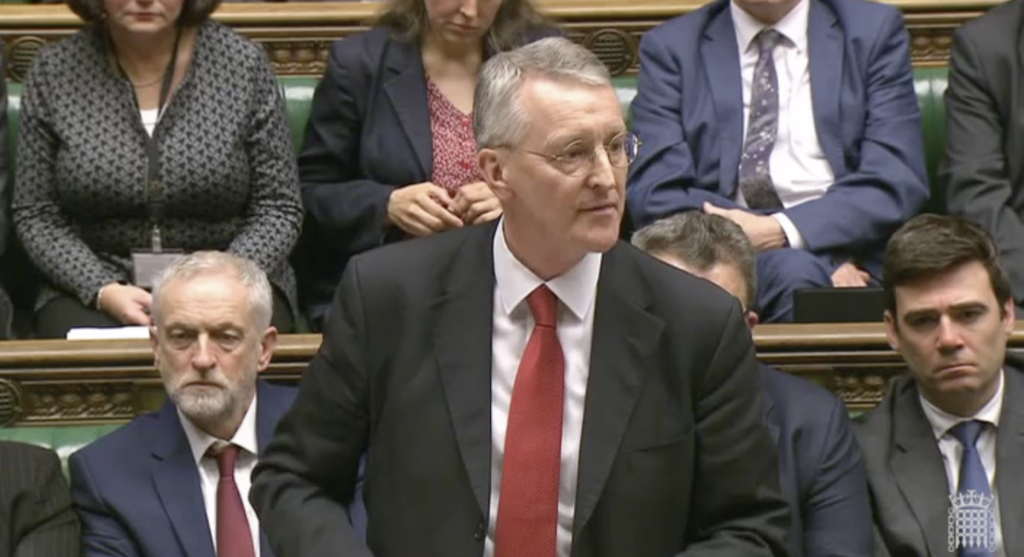
On 2 December 2015, the shadow foreign secretary, Hilary Benn, delivered an impassioned speech in the House of Commons, arguing in favour of extending British airstrikes against Islamic State into Syria. His intervention from the opposition dispatch box, which followed 10 hours of debate, was received with rare applause from MPs across the chamber.
The debate came against a backdrop of heightened security concerns following the Paris terrorist attacks in November 2015. The government, led by David Cameron as prime minister, argued that it was illogical for the RAF to strike IS/ISIL/Daesh targets in Iraq but not in Syria, where the group had its headquarters in Raqqa.
The Labour Party was deeply divided. Jeremy Corbyn, a long-standing Labour rebel and opponent of military intervention, had been elected as the party’s new leader in September. He constructed a shadow cabinet that embraced a platform of party unity. Benn, who was appointed as shadow foreign secretary after the 2015 general election, was retained in his post.
Corbyn chose to grant his MPs a free vote on Syria airstrikes to avoid a damaging split. This allowed shadow cabinet ministers to vote against the leadership’s position.
***
David Cameron, the prime minister, opened the debate by warning that the “women-raping, Muslim-murdering, medieval monsters” of IS were “plotting to kill us and to radicalise our children right now”.
Cameron argued that the strikes would “keep the British people safe”.
In his contribution, Corbyn said that the case for military action did “not stack up”.
He told the House: “Do we send in bombers, not totally aware of what all the consequences will be, or do we pause, not send them in, and instead put all our efforts into bringing about a peaceful humanitarian and just political settlement to the terrible situation faced by the people in Syria?”
Benn, however, framed the conflict as a struggle against fascism. He urged Labour members to confront the “evil” posed by Islamic State, who he said “hold our democracy in contempt”.
Benn argued that the United Nations Security Council Resolution 2249 provided a “clear and unambiguous” mandate for action. He said that the post-war Attlee government had helped found the UN “because we wanted the nations of the world working together to deal with threats to international peace and security, and Daesh is unquestionably that.”
In his peroration, Benn further invoked the party’s history of internationalism.
He told the House: “What we know about fascists is that they need to be defeated. It is why, as we have heard tonight, socialists, trade unionists and others joined the International Brigades in the 1930s to fight against Franco.
“It is why this entire House stood up against Hitler and Mussolini. It is why our party has always stood up against the denial of human rights and for justice. My view is that we must now confront this evil.
“It is now time for us to do our bit in Syria.”
Philip Hammond, the foreign secretary, said that Benn’s performance was an “outstanding exposition of the case for the motion”. He said the oration would “go down as one of the truly great speeches made in the House of Commons.”
The government’s motion endorsing airstrikes was passed by 397 votes to 223. A separate amendment seeking to block air strikes was defeated by 390 votes to 211.
In the end, Benn voted alongside 66 Labour MPs in favour of the government motion. The deputy Labour leader, Tom Watson, and the former acting leader, Harriet Harman, were among those who supported the government.
Ed Miliband, the Labour leader from 2010 to 2015, was among the 153 Labour MPs to vote against – as was Keir Starmer (then a shadow minister).
Barack Obama, the US president, welcomed the vote, describing IS as “a global threat that must be defeated by a global response”.
***
Benn’s speech drew criticism from anti-war campaigners and Corbyn allies.
The following day, John McDonnell, the shadow chancellor, compared Benn’s speech to that delivered by prime minister Tony Blair’s oratory ahead of the Iraq War.
McDonnell told BBC Radio 4‘s Today programme: “[Benn’s] oratory was great. He reminded me of Tony Blair’s speech, external taking us into the Iraq war and I am always anxious that the greatest oratory can lead us to the greatest mistakes as well.”
Alex Salmond, the former Scottish first minister, claimed that Benn’s father, the late Tony Benn – a totemic figure on the anti-war left – would be “birling in his grave” at his son’s advocacy for military action.
Salmond told LBC Radio: “[Hilary Benn] appealed to a lot of traditional Labour buttons but I will tell you this, his father, whose speech I heard, in the Iraq debate all those years ago and I was sitting virtually in the same place.
“His father would be birling in his grave hearing a speech in favour of a Tory prime minister wanting to take the country to war. And that is just the reality.”
Hilary Benn later dismissed this comment as “pretty cheap”.
The speech also sparked speculation that Benn could challenge Corbyn for the Labour leadership from the centre. Veteran Labour MP and former minster Frank Field suggested that his party could have two leaders in the wake of Benn’s speech: one in parliament and the other as the party’s figurehead beyond.
The tension between Benn and Corbyn simmered for some time after the debate.
In June 2016, Benn was dismissed from the shadow cabinet after he attempted to oust Corbyn as leader. During a phone call in the early hours of 26 June, the Observer newspaper reported that Benn “called fellow MPs over the weekend to suggest that he will ask Corbyn to stand down if there is significant support for a move against the leader.”
The report added: “[Benn] has also asked shadow cabinet colleagues to join him in resigning if the Labour leader ignores that request.”
It came amid criticism of Corbyn’s leadership and his approach to the 2016 referendum on Britain’s membership of the European Union (EU).
Politics.co.uk Newsletters
DAILY
Politics@Lunch
WEEKLY
Week in Review