Irish republic proclaimed as Easter Rising begins in Dublin
On Easter Monday, 24 April 1916, an armed insurrection against British rule began in Dublin. The Easter Rising was timed to exploit Britain’s preoccupation with the First World War.
The outbreak of war on the continent had already delayed the implementation of the Government of Ireland Act 1914. The legislation, which provided for a Dublin-based bicameral parliament consisting of a 164-member House of Commons and a 40-member senate, was postponed by the Suspensory Act 1914.
The suspension of the act reflected a wider truce in the so-called Home Rule Crisis, which had a radicalising effect on the character of both Irish unionism and nationalism. The creation of the Ulster Volunteer Force (UVF) in January 1913 to resist the introduction of home rule prompted the formation of the Irish Volunteers in November of the same year.
John Redmond, the leader of the Irish Parliamentary Party (IPP), committed the Irish Volunteers to the war effort. But a breakaway grouping, which retained the Irish Volunteers name and numbered around 13,500, did not follow Redmond’s lead. Revolutionary republicans, hostile to constitutional nationalism’s concessions, sensed England’s difficulty would be “Ireland’s opportunity”.
***
The Easter Rising was planned in secret by a military council of the Irish Republican Brotherhood (IRB), which first convened in May 1915. The days that preceded the rising, however, were characterised by confusion among its leadership. The British capture of a shipment of German arms on 21 April resulted in contradictory commands, serving to delay the rising and ultimately reduce its scale.
In the end, it was the more radical leaders who pushed that the rising go ahead on 24 April, one day later than planned.
On the day of the rising, around 1,200 members of the rump Irish Volunteers force, led by Patrick Pearse, and the Irish Citizen Army, led by James Connolly, seized strategic buildings across Dublin. The General Post Office (GPO) on Sackville Street was established as the headquarters and nerve centre of the rebellion.
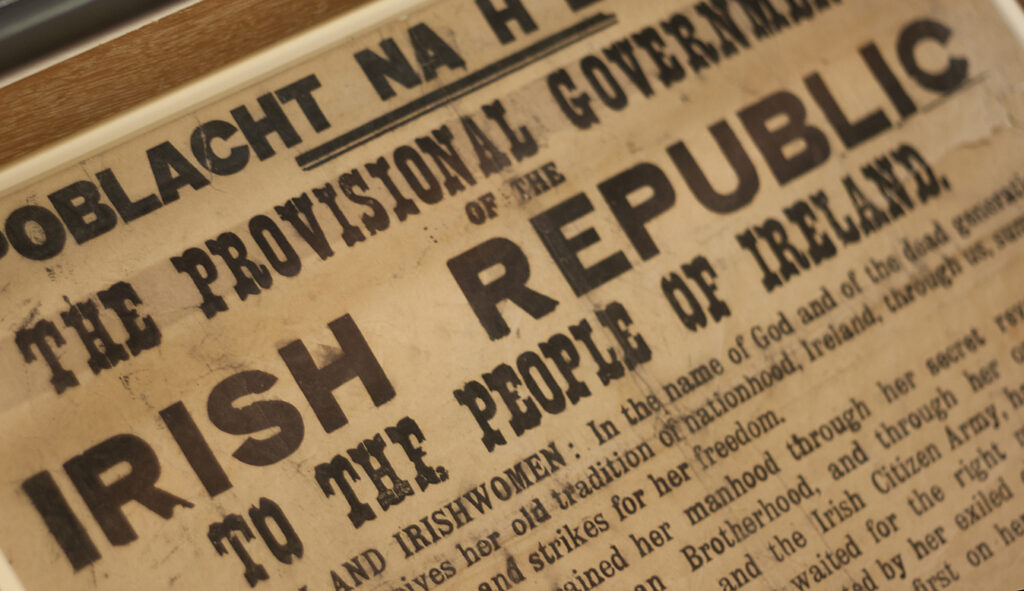
Shortly after occupying the GPO, at 12:45 pm on Easter Monday, Pearse stood and read aloud the proclamation of the Irish republic. The document declared Ireland an independent republic and announced the establishment of a provisional government, with Pearse styled as its president.
The proclamation began with the appeal: “In the name of God and of the dead generations from which she receives her old tradition of nationhood, Ireland, through us, summons her children to her flag and strikes for her freedom.”
It added: “We declare the right of the people of Ireland to the ownership of Ireland and to the unfettered control of Irish destinies, to be sovereign and indefeasible. The long usurpation of that right by a foreign people and government has not extinguished the right, nor can it ever be extinguished except by the destruction of the Irish people.”
The British authorities were initially caught off guard, with only 400 troops on hand to confront the thousand-strong insurgents. But soon reinforcements were drafted and martial law declared across Ireland. By 28 April, the 1,600 rebels, bolstered by new recruits, were nonetheless facing around 20,000 soldiers.
On the afternoon of Sunday, 29 April, Pearse agreed to an unconditional surrender.
485 people were killed over the six days of conflict, including 260 civilians, 126 members of the British armed forces, 82 rebels and 17 police. More than 2,600 were wounded, including at least 2,200 civilians and rebels.
***
The rising was first met with bemusement and even hostility from many Dubliners – reflected in the indifferent reaction to Pearse’s proclamation of the Irish republic. However, the week of fierce fighting, the destruction of much of central Dublin by artillery fire, and the British government’s hardline response – including large-scale arrests, the killing of civilians and the execution of rebel leaders – radicalised public opinion.
The seven signatories to the proclamation of the Irish republic, Pearse, Connolly, Thomas Clarke, Seán Mac Diarmada, Thomas MacDonagh, Éamonn Ceannt and Joseph Plunkett, were among those court-martialled and executed.
Most of the executions took place over a 10-day period from 3 May to 12 May.
The IPP’s mode of constitutional nationalism did not survive the Easter Rising.
Sinn Féin and its leader, Arthur Griffith, did not take part in the uprising. But the British press and political class universally labelled it the “Sinn Féin Rebellion”. (Nationalists seen as more radical than the IPP were generally referred to as “Sinn Féiners”.)
As a result, public opinion shifted – gradually then suddenly – towards the mode of nationalism associated with Sinn Féin.
In February 1917, Count George Noble Plunkett – father of the executed leader Joseph Plunkett – won the North Roscommon by-election as an independent “Sinn Féiner” nationalist.
In May, Sinn Féin’s Joseph McGuinness, won the South Longford by-election with a majority of 37 over the IPP candidate. At the time, McGuinness was serving a prison sentence for his role in the Easter Rising; Sinn Féin’s campaign slogan was “Put him in to get him out”.
In July, Éamon de Valera, recently released from imprisonment for his role in the Easter Rising, won the Clare East by-election with 71.1% of the vote.
Finally, in August 1917, Sinn Féin’s W. T. Cosgrave won the Kilkenny City by-election with 66.3% of the vote.
***
The Easter Rising, in reshaping the Irish political landscape, effectively created the conditions for Sinn Féin’s replacement of the IPP as the spokesperson for nationalism. At the 1918 general election, the party – founded just 13 years previously – won 73 out of 105 Irish seats.
The IPP secured six seats, down 74.
Among the successful Sinn Féin candidates were Griffith, in East Cavan, and Constance Markievicz, who became the first woman elected to the House of Commons.
In line with the Sinn Féin policy, neither Griffith, Markievicz nor any successful Sinn Féin candidate took up their seats. Instead, on 21 January 1919, those Sinn Féin MPs returned at the 1918 election (who were not imprisoned) convened at the Mansion House in Dublin to form the first Dáil Éireann.
The first act of Dáil Éireann was to declare Irish independence, ratifying the Irish Republic proclaimed in 1916.
The Sinn Féin representatives resolved: “Now, therefore, we, the elected representatives of the ancient Irish people in national parliament assembled, do, in the name of the Irish nation, ratify the establishment of the Irish Republic and pledge ourselves and our people to make this declaration effective by every means at our command.”
The revolutionary parliament also resolved that a state of war existed “between Ireland and England”. The Irish Volunteers, formed in 1913 to reinforce nationalist demands for home rule, were restyled as the Irish Republican Army (IRA).
The IRA waged a guerrilla campaign against the British Army in the Irish War of Independence (1919-1921).
The Irish War of Independence (1919-1921) resulted in the Anglo-Irish Treaty 1921 and the Irish Free State Constitution Act 1922.

Politics.co.uk Newsletters
DAILY
Politics@Lunch
WEEKLY
Week in Review