Home Office launches ‘Go Home’ van campaign
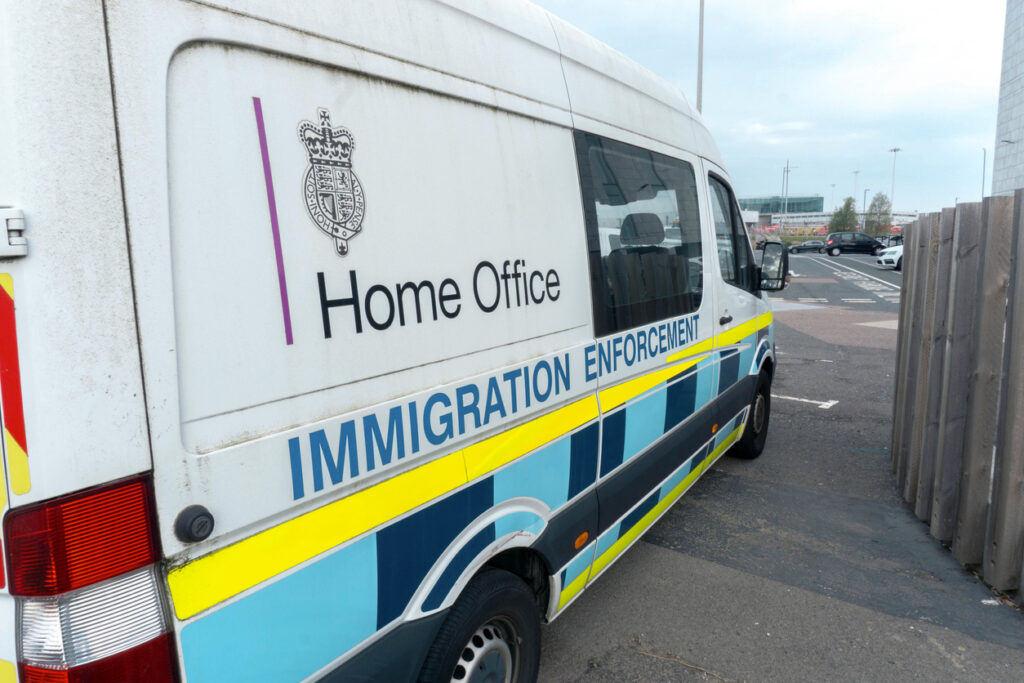
On 22 July 2013, the UK Home Office launched a highly controversial pilot advertising campaign, codenamed Operation Vaken, which saw vans displaying large billboards driving through six London boroughs urging undocumented migrants to leave the country.
The vans carried the message: “In the UK illegally? Go home or face arrest. Text HOME to 78070 for free advice, and help with travel documents. We can help you to return home voluntarily without fear of arrest or detention.”
This text was accompanied by an image of handcuffs and statistics claiming recent arrests in the area.
***
The stated aim of the campaign, which ran for a month in Barking and Dagenham, Barnet, Brent, Ealing, Hounslow, and Redbridge, was to encourage voluntary departures. The initiative was the most visible manifestation of the Home Office’s wider ‘hostile environment’ strategy, which was designed to make life difficult for those without leave to remain.
The so-called “go home vans” came in for significant criticism from a diverse array of political figures. Nick Clegg, the deputy prime minister, said he was “surprised” to hear about two “aimless” and “unsettling” vans sent out by the Home Office.
Clegg said: “Unless there is overwhelming evidence that this is a really effective way of bolstering public confidence in the immigration system and bearing down on illegal behaviour in the immigration system, I’m going to need a lot of persuasion.
“What are we going to have next? Home Office vans driving around saying, ‘Please don’t shoplift,’ or, ‘Please don’t steal this car’?”
Eric Pickles, the communities secretary, was another to say he would need to see “some very persuasive evidence that this should be passed out nationally”.
Vince Cable, the Liberal Democrat business secretary, called the campaign “stupid and offensive”.
Yvette Cooper, the shadow home secretary, likened the vans to language used by the “National Front in the 1970s”.
Nigel Farage, leader of the UK Independence Party (Ukip), accused ministers of a “nasty, unpleasant, Big Brother” billboard campaign.
He said: “I think the actual tone of the billboards is nasty, unpleasant, Big Brother. I don’t think using messages like this will make any difference. What will make a difference is enforcing our borders properly.”
The Advertising Standards Authority (ASA) received 224 complaints about the campaign. While the ASA ruled that the slogan itself did not breach rules on racial discrimination, it found that the arrest statistics displayed on the vans (“106 arrests last week in your area”) were misleading.
***
The Conservative-Liberal Democrat coalition government was ultimately forced to abandon the campaign. In October 2013, the home secretary, Theresa May, admitted the vans had been “too blunt an instrument” and confirmed the pilot scheme would not be rolled out nationally.
She said: “Politicians should be willing to step up to the plate and say when they think something actually hasn’t been as good an idea, and I think they were too blunt an instrument.”
May also denied that the scheme was her “initial idea”. She later expressed regret about the policy.
In a written statement at the time, immigration minister Mark Harper said that Operation Vaken had cost £9,740.
A Home Office evaluation report suggested only 11 voluntary departures could be directly linked to the vans themselves. It confirmed that 1,561 text messages were received in response to the campaign. However, 1,034 were hoaxes – which took 17 hours of staff time to deal with.
Harper was seen as the driving force behind the strategy in government. He resigned as immigration minister in February 2014 after he discovered that his self-employed cleaner did not have permission to work in the UK.
In June 2019, Harper said he did not regret the vans campaign. “The message that if you’re in the country, that you shouldn’t be here, I think is a perfectly sound one, and supported by the vast majority of the British people”, he told LBC Radio.
May has since expressed contrition, telling an ITV documentary in 2024: “[The vans were] wrong, and we stopped it. We realised after a short period of time that we needed to stop that.”
The vans, as a symbol of the Home Office’s ‘hostile environment’ policy, were frequently raised in relation to the Windrush scandal during May’s tenure as prime minister.

Politics.co.uk Newsletters
DAILY
Politics@Lunch
WEEKLY
Week in Review
