Commons backs same-sex marriage bill despite major Tory rebellion
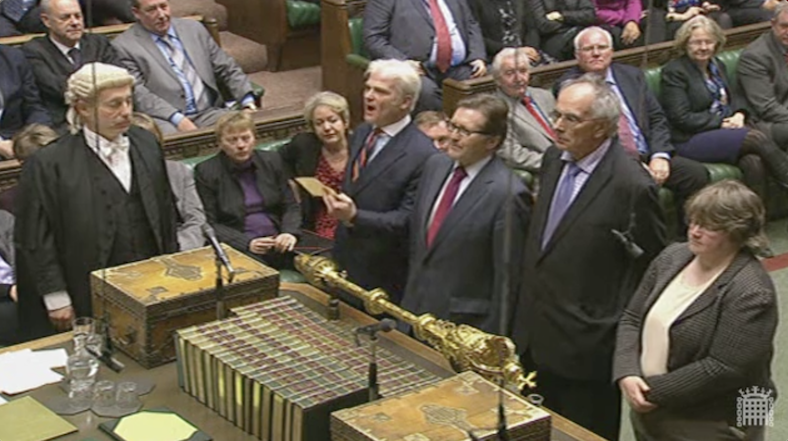
On 5 February 2013, the House of Commons voted in favour of legalising same-sex marriage in England and Wales by a decisive majority. MPs approved the second reading of the Marriage (Same Sex Couples) Bill by 400 votes to 175 – a majority of 225.
During the 2010 general election campaign, the Conservative Party published a “contract for equalities”. The contract, unveiled by Theresa May as shadow equalities minister, said the Conservatives were “committed to a fairer deal for gay people across Britain”.
It stated: “We will also consider the case for changing the law to allow civil partnerships to be called and classified as marriage.”
The Conservative Party had come under fire in the campaign over the stance of senior figures on LGBT equality.
Chris Grayling, the shadow home secretary, issued an apology after stating that individuals who operated bed and breakfasts from their own homes “have the right” to refuse accommodation to same-sex couples. Julian Lewis, a shadow defence minister, was criticised after citing what he described as a “seriously increased risk of HIV infection” to justify his opposition to age-of-consent reforms.
A Conservative candidate was suspended for saying homosexuality was “not normal”.
Nick Clegg, the leader of the Liberal Democrats, expressed his support for same-sex marriage in February 2010.
In September 2011, the Conservative-Liberal Democrat coalition government announced a formal consultation on extending civil marriage to same-sex couples. The move was announced by Liberal Democrat equalities minister Lynne Featherstone at her party’s conference.
In October 2011, addressing Conservative Party conference as prime minister, David Cameron stated that he was in favour of redefining marriage because of, not in spite of, being a Conservative.
Cameron said: “Conservatives believe in the ties that bind us; that society is stronger when we make vows to each other and support each other.
“So I don’t support gay marriage despite being a Conservative. I support gay marriage because I’m a Conservative.”
On 11 December 2012, the government announced how it intended to proceed in light of the consultation. Maria Miller, Featherstone’s successor as equalities minister, announced the government planned to legislate, allowing same-sex couples to marry in civil ceremonies and for religious organisations that wished to conduct same-sex marriages to opt in.
She also announced a “quadruple lock” to protect religious freedom and prevent legal challenges that could expand the meaning of the proposed legislation.
***
The Marriage (Same Sex Couples) Bill was introduced to parliament for its commons first reading on 24 January 2013.
The vote at second reading, which followed on 5 February, exposed deep divisions within the Conservative party and represented a significant political challenge for Cameron as prime minister. As same-sex marriage was deemed to be a matter of conscience, the bill was decided by a free vote – meaning MPs were not subject to the party whip.
Consequently, more Conservative MPs voted against the prime minister’s flagship social reform than for it. 136 Conservatives opposed the bill, while 127 voted in favour. Cabinet ministers Owen Paterson, the environment secretary, and David Jones, the Welsh secretary, voted against the bill. Approximately 40 Conservatives, including attorney general Dominic Grieve and defence secretary Philip Hammond, abstained.
In total, 22 Labour MPs and four Liberal Democrat MPs voted against the bill.
Opening the seven-hour debate, Miller argued that parliament should “value people equally in the law”.
Miller said: “Marriage is an institution with a long history of adaptation and change…
“Suggestions that the bill changes something that has remained unchanged for centuries simply do not recognise the road that marriage has travelled as an institution.”
Sir Roger Gale, a veteran Conservative MP, accused the government of attempting to “rewrite the lexicon” of marriage.
He said: “Marriage is the union between a man and a woman. It has been that historically and it remains so. It is Alice in Wonderland territory – Orwellian almost – for any government of any political persuasion to try to rewrite the lexicon. It will not do.”
Conservative MP Edward Leigh argued that marriage was about creating a “secure environment for creating and raising children, based on lifelong commitment and exclusivity.”
He stated: “Marriage is not about ‘me, me, me’, nor about legally validating ‘my rights’ and ‘my relationships’; it is about a secure environment for creating and raising children, based on lifelong commitment and exclusivity.”
Conservative MP Peter Bone argued that the government did not have a mandate to introduce the bill. He argued that the 2010 general election manifestos and the coalition programme for government did “not deal anywhere with the question of gay marriage or same-sex marriage.”
Bone called for a referendum to be held on the subject of same-sex marriage.
Supporters of the legislation pointed to the Conservative “Contract for Equalities”, published during the 2010 general election campaign.
Conservative MP Tony Baldry, who served as the second church estates commissioner, warned the bill would “alter the intrinsic nature of marriage”.
He said: “The uniqueness of marriage is that it embodies the distinctiveness of men and women, so removing that complementarity from the definition of marriage is to lose any social institution where sexual difference is explicitly acknowledged.”
Labour MP David Lammy likened arguments against same-sex marriage based on the existence of civil partnerships to the “separate but equal” doctrine of racial segregation.
Lammy stated: “Separate but equal is a fraud. It is the language that tried to push Rosa Parks to the back of the bus. It is the motif that determined that black and white people could not possibly drink from the same water fountain, eat at the same table or use the same toilets.”
David Simpson of the Democratic Unionist Party (DUP) deferred to scripture, declaring: “This is not the jurisdiction of this House. This is not the jurisdiction of this government, of any European government or of any government in the world. This is an ordained constitution of God.”
Simpson added: “In the garden of Eden, it was Adam and Eve, not Adam and Steve.”
The announcement of the result was greeted with rare applause in the public gallery.
Cameron welcomed the vote. In a post to Twitter (now X), he said: “Strong views exist on both sides but I believe MPs voting for gay people being able to marry too, is a step forward for our country.”
https://x.com/david_cameron/status/298881371055718400
In a statement after the vote, deputy prime minister Nick Clegg said: “I genuinely believe that we will look back on today as a landmark for equality in Britain.
“Tonight’s vote shows parliament is very strongly in favour of equal marriage. No matter who you are and who you love, we are all equal. Marriage is about love and commitment, and it should no longer be denied to people just because they are gay.
“The Liberal Democrats have long fought for equal marriage. It is party policy and I am proud that the Liberal Democrats are part of the coalition government that are making it happen.”
Among the Conservative MPs who voted against the bill at second reading was Adam Afriyie, who had been linked with a possible challenge to Cameron’s leadership.
***
The bill returned to the commons in May 2013 having undergone line-by-line scrutiny in committee. During its report stage, Edward Leigh championed an amendment to the Equality Act to state that the protected characteristic of religion or belief “may include a belief regarding the definition of marriage as being between a man and a woman”.
Leigh argued that when there “is a clash between gay rights and religious freedom, I am afraid that gay rights come first”. He pointed to a “real sense of alienation in this country among people with traditional views” and called for “real legal protection against the bullies”.
Conservative MP Sir Gerald Howarth expressed his support for the amendment, citing his fear that the bill would create a “chilling effect” on free speech and “intimidation”.
He told the House: “I fear that the playing field is not being levelled. I believe that the pendulum is now swinging too far in the opposite direction. There are plenty in the aggressive homosexual community who see this as but a stepping stone to something even further.”
Leigh’s amendment was rejected by 339 votes to 148.
Stuart Andrew, a Conservative supporter of the bill, condemned Howarth’s use of language as “disappointing, to say the least”. Andrew told the House he had been “attacked and beaten unconscious by three men” in 1997 because of his sexuality.
The Tory MP said: “I am not an aggressive man, but I have had the misfortune of facing aggression in a violent, physical form”.
Kate Green, the shadow women and equalities minister, tabled an amendment to introduce humanist marriage.
Green argued the measure would remove an “unnecessary injustice based on religion or belief, and it will strengthen the institution of marriage, going with the grain of ministers’ intentions for the bill.”
Dominic Grieve, the attorney general, argued that privileging one secular belief over another would render the entire bill incompatible with human rights law, thereby unpicking the proposed “quadruple lock”.
He responded: “The local tiddlywinks club might wish to become a registered charity and to conduct weddings, so by its very nature, and for that reason, it is discriminatory, and by being discriminatory it is in serious danger, I suggest, of violating article 14 of the European Convention on Human Rights.”
Tony Baldry, the second church estates commissioner, also expressed his opposition to the amendment, telling the House: “I have had enough problems in my constituency with same-sex marriage.
“If I go back to the shires of Oxfordshire and tell constituents that parliament is about to endorse pagan marriage in England, they will think that we have lost the plot completely.”
Green ultimately withdrew her amendment and the Marriage (Same Sex Couples) Bill received its commons third reading by 366 votes to 161.
***
The legislation moved to the House of Lords in June 2013.
During the bill’s second reading stage in the upper chamber, crossbench peer Lord Dear’s wrecking amendment was rejected by 390 votes to 148 – a majority of 242. Dear warned that the “ill-considered bill seeks to overturn centuries of tradition, heedless of public opinion and the views of religious leaders and blind to the laws of unintended consequences.”
Nine of the 14 Anglican bishops in attendance voted for Lord Dear’s amendment, including the archbishop of Canterbury, Justin Welby.
At the bill’s report stage in the Lords, the government inserted a new clause into the bill which required a review to be conducted over whether the law should be changed to permit marriages by non-religious belief organisations (such as humanists).
The Marriage (Same Sex Couples) Act 2013 received royal assent on 17 July 2013.
The first same-sex weddings in England and Wales took place on 29 March 2014.
In his 2019 memoir, For the Record, Cameron said the introduction of same sex marriage was one of his proudest moments as prime minister.
He wrote: “Equal marriage was one of the most contentious, hard-fought and divisive issues during my time as prime minister. We would lose party members; one even came to my surgery and tore up their membership card in front of me.
“It was an issue that I would worry and even wobble over. But I have absolutely no regrets, and it is one of the things of which I’m proudest.”
He wrote: “Equal marriage was one of the most contentious, hard-fought and divisive issues during my time as prime minister”.
Cameron also suggested the legislation’s quadruple lock was “excessive”.
He added: “Stipulating that an entire Church must agree to gay marriage if just one wedding is to take place in one church seems over the top.”

Politics.co.uk Newsletters
DAILY
Politics@Lunch
WEEKLY
Week in Review
