Cameron suffers historic commons defeat on Syria intervention
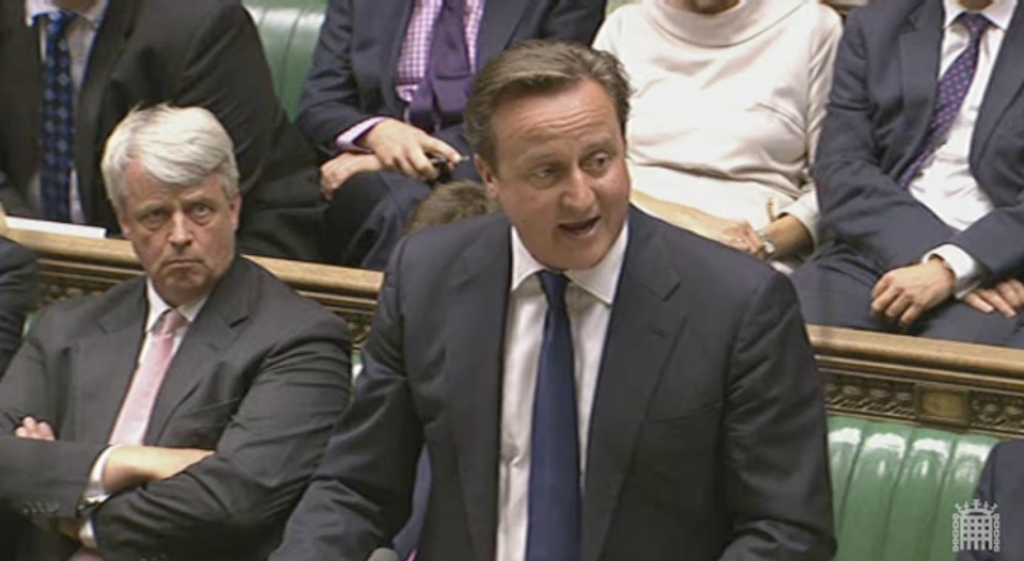
On 29 August 2013, the House of Commons rejected a motion from David Cameron’s coalition government that sought parliamentary approval for military action against Syria.
The government’s motion was debated after parliament had been recalled from its summer recess. It was defeated by 285 votes to 272, a majority of 13.
The defeat was a significant blow to the prime minister and effectively ended any prospect of UK participation in any US-led military strikes. The vote was non-binding. But Cameron – the first prime minister to lose a parliamentary vote on military action since Lord North in 1782 – accepted the result.
***
The emergency recall of parliament from its summer recess was prompted by the chemical weapons attack in Ghouta, a suburb of Damascus, on 21 August 2013. The UK government, along with allies including the United States, attributed the attack, which killed hundreds of civilians, to the Syrian regime of Bashar al-Assad.
Cameron argued that a “strong humanitarian response” was required to deter the future use of chemical weapons, and that this response could include targeted military action.
The government’s motion was carefully worded to authorise military action only in principle, with a second vote to be held on specific intervention plans once United Nations inspectors had reported. However, the Labour opposition, led by Ed Miliband, argued that no action should be taken without “compelling evidence” and explicit UN authorisation.
Many members, mindful of the flawed intelligence used to justify the 2003 Iraq War, were unwilling to commit to military action without greater certainty and a clear legal basis. The debate, it was said, was conducted in the “shadow of Iraq”.
Addressing MPs during the debate, Cameron conceded that “the well of public opinion was well and truly poisoned by the Iraq episode” and that this legacy “imposes particular responsibilities on me as prime minister”.
He stated: “I remember 2003… I wanted to listen to the man [Tony Blair] who was standing right here and believe everything that he told me.”
But he maintained that the circumstances were now different. “This situation is not like Iraq. What we are seeing in Syria is fundamentally different. We are not invading a country. We are not searching for chemical or biological weapons”, he said.
“The fact that the Syrian government have, and have used, chemical weapons is beyond doubt. The fact that the most recent attack took place is not seriously doubted. The Syrian government have said it took place. Even the Iranian President said that it took place.
“The evidence that the Syrian regime has used these weapons, in the early hours of 21 August, is right in front of our eyes.”
He added: “We must ensure that any action supports and is accompanied by a renewed effort to forge a political solution and relieve humanitarian suffering in Syria. But at the same time, we must not let the spectre of previous mistakes paralyse our ability to stand up for what is right.
“We must not be so afraid of doing anything that we end up doing nothing.”
Jack Straw, who was foreign secretary in 2003, stated that the Iraq failure had profound consequences by “fraying of those bonds of trust between the electors and the elected”.
He reminded MPs: “I was the final speaker in the debate in this House on 18 March 2003 on the resolution in which I… recommended to the House that we should take military action against the Saddam Hussein regime.”
He warned Cameron that “one of the consequences of the intelligence failure on Iraq has been to raise the bar that we have to get over when the question of military action arises.”
Straw argued that the government’s case did not clear that bar. “My conclusion at the moment is that the government have yet to prove their case”, he said.
Liam Fox, a senior Conservative backbencher, argued that “to do nothing” would be interpreted “as appeasement of a dreadful regime”.
He declared: “Appeasement has never worked to further the cause of peace in the past, and it will not now, and it will not in the future.”
***
The government’s final defeat on its own motion, by 285 votes to 272, was secured by a significant rebellion from within its own ranks. 30 Conservative MPs and nine Liberal Democrats voted with the opposition.
The Labour amendment was defeated by 332 votes to 220.
One MP shouted “resign” as the results were read out by the commons speaker, John Bercow.
In the immediate aftermath of the vote, Cameron conceded defeat, stating: “Let me say, the House has not voted for either motion tonight. I strongly believe in the need for a tough response to the use of chemical weapons, but I also believe in respecting the will of this House of Commons.
“It is very clear tonight that, while the House has not passed a motion, it is clear to me that the British parliament, reflecting the views of the British people, does not want to see British military action. I get that and the government will act accordingly.”
Miliband said that British involvement in any military action was now “off the agenda”, adding: “The prime minister has been cavalier and reckless. The result of the vote must be respected.”
Speaking after the vote, George Osborne, the chancellor of the exchequer, predicted a moment of “national soul-searching” about Britain’s role in the world.
He said: “I think there will be a national soul-searching about our role in the world and whether Britain wants to play a big part in upholding the international system, be that a big open and trading nation that I’d like us to be or whether we turn our back on that.”
Barack Obama, the US president, postponed US action in the aftermath of the vote.
In 2017, John Kerry, the US secretary of state, pointed to parliament’s vote against airstrikes to explain the administration’s apparent climbdown.
The vote has since been regarded as solidifying a new constitutional convention requiring explicit parliamentary consent for armed intervention.
***
The vote, heavily informed by the memory of the Iraq War, has had a significant legacy in its own right.
In April 2018, Cameron’s successor as prime minister, Theresa May, authorised military airstrikes against Syria without first seeking parliamentary consent. The action, taken in coordination with the United States and France, was a direct response to a suspected chemical weapons attack in the Syrian city of Douma on 7 April, which resulted in civilian casualties.
In a statement to parliament, May argued that the targeted strikes were “not just morally right but also legally right… to alleviate further humanitarian suffering.”
The decision to act without a parliamentary vote proved controversial, with opposition parties and some Conservative backbenchers arguing it ignored the constitutional convention apparently established since the 2003 Iraq War, and affirmed in 2013.
May took questions for nearly three hours in the chamber, defending her decision not to seek parliamentary approval. She repeatedly contended that seeking a vote would have involved the disclosure of sensitive intelligence, placing military operations at risk.
As for her right to authorise military action, May was plain: “It is parliament’s responsibility to hold me to account for such decisions, and parliament will do so. But it is my responsibility as prime minister to make these decisions – and I will make them”.
The government later won a symbolic vote on whether the House had sufficiently debated the matter of Syria by 314 to 36 votes, a majority of 278.
In December 2024, over a decade after the 2013 vote, Wes Streeting, the Labour health secretary, argued that “the hesitation of this country and the United States created a vacuum that Russia moved into and kept Assad in power for much longer.”
He added: “What I cannot say with certainty – and what we can’t say for certainty even now that the rat has fled to Moscow to his backers – we cannot say that the back of Assad is going to lead to a better Syria yet… We don’t know. It is too soon to judge.”
This position put Streeting at odds with Miliband, the energy and net zero secretary, who maintained that his opposition in 2013 was the correct stance.
Asked about his cabinet colleague’s comments, Miliband said he did not regret opposing military action.
He told Times Radio: “The decision I was confronted with, though, in 2013 was whether we did a bombing of president Assad without any clear plan for British military engagement, where it would lead and what it would mean.
“And I believe then, and I do now, that one of the most important lessons of the Iraq war is we shouldn’t go into military intervention without a clear plan, including an exit strategy.”

Politics.co.uk Newsletters
DAILY
Politics@Lunch
WEEKLY
Week in Review
