Guy Fawkes arrested in failed ‘Gunpowder Plot’ against King James I and parliament
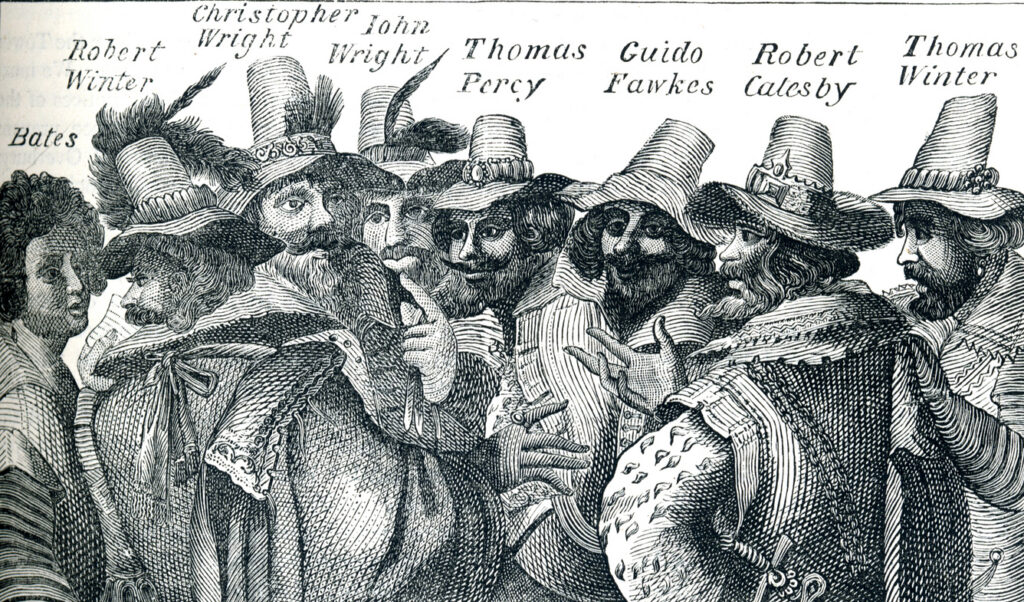
The Gunpowder Plot of 1605 was an attempted regicide masterminded by a group of English Catholics who sought to assassinate the Protestant King James I and destroy the entire English establishment by blowing up the Houses of Parliament. The plot was scheduled for Tuesday 5 November 1605, the date of the state opening of parliament.
The conspiracy, led by Robert Catesby, formed in an atmosphere of hostility and resentment among Catholics following the accession of James I in 1603.
The king’s mother, Mary, Queen of Scots, had been Catholic. But James failed to deliver an era of greater religious tolerance. Penal laws against Catholics remained in force and recusancy fines were enforced.
The conspirators conceived a radical, multi-stage plan. They planned to detonate explosives in the cellars beneath the House of Lords when the king, his heir, peers and MPs would all be assembled for the state opening.
The vacuum of power created by this mass establishment decapitation would be followed by a revolt in the Midlands. In the process, the conspirators would capture James’s nine-year-old daughter, princess Elizabeth, and install her as a Catholic figurehead.
***
The key conspirators included Thomas Percy, John and Christopher Wright, Thomas and Robert Wintour and Guy Fawkes – a soldier who had served 10 years fighting for the Spanish in the Netherlands and was entrusted with the execution of the explosion.
By late 1604, the conspirators had rented an undercroft beneath the House of Lords. The conspirators transported and concealed 36 barrels of gunpowder, hiding the barrels beneath large quantities of firewood and coal.
The plot was discovered just hours before it was due to be executed. On 26 October 1605, an anonymous letter was sent to William Parker, 4th Baron Monteagle, a Catholic peer, warning him not to attend parliament on the appointed day. Monteagle immediately took the letter to the authorities.
The letter warned that “they shall receive a terrible blow this Parliament; and yet they shall not see who hurts them”.
Francis Tresham, the suspected author of the letter, was Monteagle’s brother-in-law.
On the evening of 4 November, a search of the cellars beneath the House of Lords was undertaken by officials. The searchers, led by Sir Thomas Knyvett, discovered the hidden barrels of gunpowder and their guard, Guy Fawkes.
Fawkes, who gave his name as John Johnson, was arrested and taken to the Tower of London.
The entry from the journal of the House of Commons for 5 November includes a note from Ralph Ewens, the clerk at the time.
It stated: “This last night the Upper House of Parliament was searched by Sir Tho. Knevett; and one Johnson, servant to Mr Thomas Percye, was there apprehended; who had placed 36 barrels of gunpowder in the vault under the House, with a purpose to blow King and the whole Company, when they should there assemble. Afterwards divers other gentlemen were discovered to be of the Plot.”
King James I recounted the plot in his speech at the state opening of parliament on 9 November, delivered four days later than previously planned.
The sovereign spoke of “a far greater Thanksgiving… which is to GOD, for the great and miraculous Delivery he hath at this time granted to me, and to you all, and consequently to the whole Body of this Estate”.
He referred to the “cruelty of the Plot it self, wherein cannot be enough admired the horrible and fearful cruelty of their Device, which was not only for the destruction of my Person, nor of my Wife and Posterity only, but of the whole Body of the State in general”.
He urged parliament not to blame all Catholics for the actions of the conspirators, warning MPs and peers not to “rashly to blame such as may be innocent of this attempt.”
He distinguished between those Catholics “truly know and believe the whole grounds, and School-conclusions of their Doctrine” and those who were merely “blinded peradventure with some opinions of Popery”
The latter cases, he said, might still remain “good and faithful Subjects”.
He said parliament would be prorogued until after Christmas to allow his Council to handle the “apprehension and trial of these Conspirators”.
***
Under interrogation, Fawkes initially maintained his cover identity as John Johnson – impressing the king with his “Roman resolution.”
It was James I who ordered that Fawkes be tortured, and, on 7 November, his resolve broke. He confessed, revealing the identities of his co-conspirators.
Upon hearing the news of Fawkes’s arrest, Catesby and the others immediately fled London for the Midlands, attempting unsuccessfully to raise a Catholic rebellion along the way.
On 8 November, the remaining conspirators made a final stand against a posse led by the Sheriff of Worcestershire at Holbeche House in Staffordshire. In the ensuing gunfight, Robert Catesby, Thomas Percy, and the Wright brothers were among those shot and killed.
On 27 January, the surviving conspirators, including Fawkes, were tried for high treason in Westminster Hall. All were convicted and sentenced to be hanged, drawn and quartered.
The executions took place on 30 and 31 January. Fawkes broke his own neck by jumping from the gallows ladder, thus avoiding the full horror of his sentence.
One observer wrote: “Last of all came the great devil of all, Guy Fawkes… who should have put fire to the powder. His body being weak with the torture and sickness he was scarce able to go up the ladder, yet with much ado, by the help of the hangman, went high enough to break his neck by the fall.
“He made no speech, but with his crosses and idle ceremonies made his end upon the gallows and the block, to the great joy of all the beholders that the land was ended of so wicked a villainy.”
The conspirator’s quartered body parts and decapitated heads were then displayed across Westminster, London and the country – a clear warning against those who too conceived of sedition.
***
The plot intensified anti-Catholic sentiment. In the summer of 1606, parliament passed new anti-Catholic legislation, including the Popish Recusants Act, which tightened fines, legal restrictions and introduced a binding Oath of Allegiance.
Many loyal Catholics retained high office during James’s reign. But full Catholic emancipation was only realised in 1829.
Parliament passed the Observance of 5 November Act, making the date as an annual public day of celebration. This legislative commemoration has evolved into the modern observance of Bonfire Night.
The preamble to the act noted that “many malignant and devilish Papists, Jesuits, and Seminary Priests, much envying and fearing, conspired most horribly, when the King’s most excellent Majesty, the Queen, the Prince, and the Lords Spiritual and Temporal, and Commons, should have been assembled in the Upper House of Parliament upon the Fifth Day of November in the Year of our Lord One thousand six hundred and five, suddenly to have blown up the said whole House with Gunpowder : An Invention so inhuman, barbarous and cruel, as the like was never before heard of”.
The preamble concluded: “And to the End this unfeigned Thankfulness may never be forgotten, but be had in a perpetual Remembrance, that all Ages to come may yield Praises to his Divine Majesty for the same, and have in Memory this joyful Day of Deliverance”.
To this day, a ceremonial search of the Palace of Westminster’s cellars is carried out by the Yeomen of the Guard, the royal bodyguards, ahead of the state opening of parliament.

Politics.co.uk Newsletters
DAILY
Politics@Lunch
WEEKLY
Week in Review