Great Reform Act receives royal assent after prolonged political crisis
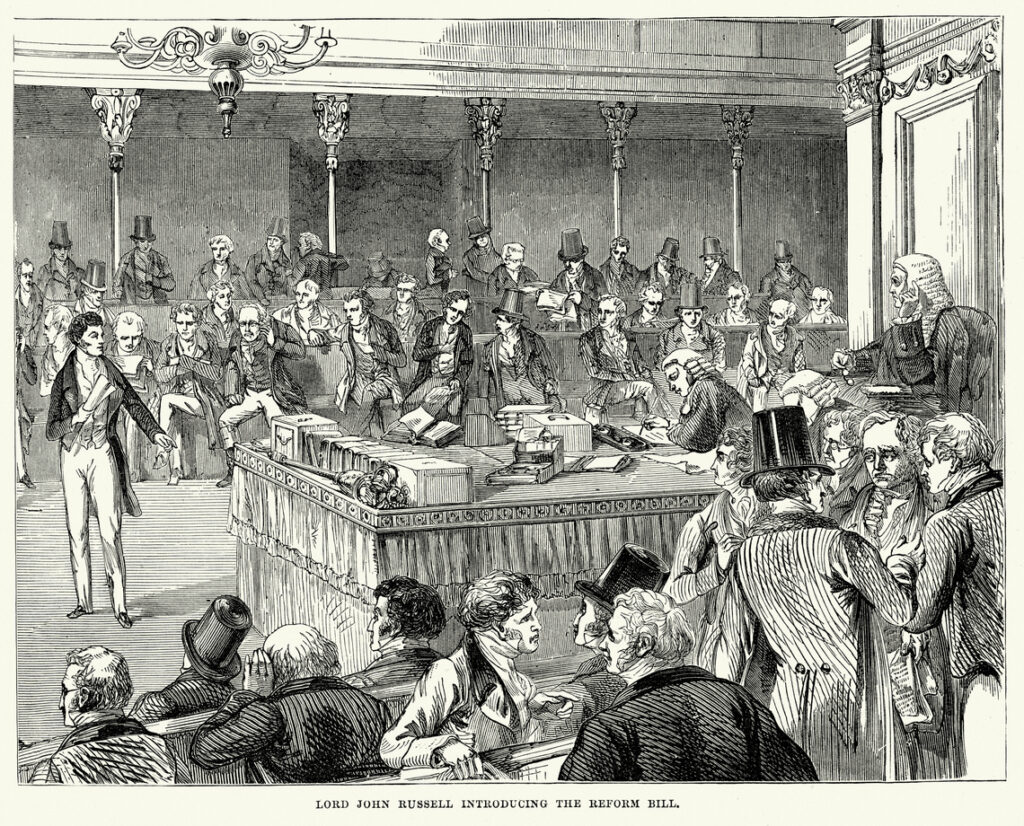
On 7 June 1832, the Representation of the People Act, commonly known as the Great Reform Act, received royal assent, marking a key milestone in the development of the British political system.
Passed at a moment of intense crisis, the bill rebalanced the political system – with the landowning classes losing out to growing industrial towns. It represented a legislative acknowledgment of the social changes wreaked by the Industrial Revolution.
***
The unreformed electoral system featured a series of so-called ‘rotten borough’ seats, depopulated constituencies controlled by wealthy patrons. Meanwhile, major new densely populated industrial cities like Manchester, Birmingham, and Leeds had no MPs of their own. Old Sarum in Salisbury, perhaps the most notorious of the ‘rotten boroughs’, existed from 1295 to 1830, returning two members of parliament at every election. Once the site of a busy cathedral city, the constituency had so ‘rotted’ that, by the 1830s, it consisted of an uninhabited hill.
In his radical tract, Rights of Man (1791), Thomas Paine wrote of the unreformed political system: “The county of Yorkshire, which contains near a million souls, sends two county members; and so does the county of Rutland which contains not a hundredth part of that number.
“The town of Old Sarum, which contains not three houses, sends two members; and the town of Manchester, which contains upwards of sixty thousand souls, is not admitted to send any. Is there any principle in these things?”
Owned for a period by the Pitt family, Old Sarum was also considered a “burgage borough” and a “pocket borough”. In a so-called burgage borough, the right to vote was attached to ownership of certain properties, known as burgages. Come election time a landowner could allocate these burgages to his relatives and friends, thereby effectively nominating two members of parliament. The landowner was said to have these boroughs in their “pocket”.
This, at least, would explain Old Sarum’s remarkable habit for electing ‘Pitts’ in the 18th century – such as Robert Pitt, Thomas Pitt, George Pitt, Pitt the Elder, Thomas Pitt of Boconnoc and Thomas Pitt (the younger).
Another famous example of a rotten borough was Dunwich in Suffolk. It elected two MPs from 1296 to 1832, notwithstanding the fact that it spent a significant part of this period underwater. In 1670, the encroaching sea had destroyed the seat’s major settlements, leaving only one tiny village.
The rotten borough concept was memorably depicted by the British sitcom, Blackadder.
***
Political reform was stridently resisted by the Duke of Wellington during his tenure as prime minister from 1828 to 1830.
On 2 November 1830, Wellington told the House of Lords that the current “system of representation possessed the full and entire confidence of the country”. But within days, Wellington’s ministry had collapsed and the new Whig government, led by Earl Grey as prime minister, entered office determined to reform the political system.
Grey’s first Reform Bill sought to disenfranchise Old Sarum and other such symbols of electoral inequality and political corruption.
On 22 March 1831, Grey’s bill passed its second reading in the commons – still divided between pro- and anti-reform politicians – by one vote. However, an opposition “wrecking amendment” was approved during the bill’s committee stage by eight votes (by 299 to 291).
The proposed legislation was subsequently dropped.
Grey responded by asking King William IV to dissolve parliament and call a general election.
William assented and the Whigs won as close to a landslide victory as was possible under the unreformed electoral system. The party gained 174 new MPs at the 1831 general election – securing a decisive majority of 82 seats.
As a result, the second Reform Bill easily cleared the commons by a margin of 100, but met its end in the Lords on 8 October. The upper chamber was still dominated by the anti-reform Tories, led by Wellington.
Under longstanding parliamentary rules, the same bill cannot be introduced multiple times in the same session, and so Grey persuaded William IV to prorogue parliament. The new session began with the immediate introduction of a third Reform Bill in December 1831.
MPs passed it with a significant majority. But once again, Wellington and anti-reform peers refused to relent.
In May 1832, Grey threatened to resign unless the king elevated enough Whig peers to secure the bill’s passage. William IV refused and so Grey stood down.
***
The king turned to Wellington, who was asked to return as prime minister with Britain in the throes of revolt. The so-called ‘Days of May’ crisis was characterised by mass petitioning, riots and a run on the Bank of England.
Against this backdrop of protest, Wellington proved unable to form a stable government. His residence at Apsley House was twice targeted by a mob of demonstrators.
William thus reinstated Grey as prime minister.
With the country on the verge of insurrection, the sovereign reluctantly agreed to create enough new Whig peers to force the bill through the upper House.
In a speech to the Lords on 17 May, Grey declared: “I ask what would be the consequence if we were to suppose that such a prerogative [appointing peers en masse] did not exist, or could not be constitutionally exercised?”
He added: “The commons have a control over the power of the crown by the privilege, in extreme cases, of refusing supply. The crown has, by means of its power to dissolve the House of Commons, a control upon any violent and rash proceedings on the part of the commons.
“If a majority of this House [the Lords] is to have the power whenever they please of opposing the declared and decided wishes both of the crown and the people without any means of modifying that power, then this country is placed entirely under the influence of an uncontrollable oligarchy.”
In the end, the threat alone was sufficient; under instructions from Wellington, Tory peers backed down and abstained, allowing the bill to pass.
Wellington’s about-face did not signal his embrace of the reform cause, however. At the meeting of the new parliament following the 1832 general election (the first since the Great Reform Act), Wellington is reported to have said: “I never saw so many shocking bad hats in my life”.
***
The Representation of the People Act 1832 abolished the 56 smallest rotten boroughs. The next 31 smallest boroughs each lost one of their two MPs. Old Sarum and Dunwich were entirely disenfranchised.
In total, 143 borough seats were abolished, with 130 new constituencies created in their place. New industrial towns and counties were afforded representation. The act also created a uniform voting qualification for householders paying a yearly rental of £10.
The franchise remained narrow, but the 1832 act is considered a milestone in the development of British democracy. Reformers called for a still ‘greater’ act, however – a feeling that motivated future conflicts with the political system.
The crisis that surrounded the 1832 act’s passage is remembered by some historians as the closest Britain came to revolution.
Grey resigned as prime minister on 9 July 1834. He was succeeded for a short time by Viscount Melbourne.
In November 1834, William IV controversially dismissed Melbourne’s administration. He reportedly objected to the appointment of Lord John Russell – the architect of the Great Reform Act – as leader of the commons.
This move resulted in Robert Peel’s appointment as prime minister, the landmark Tamworth Manifesto, and the 1835 general election.

Politics.co.uk Newsletters
DAILY
Politics@Lunch
WEEKLY
Week in Review