First women’s suffrage petition presented to parliament
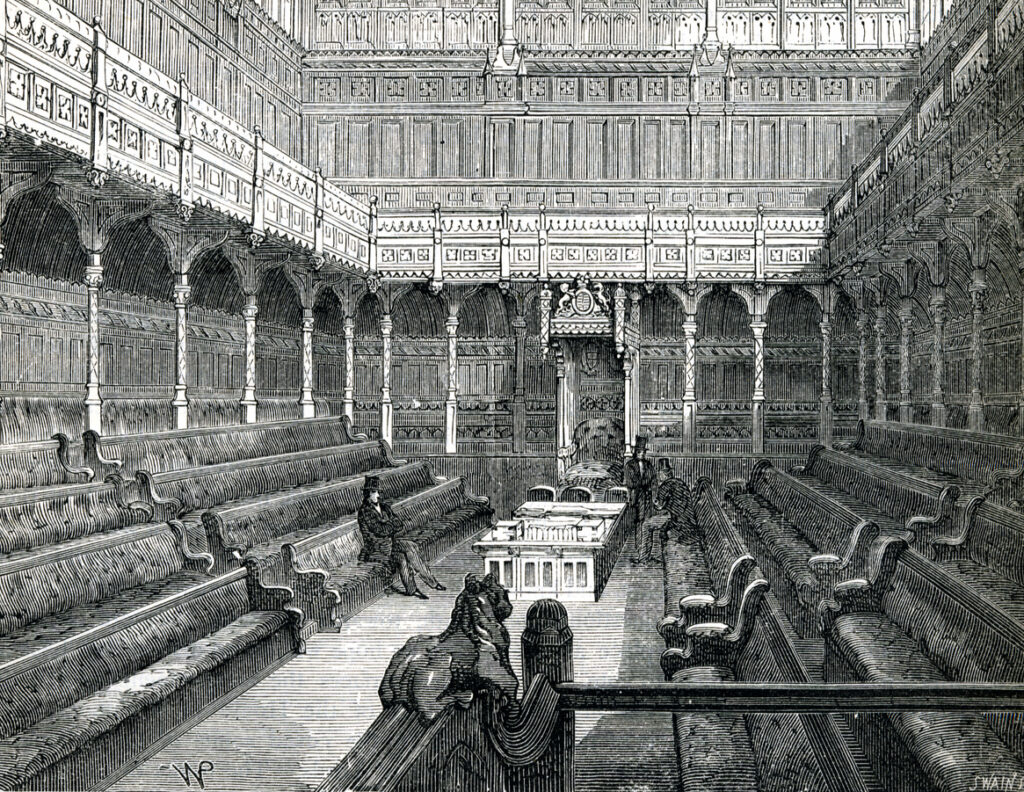
On 3 August 1832, the radical MP Henry “Orator” Hunt presented the first recorded petition to the House of Commons specifically calling for women to be granted the parliamentary vote.
The petition, submitted on behalf of Mary Smith, from Stanmore in Yorkshire, arrived just months after the passage of the Great Reform Act, which had expanded the male electorate but explicitly excluded women by defining voters as “male persons”.
The 1832 act was the first time a distinction in the franchise had been explicitly defined along the lines of sex. The Great Reform Act, therefore, in clarifying the country’s complex and somewhat informal franchise arrangements, legally codified the exclusion of women from the reformed parliamentary system. Prior to the 1832 act, women’s names did appear on election indentures, documents recording the candidates voters had chosen to represent them in parliament.
***
Smith’s petition argued that, as a property owner who paid taxes and was subject to the laws of the land, including its punishments, she was unjustly denied representation.
It highlighted that women were “liable to all the punishments of the law, not excepting death”, but that “even upon their trials, both judges and jurors were all of the opposite sex.”
Smith noted the apparent inconsistency of excluding women from the franchise when a woman could inherit the throne and become Head of State.
The petition was specifically focused on propertied women not subject to the legal authority of a husband, requesting that “every unmarried female, possessing the necessary pecuniary qualification, should be entitled to vote for members of parliament”.
Hunt told the House that Smith’s petition was “deserving of consideration”.
Its reception, however, was one of derision and apparent ridicule in the uniformly male commons.
The Tory MP Frederick Trench mockingly questioned the practicality of female participation in public life, quipping about the “rather queer predicaments” that might arise if mixed juries were “locked up together for a night”.
Having already conceded that the petition “might be a subject of mirth to some honourable gentlemen”, Hunt retorted that Trench had often been in the company of ladies “for whole nights” without “mischief” resulting.
The petition was “laid on the table” – where it would be ignored.
***
Hunt, revered by radicals for his role at the Peterloo Massacre in 1819, opposed the Great Reform Act on the grounds that it did not go far enough in the extension of the franchise. Moreover, he thought it would be a block on future reform efforts rather than a “stepping stone”.
Elected to parliament in 1830, Hunt was an enthusiastic conduit for pro-reform petitioners.
In his first recorded petition, presented February 1831, Hunt called for a wide range of reforms, including the commutation of tithes, the abolition of “all sinecures”, and to “parliament, by extending the franchise, and allowing the people to vote by ballot”.
He introduced himself as a “radical reformer”, having been one since 1815 and “the passing of the Corn-laws”.
In April 1831, however, Hunt’s presentation of a “full reform” petition was somewhat overshadowed by a bitter spat with Daniel O’Connell. The Irish “Liberator”, having entered the House as Hunt was speaking, congratulated the “Orator” on becoming the “oracle of the Tories”, noting his opposition to the government’s reform proposals.
In “urging the people of England to look after the shadow and forget the substance”, O’Connell considered Hunt to be a “mock reformer… not a real one”. The Clare MP said he was willing to “sacrifice the theory of Reform to its practice”.
O’Connell did not mean to suggest “he had been bought, for he did not think that he would sell himself to the Tories, or that they would buy him; but he had certainly shown them that he was a lumping pennyworth if they were disposed to purchase.”
Hunt hit back that O’Connell had broken his promises to voters in agitating for repeal of the Anglo-Irish union. He argued O’Connell had spoken in favour of the secret ballot and universal suffrage during his famous 1828 by-election campaign; as such, he accused the Clare MP of projecting his “shifter” status.
The Liberator denied the accusations.
In March 1832, Hunt introduced a petition calling for a select committee to investigate the “military execution” of peaceably assembled people at Manchester (Peterloo, August 1819). Hunt, who had been the main speaker at the mass rally, hoped the new pro-reform government would investigate the “grossest misrepresentations” made of that day. “No lapse of years could extinguish the crime of murder”, he argued.
On 1 August, two days before he introduced Smith’s petition, Hunt claimed to be the “only openly avowed radical in the House”.
However, Hunt’s decision not to support the Great Reform Act is said to have alienated some of his erstwhile supporters in Preston. The “Orator” lost his seat in the 1832 general election – the first since the passage of the Great Reform Act.
Hunt was magnanimous in defeat, telling his supporters: “I have done everything in my power to maintain, uphold, and secure your rights, but I have failed upon this occasion. I shall retire into private life with the reflection, that I have never, upon any occasion, flinched from performing my duty to you, and the whole of the working classes of the United Kingdom.”
Hunt died on 13 February 1835. The legacy of his life’s agitation would be felt almost immediately with the rise of Chartism.
***
Smith’s 1832 petition articulated key arguments concerning taxation, legal rights, and representation that would be echoed by subsequent generations of women’s suffrage campaigner. Decades earlier, Mary Wollstonecraft had advanced similar principles in A Vindication of the Rights of Woman (1792).
In April 1833, Robert Peel, the leading Conservative statesman, intervened during a debate on the introduction of a ballot for parliamentary elections.
Peel warned of a slippery slope, arguing that such a morally corrosive measure would be a “prelude to further demands”, including universal suffrage and the enfranchisement of women.
He told the House: “There was no system which had not plausible arguments in favour of its adoption, and certainly the theoretical arguments in favour of universal suffrage were at least as strong as those in favour of the ballot.
“There were arguments in favour of extending the franchise to women, to which it was no easy matter to find any logical answer.”
He maintained that other “more important” duties were entrusted to women, including the right to “hold property, to vote on many occasions in right of that property – nay, a woman might inherit the throne, and perform all the functions of the first office of the state.”
Peel added: “Why should they not vote for a member of parliament?”
Although excluded from the franchise, women played active and often prominent roles in many of the 19th century’s most significant political movements – including the anti-slavery, anti-corn law and Chartist causes. In the decades that followed, dedicated women’s suffrage organisations began to emerge.
Accordingly, in the years after Smith’s intervention, parliament received thousands of petitions with rather more supporters than just the lone signatory. In fact, nearly 12,000 petitions for women’s suffrage were presented to the commons between 1866 and 1918.
In 1866, the Women’s Suffrage Petition Committee led by Barbara Bodichon collected 1521 signatures on a petition calling for the elective franchise to be extended to all householders “without distinction of sex”.
In May 1867, the seminal philosopher and Liberal MP John Stuart Mill made the first substantive case for women’s suffrage in the UK parliament, proposing an amendment during the committee stage debates on the Representation of the People Bill (known as the Second Reform Act after its passage).
The Representation of the People Act 1918 (or Fourth Reform Act) extended the parliamentary franchise to women, granting the vote to those aged 30 and who were either: a property owner, a graduate voting in a university constituency, a member of or married to a member of the local government register (which listed who could vote in local elections). This excluded women living as domestic servants or with family members.
The Representation of the People (Equal Franchise) Act 1928 (Fifth Reform Act) granted the vote to all women over the age of 21 across all elections.

Politics.co.uk Newsletters
DAILY
Politics@Lunch
WEEKLY
Week in Review
