Combination Act and Unlawful Societies Act receive royal assent
On 12 July 1799, the Combination Act and the Unlawful Societies Act received royal assent. Passed during William Pitt the Younger’s premiership, the acts formed part of a package of repressive legislation aimed at quashing political radicalism and perceived threats to domestic security.
The legislation was borne of severe conservative anxiety following the French Revolution (1789). Events such as the 1797 naval mutinies at Spithead and the Nore, and the bloody Irish Rebellion of 1798, intensified fears of Jacobin-inspired insurrection.
Pitt’s government responded with a reactionary programme of authoritarian measures, equipping itself with powers to stifle and punish dissent.
The Aliens Act (1793) regulated immigration from revolutionary France, for fear of Jacobin infiltrators hiding among royalist refugees; Habeas Corpus was repeatedly suspended under the Habeas Corpus Suspension Acts; the Treasonable Practices Act and Seditious Meetings Act of 1795 – the ‘Two Acts’ – dramatically curtailed free speech and assembly; the Unlawful Oaths Act (1797) targeted secret societies; the Newspaper Publication Act (1798) tightened press controls.
***
On 15 March 1799, a committee of secrecy reported to the House on “the propagation of… destructive principles which originally produced the French Revolution”.
It condemned “domestic traitors” and their attempts to “overturn the laws, constitution and government, and every existing establishment, civil or ecclesiastical, both in Great Britain and Ireland, as well as to dissolve the connection between the two kingdoms.”
The report added: “The most effectual engine employed for this purpose has been the institution of political societies of a nature and description before unknown in any country and inconsistent with public tranquillity and with the existence of regular government.”
The report highlighted the use of “an oath of fidelity and secrecy” to “form themselves, under the eye and in defiance of government, into one body, compacted by one bond of union”.
The result was the Unlawful Societies Act (also known as the Corresponding Societies Act or Seditious Societies Act) and Combination Act, which passed through parliament in a matter of weeks – despite opposition from the Whigs, led by George Tierney.
Tierney and Pitt clashed in May 1798 by way of a duel.
The Unlawful Societies Act, passed for “the more effectual suppression of societies established for seditious and treasonable Purposes; and for better preventing treasonable and seditious practices”, proscribed named radical groups like the United Irishman (established 1791) and the London Corresponding Society (1792).
The act also included sweeping measures to prevent the proliferation of such organisations. It was made illegal for any society to require its members to take an oath, and societies were required to keep lists of members available for inspection. Those who possessed printing equipment, meanwhile, were required to register.
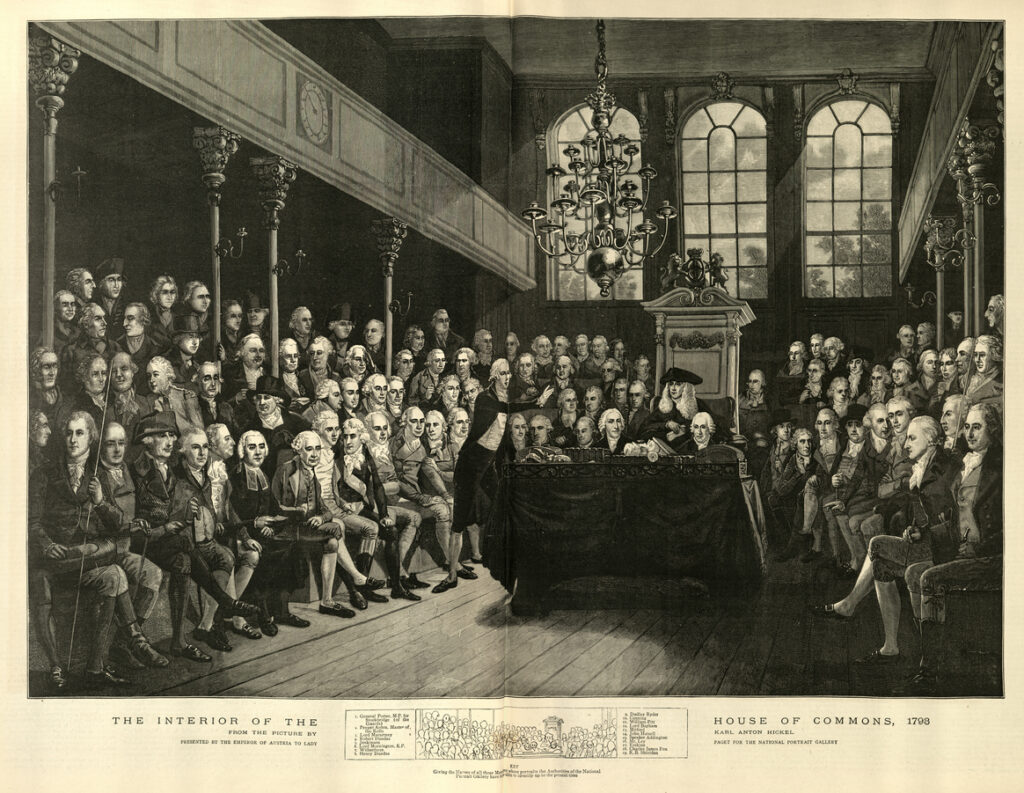
Speaking in support of the legislation, Pitt told the commons: “These marks are, wicked and illegal engagements of mutual fidelity and secrecy by which the members are bound; the secrecy of electing the members; the secret government and conduct of the affairs of the society; secret appointments unknown to the bulk of the members; presidents and committees, which, veiling themselves from the general mass and knowledge of the members, plot and conduct the treason – I propose that all societies which administer such oaths shall be declared unlawful.”
William Wilberforce was another leading proponent of the legislation.
The Combination Act was motivated by the fear that, at a time of rising food prices, political agitation among industrial workers could cripple Britain’s capacity for warmaking.
The Combination Act’s full title conveyed its purpose: to “prevent unlawful combinations of workmen”. It was prompted by a petition from London master millwrights complaining about strike action by their workers.
Under the act, it was made illegal for two or more workmen to combine to improve conditions or seek wage increases. They faced penalties of up to three months’ imprisonment or two months’ hard labour. While combinations of workers were already technically illegal under common law, the acts also provided for the faster application of the law, allowing offenders to be tried quickly before two Justices of the Peace rather than awaiting the Assizes. A subsequent Act in 1800 superseded and slightly moderated these provisions.
***
Pitt’s repressive legislation forced trade societies underground and helped fuel popular resentment.
Radical London tailor Francis Place and Joseph Hume, an elected parliamentarian, successfully campaigned for the repeal of the Combination Acts in 1824.
However, restrictions on collective industrial action were quickly reimposed the following year with the Combinations of Workmen Act 1825. The repeal of the 1799 and 1800 acts had sparked a series of strikes.
The 1825 act was wholly displaced by the Trade Union Act 1871.
In 1967, a new Criminal Justice Act repealed the mostly obsolete and deprecated measures of the 1799 Unlawful Societies Act.

Politics.co.uk Newsletters
DAILY
Politics@Lunch
WEEKLY
Week in Review