Thomas Paine’s revolutionary ‘Rights of Man’ published
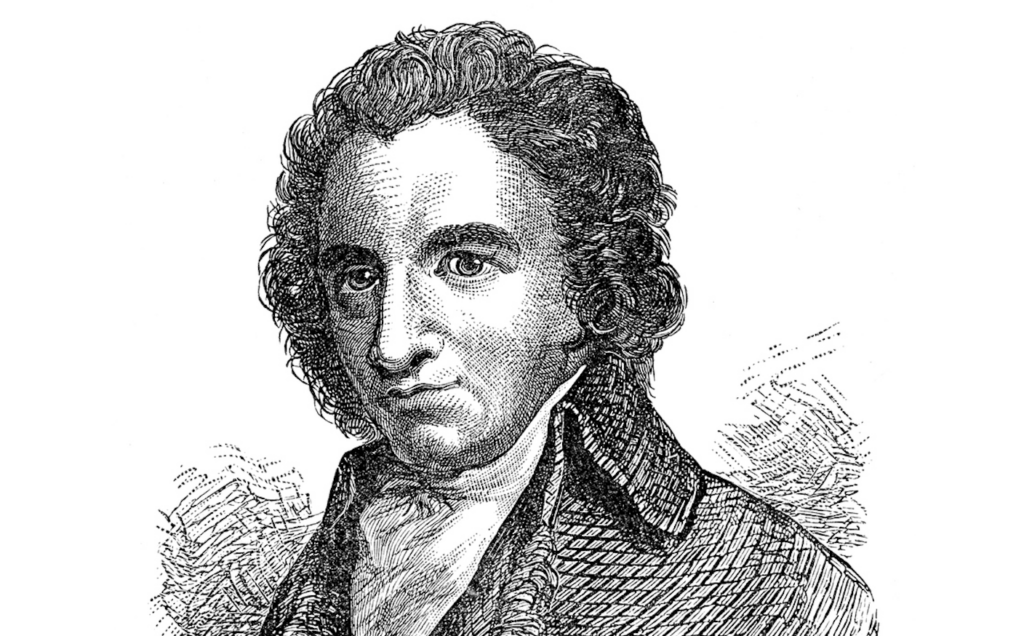
On 16 March 1791, the first part of Thomas Paine’s seminal political work, Rights of Man, was published in London. The book brought radical political ideas to a mass audience and, in becoming one of the most widely circulated titles of the 18th century, helped foster mass enthusiasm for democratic reform.
The book was conceived as a direct rebuttal to conservative intellectual Edmund Burke’s counter-revolutionary 1790 tract, Reflections on the Revolution in France, which had attacked the French Revolution and defended the principles of hereditary monarchy and aristocracy. By contrast, in parts one and two of Rights of Man, Paine mounted a robust defence of the French Revolution and the permissibility – and necessity – of revolutionary challenge.
He argued that rights are not granted by governments or charters, but are universal and natural. This belief formed the basis of his democratic republicanism. Moreover, he framed the French Revolution as a revolt against the despotism of the hereditary monarchy of the French government, not any particular monarch.
In a direct challenge to Burke’s reverence for tradition, Paine derided all forms of monarchy, aristocracy and privilege.
He wrote: “It is a perversion of terms to say that a charter gives rights. It operates by a contrary effect – that of taking rights away. Rights are inherently in all the inhabitants; but charters, by annulling those rights, in the majority, leave the right, by exclusion, in the hands of a few.”
Paine described the concept of aristocracy as a “monster” which must be upheld by “tyranny and injustice.”
He outlined further objections, arguing that the very idea of hereditary legislators is as “inconsistent as that of hereditary judges, or hereditary juries; and as absurd as an hereditary mathematician, or an hereditary wise man; and as ridiculous as an hereditary poet laureate.”
He argued that a “body of men, holding themselves accountable to nobody, ought not to be trusted by anybody.”
***
The government of William Pitt the Younger, fearing the work would inspire a similar revolution in Britain, sought to suppress it. Following the publication of Part Two in 1792, Paine was charged with seditious libel.
Paine fled to France to escape arrest and was subsequently tried and convicted in absentia.
Despite this, Rights of Man became a foundational text for the radical movement in Britain for generations. It is said that Rights of Man, an accessible tract of 90,000 words, sold between 100,000 and 200,000 copies in the first three years after publication.
Across Britain, the work was used as the discussion topic for political groups and new radical ‘corresponding’ societies.
Paine’s previous work Common Sense (1776), which argued that republicanism was the sole rational means of government, helped inspire the American Revolution. Part 1 of Rights of Man was dedicated to US president George Washington.
The work opened: “I present you a small treatise in defence of those principles of freedom which your exemplary virtue hath so eminently contributed to establish. That the Rights of Man may become as universal as your benevolence can wish, and that you may enjoy the happiness of seeing the New World regenerate the Old, is the prayer of… Your much obliged, and Obedient humble Servant, Thomas Paine.”

Politics.co.uk Newsletters
DAILY
Politics@Lunch
WEEKLY
Week in Review