Clement Attlee retires as Labour leader after two decades
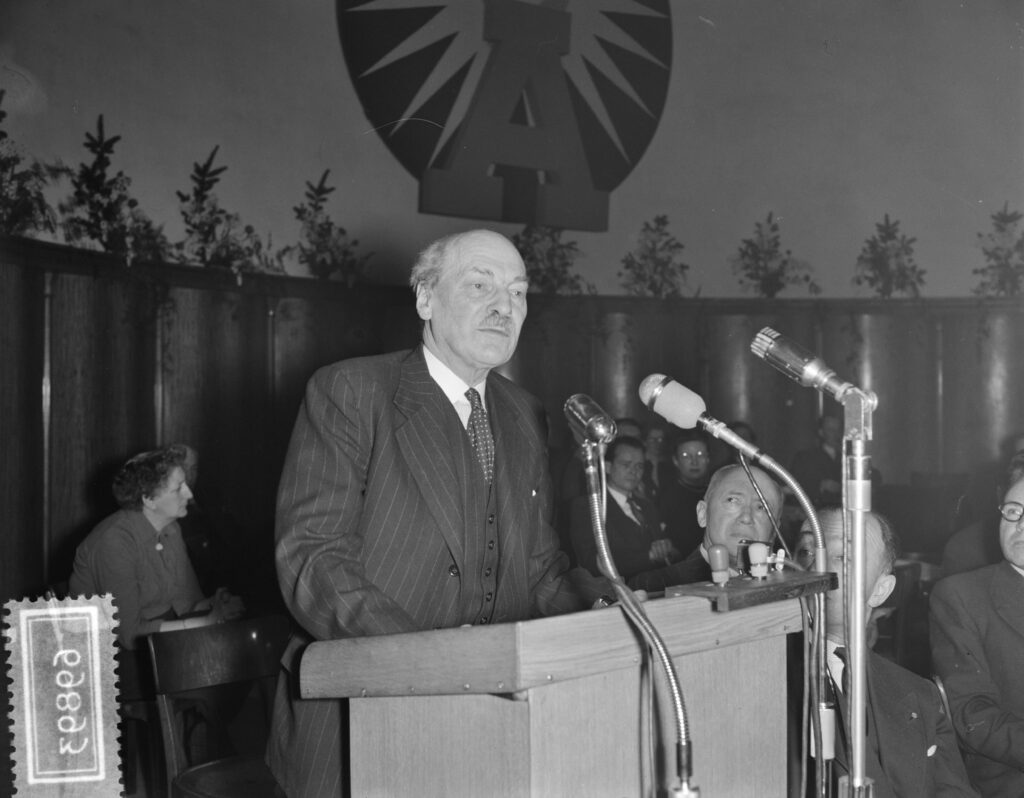
On 7 December 1955, Clement Attlee announced his resignation as leader of the Labour Party. The 72-year-old former prime minister, who had recently suffered a stroke, made the announcement in a meeting of the Parliamentary Labour Party (PLP).
Attlee told those in attendance: “Before proceeding to the main business for which you have been called, I have a statement to make.”
He expressed regret that speculation about his departure had been rife for some time, noting that “there has scarcely been a week passed without one prominent member of the party or another talking about my impending resignation.”
Attlee’s resignation came eight months after Winston Churchill, his wartime partner, stepped down as prime minister.
Herbert Morrison, Attlee’s longstanding deputy, served as interim leader of the Labour Party during the 1955 leadership election – the party’s first since 1935.
***
Attlee’s resignation marked the end of his storied 20-year tenure as Labour leader. He had served in the wartime coalition as deputy prime minister from 1942 to 1945. He then oversaw the party’s landslide victory at the 1945 general election, when Labour secured a majority of 145 seats. Over the next six years, the first majority Labour government established the National Health Service (NHS), created a “cradle to grave” welfare state, nationalised around 20% of the economy, constructed new towns, and began the process of decolonisation – most notably granting independence to India in 1947.
Under Attlee’s leadership, Britain was also one of the founding members of Nato in 1949.
Attlee fought five general elections in his tenure as Labour leader. The 1935 general election, fought against the National Government led by Stanley Baldwin, saw Labour win 154 seats (a net gain of 102). Attlee had initially been regarded as a caretaker leader during this period, taking office after the resignation of George Lansbury, a staunch pacifist, with the election looming. But he went on to lead the party into the 1945, 1950, 1951 and 1955 elections.
Labour left office in the wake of the 1951 election, with the party’s transformative 1945 programme mostly implemented. The 1955 contest, with Anthony Eden as prime minister, saw the Conservatives increase their majority to 60 seats.
On 8 December, Eden paid tribute to Attlee in the House of Commons, with the former Labour leader reportedly spectating from the gallery. The prime minister said that Attlee had “never made a personal enemy” in his 30 years as an MP and praised “his courage, his patience and his tenacity”.
Clement Davies, the Liberal leader, said that Attlee was not “ambitious”, but that “events, combined with a high sense of duty and sterling character, called on him to fill in succession posts of increasing responsibility which he so honourably and successfully undertook.”
Davies said the commons would remember Attlee’s “tenacity, his courage – his quiet, steady courage – night after night as he battled during that period from 1931 onwards for the cause in which he so sincerely believed.”
Morrison, speaking on the Labour frontbench, said his party owed Attlee “an especial debt for the services he has rendered to us over that long period of 20 years as leader and a number of years before that.”
***
The 1955 Labour leadership election pitted the party’s “old guard” represented by Morrison (aged 67), against a new generation drawing from both the left and right: Aneurin Bevan, the architect of the NHS, and Hugh Gaitskell, the former chancellor.
Attlee had delayed his resignation partly to prevent Morrison, whom he considered too old and divisive, from succeeding him. Morrison, a former home secretary and foreign secretary, had not followed the path taken by many of Labour’s pre-war and wartime grandees – now including Attlee – who had already stepped down from frontline politics.
Attlee first announced his intention to resign as Labour leader in September, when he said the party needed leaders “brought up in the present age, not, as I was, in the Victorian age”. This comment was seen as a tacit endorsement of Gaitskell’s unannounced candidacy. Both Bevan and Morrison were born during Queen Victoria’s reign.
Attlee added: “Labour must look forward, not backward… We have to deal with a new conception of society.
“Many evils against which we were fighting fifty years ago have been overcome, and socialist ideas, then regarded as outlandish, are now accepted. Even the Tories have a broader, more humane outlook.”
Attlee’s delay was also an attempt to manage the deepening rift between the “Bevanite” left and the “Gaitskellite” right.
Bevan had resigned from Attlee’s cabinet in 1951 in protest at the decision – taken by Gaitskell as chancellor – to impose prescription charges on glasses and false teeth. The move came as Britain struggled to finance its part in the Korean War. Bevan resigned alongside Harold Wilson, the president of the Board of Trade since 1947.
Bevan had since taken up the post of shadow minister of labour and national service; Gaitskell had served as shadow chancellor since the 1951 general election.
Gaitskell initially supported Morrison’s candidacy, but chose to stand himself in order to thwart Bevan. The shadow chancellor won the support of the so-called “Big Three” trade unions: the Transport and General Workers’ Union, the National Union of Mineworkers, and the General and Municipal Workers Union.
During the short campaign, Bevan said he was willing to withdraw from the contest to ensure Morrison’s election unopposed. But Gaitskell declined to stand aside, thwarting attempts at a Morrison coronation. “I have the highest regard for Mr Morrison,” Gaitskell said, “but I think the party should have the opportunity of choosing.”
Bevan was speculated to have resolved on a strategy that would see him challenge for the leadership later in the parliament.
***
In the ballot of Labour MPs held on 14 December 1955, Gaitskell won 157 votes (58.8%), easily defeating Bevan, who secured 70 votes (26.2%). Morrison won the backing of just 40 colleagues (15.0%).
Morrison resigned as deputy leader immediately after his defeat.
Following his election, Gaitskell, 49, paid tribute to both Attlee and Morrison, calling it a “great honour but a great responsibility” to lead the Labour Party.
Gaitskell said: “I can only say that I will try to discharge this in such a way as to justify the confidence of the party…
“All of us, I think, have a deep feeling of sadness that he has decided to resign from the position of deputy leader. He is a man who has served the party and country in the most devoted manner for well over 30 years.
“There is no use denying that we shall miss very much his wise counsel and his great experience, just as we shall miss those qualities in Mr Attlee.”
At a subsequent press conference, Gaitskell said he thought there was a “very much better spirit” in the Labour Party after recent divisions.
In his first speech as Labour leader at Cleckheaton on 18 December, Gaitskell vowed to pursue the “most vigorous opposition” to the Conservative government’s “follies and weaknesses”.
He endorsed the “sensible recommendations” of Harold Wilson’s report into the party organisation after the 1955 general election defeat, and denounced Bevanite criticism of the party’s policy review as “just rubbish”. He insisted on bringing Labour policy “up to date as circumstances change.”
Attlee, first elected to parliament in 1922, also stood down as an MP upon his resignation. He accepted a hereditary peerage – the first Labour leader to do so.
On 16 December 1955, he became Earl Attlee and Viscount Prestwood.
In his maiden speech on 15 March 1956, Attlee addressed the deteriorating situation in the Middle East and Cyprus. He criticised the deportation of archbishop Makarios to the Seychelles, saying he did not “believe it is ever wise to remove the leader of a nationalist movement”. Attlee cited Charles Stewart Parnell’s comment that if he were arrested, “Captain Moonlight” would take his place.
He said that the times had changed since, “as Palmerston did in the past, we could send the British Fleet here and there if troubles should break out.”
He added: “We have not the greatest strength in the world; we have not the greatest wealth in the world. What we have is a great tradition for good will. And our role in the world, particularly in Asia – as we have exemplified in the British Commonwealth – is that we stand for freedom and democracy…
“I hold no brief for the archbishop, but I remember that the rebels of the past generally tend, sooner or later, to become prime ministers in the British Commonwealth.”
(Makarios served as the first president of Cyprus between 1960 and July 1974).
Gaitskell first made his mark as Labour leader during the parliamentary debates over the Suez Crisis. He opposed the invasion from the outset, which elicited much condescension from Conservative benches. In a masterful statement on 31 October 1956, Gaitskell accused the government of “an act of disastrous folly whose tragic consequences we shall regret for years.”
Earl Attlee, having returned from a trip to India, denounced the government’s Suez policy as “wrong” and “extraordinarily stupid”. He accused the government’s defenders of repeating “the same excuses for action as have been put up by every aggressor – by Austria in relation to the Yugoslavs in 1914; by Germany in respect of Belgium, and by Hitler in respect of Czechoslovakia.”
***
Bevan stood in the February 1956 Labour deputy leadership election, but was defeated by James Griffiths. In 1956, after reconciling with Bevan, Gaitskell appointed his erstwhile rival as shadow foreign secretary. It came after Bevan’s own strident criticism of the UK government’s conduct during the Suez Crisis.
In the wake of the 1959 general election, which returned Harold Macmillan as prime minister, Gaitskell fought his party over Clause IV and unilateral nuclear disarmament.
Attlee and Gaitskell were one when it came to their opposition to Britain’s accession to the European Economic Community (EEC). In a speech to the House of Lords on 8 November 1962, Attlee stated his belief that it was quite “impossible for us to enter into these economic arrangements without being pulled, sooner or later, into a political association.”
He declared: “I am prepared to give up sovereignty to the world, but not to a selected number of European countries. That is not giving up something for world security; it is giving something up to sectional interests…
“I think that by marrying into Europe we are marrying a whole family of ancient prejudices and ancient troubles.”
In a famous speech to Labour’s annual conference in October 1962, Gaitskell said the creation of a federal Europe would mean “the end of Britain as an independent European state, the end of a thousand years of history!”.
On 18 January 1963, with Labour on the verge of returning to power, Gaitskell died suddenly. Gaitskell’s death, caused by lupus, sent shockwaves through British politics.
Harold Wilson was elected as Gaitskell’s successor as Labour leader and led his party to victory in the 1964 general election.
Attlee died on 8 October 1967, aged 84.
The former prime minister had appeared frail as an honorary pallbearer at Churchill’s funeral in January 1965. Having insisted on attending the funeral against medical advice, Attlee’s stumble on the steps of St Paul’s Cathedral almost led to Churchill’s coffin being dropped.

Politics.co.uk Newsletters
DAILY
Politics@Lunch
WEEKLY
Week in Review