Churchill says an ‘iron curtain’ has descended across Europe
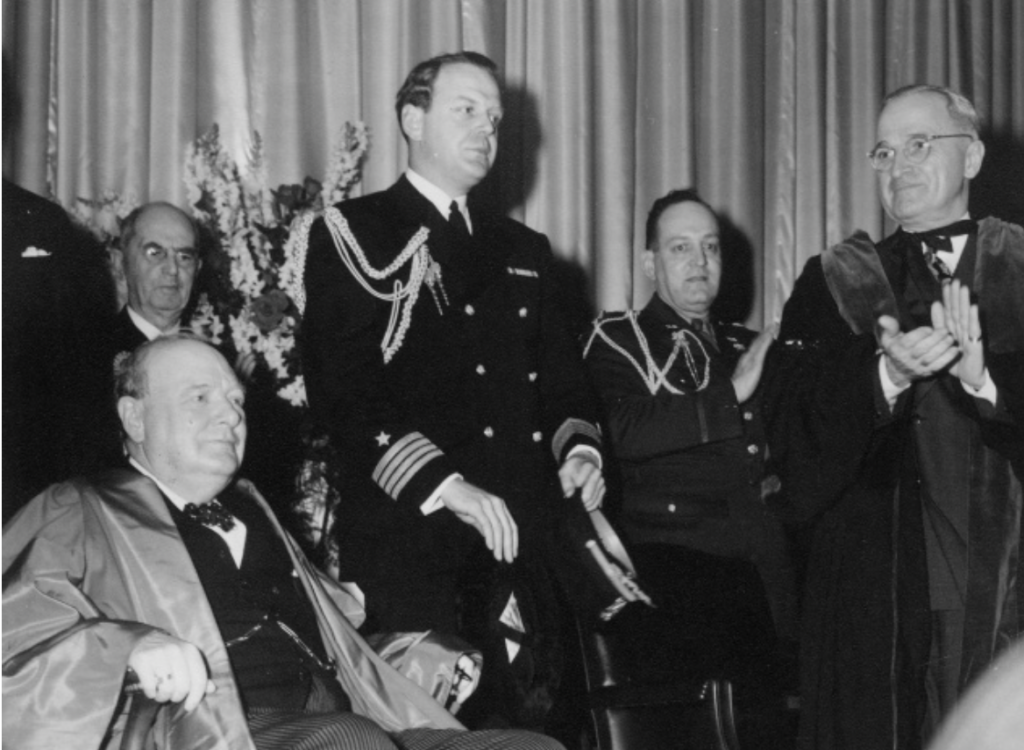
On 5 March 1946, in a speech at Westminster College in Fulton, Missouri, Winston Churchill gave one of the defining addresses of the post-war era, declaring that an “iron curtain” had descended across Europe. The speech helped frame the emerging Cold War, defining a conflict between democratic West and Soviet-dominated East.
Churchill became the prime minister of the United Kingdom on 10 May 1940, replacing Neville Chamberlain on the same day that Nazi Germany launched its invasion of France and the Low Countries.
Five years later, following the break-up of the wartime coalition government shortly after VE Day in May 1945, Churchill called a general election. The Conservative Party was ultimately reduced to 197 seats, losing 190. Labour secured 393 seats, a net gain of 239, and a landslide parliamentary majority of 145. The swing of 12 points to Labour was unprecedented; both Churchill and Attlee were said to be astounded at the result.
Relegated to leader of the opposition, Churchill’s global stature endured.
The former prime minister delivered his famous “Fulton Speech” speech on a private visit to the United States. But the presence of US president, Harry S. Truman – who was among those in attendance on 5 March 1946 – lent the occasion a quasi-official character.
***
In his address, officially titled “The Sinews of Peace”, Churchill began by emphasising the immense responsibility now resting on the United States, which he described as standing at “the pinnacle of world power.”
The former prime minister, whose mother was a US citizen, stated: “If you look around you, you must feel not only the sense of duty done but also you must feel anxiety lest you fall below the level of achievement.
“Opportunity is here now, clear and shining for both our countries. To reject it or ignore it or fritter it away will bring upon us all the long reproaches of the after-time.”
He argued that in many countries political freedom had been replaced by authoritarian regimes where “control is enforced upon the common people by various kinds of all-embracing police governments, to a degree which is overwhelming and contrary to every principle of democracy.”
He insisted that democratic nations must continue to defend the “great principles of freedom and the rights of man” encapsulated in Magna Carta, the Bill of Rights and the United States Declaration of Independence.
The central argument of the speech was Churchill’s call for a “fraternal association of the English-speaking peoples.” He spoke of a “special relationship” between the United States and the British Commonwealth.
The Conservative leader explained: “Fraternal association requires not only the growing friendship and mutual understanding between our two vast but kindred systems of society, but the continuance of the intimate relationship between our military advisers, leading to common study of potential dangers, the similarity of weapons and manuals of instructions, and to the interchange of officers and cadets at technical colleges.”
Churchill then turned to the most famous part of the address, warning that Soviet power was rapidly expanding across Europe. He said a shadow had “fallen upon the scenes so lately lighted by the Allied victory.”
The former prime minister expressed his “strong admiration and regard for the valiant Russian people and for my wartime comrade, Marshal Stalin.” But he retained the right to detail “certain facts about the present position in Europe.”
Churchill declared: “From Stettin in the Baltic to Trieste in the Adriatic, an iron curtain has descended across the Continent. Behind that line lie all the capitals of the ancient states of Central and Eastern Europe. Warsaw, Berlin, Prague, Vienna, Budapest, Belgrade, Bucharest and Sofia, all these famous cities and the populations around them lie in what I must call the Soviet sphere, and all are subject in one form or another, not only to Soviet influence but to a very high and, in many cases, increasing measure of control from Moscow.”
The Tory statesman referenced his opposition to the policy of appeasement in the 1930s and his efforts to sound the alarm for “my own fellow-countrymen and to the world”. In the 1940s, he argued firm cooperation among democratic nations could deter aggression and prevent another catastrophe.
Churchill called for a close military alliance to thwart what he termed a “growing challenge and peril to Christian civilisation”.
***
The speech represented a clarion call for the United States to reject isolationism and embrace its role as a defender of the “free world”.
The speech was criticised by some at the time as unnecessarily provocative, but it proved prophetic. It foreshadowed the policy of containment that would define US and UK foreign policy for the next four decades, including the Truman Doctrine of 1947, the Marshall Plan (officially the European Recovery Program), and the formation of Nato in 1949.
Churchill returned as prime minister after his Conservative Party secured a majority at the 1951 general election.
The Conservative Party’s 1951 general election manifesto included a commitment to “labour for a United Europe, including in the course of time those unhappy countries still behind the iron curtain.”

Politics.co.uk Newsletters
DAILY
Politics@Lunch
WEEKLY
Week in Review