Callaghan accused of ‘running scared’ after ruling out autumn election
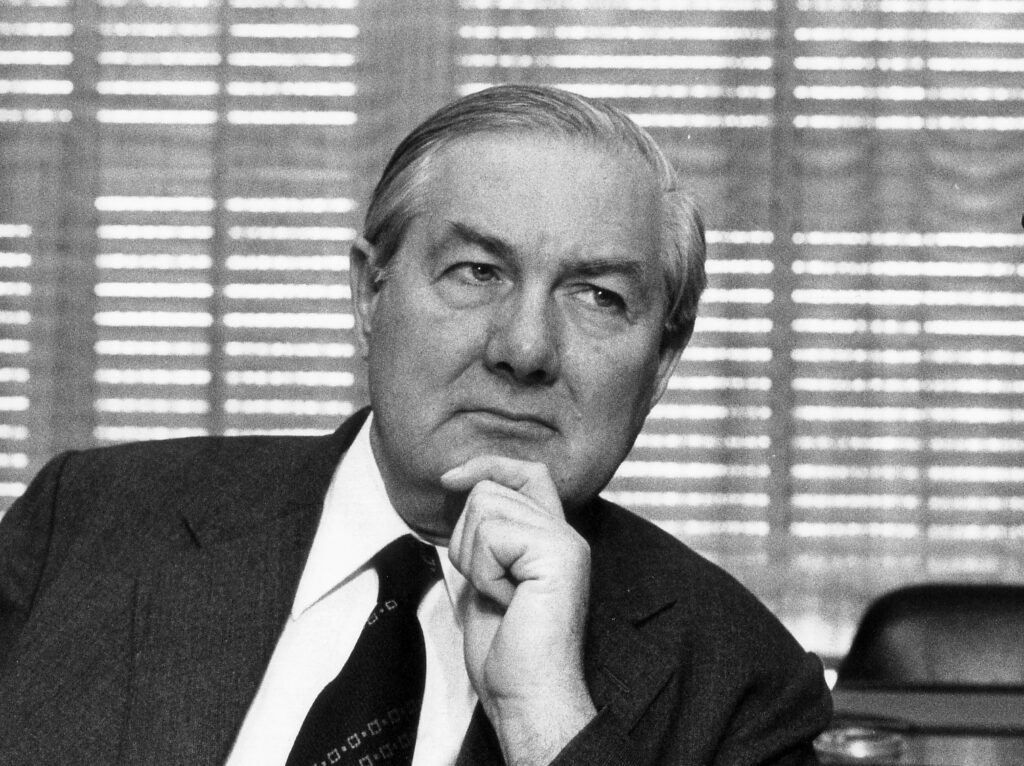
On 7 September 1978, the prime minister, James Callaghan, used a prime ministerial broadcast to announce that he had decided not to call a general election for the autumn.
The decision, resolved upon after weeks of incessant speculation, is now regarded as a major strategic miscalculation with devastating political repercussions.
***
Callaghan succeeded Harold Wilson as prime minister on 5 April 1976. The foreign secretary had defeated the candidate of the Labour left, employment secretary Michael Foot, by 176 votes to 137 in a swift two-week leadership contest.
In assuming the role of prime minister, Callaghan – variously referred to as ‘Sailor Jim’ and ‘Sunny Jim’ – became the first and so far only politician in history to hold all four of the ‘great offices of state’: chancellor of the exchequer (1964 to 1967), home secretary (1967 to 1970), foreign secretary (1974 to 1976) and prime minister.
But he inherited a precarious political and economic situation. The country was in the grip of an economic crisis with high inflation; Labour, meanwhile, stood on the cusp of losing its majority in parliament.
Shortly after entering Downing Street, Callaghan was forced to negotiate a deal with the Liberal Party, known as the Lib-Lab pact. The pact ended in the summer of 1978, depriving the government of 13 crucial parliamentary votes. Labour was left to rely on ad-hoc support.
However, with the economic picture now improving, Labour edged ahead of Margaret Thatcher’s Conservatives in the opinion polls. Inflation, which had peaked at 26% in 1975, fell into the single digits in 1978. Unemployment declined from a peak of 1.5 million in the third quarter of 1977, to 1.3 million a year later.
Callaghan also bested Thatcher on the measure of personal popularity.
The economics, politics, polling and parliamentary arithmetic pointed to an autumn election. Westminster and the country were simply waiting for Callaghan to give the go-ahead.
***
On 6 September, Callaghan fuelled such speculation in a speech to the Trades Union Congress (TUC) conference. He delivered a rousing, partisan address – the sort of speech a prime minister delivers on the cusp of an election campaign.
Callaghan told the conference that he would indicate his electoral intentions “very shortly.”
The prime minister said he understood that election speculation was “bound to happen once the Liberals withdrew”. But he urged the media to wait for an official pronouncement.
He stated: “The commentators have fixed the month for me, they have chosen the date and the day. But I advise them: Don’t count your chickens before they are hatched.
“Remember what happened to Marie Lloyd [sic]. She fixed the day and the date, and she told us what happened. As far as I remember it went like this: There was I, waiting at the church.”
The prime minister proceeded to sing the rest of the chorus to the old music hall song.
“All at once he sent me round a note
“Here’s the very note, and this is what he wrote
“I can’t get away to marry you today,
“My wife won’t let me.”
After this musical interlude, Callaghan added: “Now let me just make clear that I have promised nobody that I shall be at the altar in October. Nobody at all.”
By all accounts, the prime ministerial pantomime failed to dampen the pre-election speculation. Many misinterpreted Callaghan’s cryptic-sounding sing-song.
Indeed, he then hit out at Thatcher and the Conservatives, declaring: “Let others stoop, if they must, to scapegoat politics.”
Callaghan said that the Labour Government would match “tolerance against prejudice, policies against slogans, co-operation against conflict, unity against racialism and sectarian divisions.
“We will not tolerate policies that would require the sick to pay if they go to visit their doctor or spend time in a hospital, or policies that would endanger people’s jobs be simple-minded theories.”
The Conservatives were primed for an election. With Thatcher out campaigning, the party had already begun to spend.
The Tory leader was apparently convinced that Callaghan would call an election. She told reporters at a lunchtime drinks reception on 7 September: “I don’t imagine he’s making a ministerial broadcast just to say he isn’t holding a general election.”
Addressing a rally of Conservative Party workers on 6 September, Thatcher declared that the longer the government clings to power, the greater “the victory of the next Conservative government.”
She added: “If a prime minister shows he is afraid to go when he is in a minority then when the time comes that he has to go he has to be dispatched with all possible speed.”
Thatcher referred to Callaghan’s whimsical sing-song at the TUC conference. She said her own choice of tune would be: “I want to wash that man right out of my hair.”
***
On the evening of 7 September, Callaghan addressed an expectant nation.
In an uncharacteristically pessimistic intervention, ‘Sunny Jim’ said there would be no general election that autumn.
Callaghan argued that his government should “continue to carry out policies that are consistent, determined, that don’t chop or change and that brought about the present recovery in our fortunes.”
Addressing the nation in a four-minute prime ministerial broadcast, he said: “I know that we have large and positive support in the country for the way we are facing these problems. So, when I met the cabinet this morning, I invited ministers to prepare themselves for the fifth and final session of this parliament.
“We shall work with the greatest vigour to control inflation, to reduce unemployment and to improve the efficiency and prosperity of British industry. We shall face difficulties as we come to them. I can’t and don’t promise that we shall succeed; I can say that we shall deserve to.
“But I want to say to you that we go on because we are doing what is best for Britain. So I shall not be calling for a general election at this time. Instead, I ask every one of you to carry on with the task of consolidating the improvement.
“Let’s see it through together.”
The announcement was met with near-universal surprise.
The bookies were reportedly already taking bets on the election’s outcome
Thatcher, having cancelled a holiday to France, heard the news at the Little Barrow Hotel in Lichfield.
The Conservative leader said: “I believe the prime minister has made a mistake and his decision is against the nation’s interest. He has lost his majority and with it the authority to govern. He should now properly seek the verdict of the people.
“There are indeed many problems to be tackled in industry, commerce, jobs, the social services, Rhodesia and defence. They need long-term solutions, not short-term expedients.
“They need a government with a clear mandate from the people and several years’ life. Only that would restore confidence. As it is, we shall now have a long period of election fever. The country belongs to the courageous, not to the timid.”
She also accused the prime minister of “running scared”.
She referred to Callaghan and his cabinet colleagues as “chickens”.
David Steel, the Liberal leader, called Callaghan’s statement “quite astounding”.
He said: “Parliament is four years old and to breathe new life into it we must have an election.”
***
Callaghan’s decision was predicated, in significant part, on his belief that he could secure an agreement with the trade unions on pay restraint. He then hoped that continued economic recovery would further improve Labour’s standing ahead of a spring election.
Formerly confidential material released by the National Archives in 2008 under the 30-year rule reflected Callaghan’s fervent belief he could ward off industrial strife.
One note read: “I’ve been written off more times than I care to remember”.
It added:
1. In March 76– they said an election in the autumn.
2. At Oct’76 conference [they said] I had delivered my rst and last speech as PM.
3. In March’77– prior to the arrangement with the Libs [they said] we should be forced to go to the country then.
4. After the Liberal arrangement they forecast an election in Oct’77.
5. They decided they would x the election date for Oct’78.
He was determined that neither “the press nor the Tory party” should fix the election date. He would go to the country on his own terms at a moment of his choosing.
The prime minister had disastrously miscalculated.
Within weeks, the country began its slow descent into the ‘Winter of Discontent’ – a period of widespread industrial unrest and economic disruption. The government was seen as flat-footed in responding to the turmoil, symbolised by the infamous Sun headline: “Crisis? What Crisis”
Labour’s poll lead summarily collapsed into a double-digit deficit.
This weakened Callaghan’s position in parliament. The Labour government stumbled forth, relying on the support of smaller parties and an often innovative whipping operation.
On 28 March 1979, having chosen to put off an autumn election, Callaghan soon found the issue forced upon him. The Labour government lost a confidence motion by one vote; he was now obliged to call a general election.
***
The 1979 general election produced the first female prime minister in British and European history.
Thatcher’s Conservatives won 339 seats (up 62), securing a comfortable majority of 43. The Labour Party slumped to 269 seats (down 50). The swing to the Conservatives of 5.2% was the largest since 1945.
Callaghan stepped down as Labour leader in 1980.
He died on 26 March 2005.
Callaghan would not be the last Labour prime minister to spark frenzied speculation as to a forthcoming election. Nor would he be the last to decline to capitalise on a dwindling Conservative poll advantage, before facing a sustained and politically damaging economic crisis.
In 2007, Gordon Brown would go through the comparable motions of pre-election speculation for his own edition of the election that never was.

Politics.co.uk Newsletters
DAILY
Politics@Lunch
WEEKLY
Week in Review