Boris Johnson and Rishi Sunak fined for lockdown breach
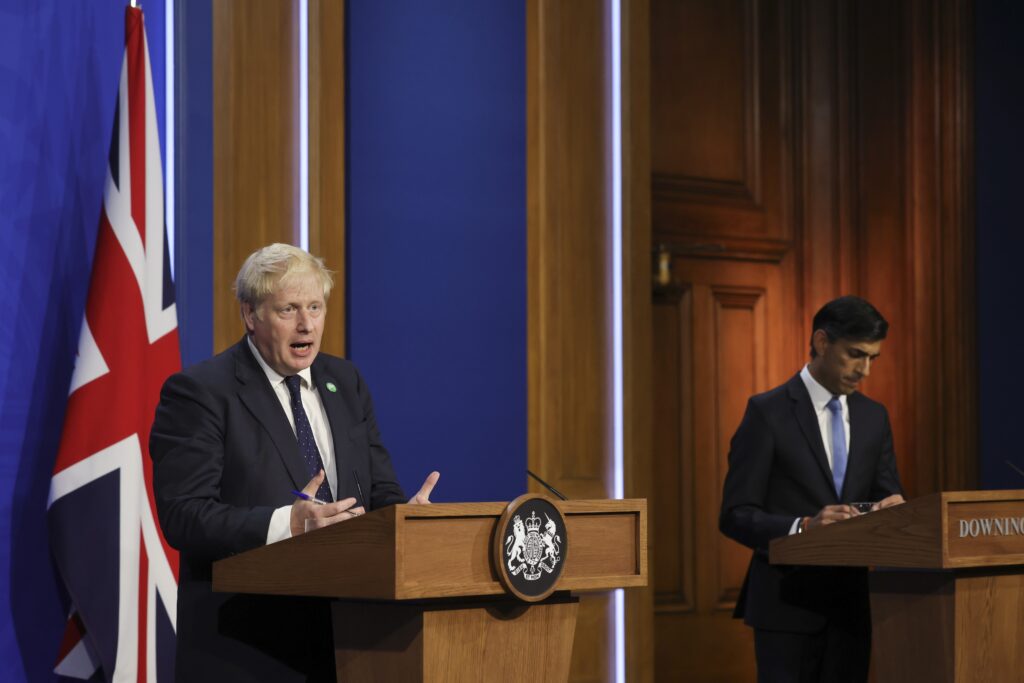
On 12 April 2022, prime minister Boris Johnson and the chancellor of the exchequer, Rishi Sunak, were issued with fixed penalty notices by the Metropolitan Police for breaching Covid-19 lockdown regulations.
The announcement confirmed that the two most senior members of the government had broken the laws their own administration had imposed on the country.
***
The Partygate scandal first emerged in late 2021 when the Daily Mirror’s political editor, Pippa Crerar, reported that Johnson had broken rules with a series of Downing Street gatherings during the 2020 festive period. At the time, the prime minister insisted that no rules had been broken, telling MPs “that all guidance was followed completely in No 10”.
The specific event for which Johnson and Sunak were penalised was a birthday celebration for the prime minister held in the cabinet room on 19 June 2020, at a time when restrictions banned most indoor gatherings involving more than two people.
The fines made Johnson the first serving prime minister in British history to be sanctioned for breaking the law. They were issued as part of the police investigation, known as Operation Hillman, into gatherings in Downing Street and Whitehall during the pandemic.
The news triggered a political firestorm. Opposition parties demanded that both men resign.
Angela Rayner, the deputy leader of the Labour Party, posted to Twitter (now X): “You made the rules. You broke your own law. Just go.”
In a televised statement, Johnson apologised but rejected calls to quit, saying: “In all frankness, at that time it did not occur to me that this might have been a breach of the rules.
“But, of course, the police have found otherwise and I fully respect the outcome of their investigation.”
https://x.com/BBCNews/status/1513927959240970240
In a statement, Sunak offered an “unreserved apology”.
The chancellor said: “I understand that for figures in public office, the rules must be applied stringently in order to maintain public confidence. I respect the decision that has been made and have paid the fine.
“I know people sacrificed a great deal during Covid, and they will find this situation upsetting. I deeply regret the frustration and anger caused and I am sorry.”
***
The fine prompted several MPs, including the Labour leader of the opposition, Keir Starmer, to send letters to the commons speaker requesting that a debate be held on a motion referring Johnson to the privileges committee.
At the start of business on 19 April, Sir Lindsay Hoyle announced that he would allow such a debate. The matter, Hoyle said, concerned “the prime minister’s statements to the House regarding gatherings held at Downing Street and Whitehall during lockdown.”
Hoyle’s actions were consistent with the rules of the House, which require that a matter of privilege must first be raised with the commons speaker. It is the speaker who has discretion to decide whether the matter should have the precedence accorded to matters of privilege – i.e. that the issue should be given priority over other business set down for debate. MPs then vote on a motion to refer the matter specifically to the committee of privileges for a full inquiry.
The commons debated a motion tabled by Starmer as leader of the opposition, calling for an investigation on 21 April 2022. The motion noted “the issue of fixed penalty notices by the police in relation to events in 10 Downing Street and the Cabinet Office” and the prime minister’s assertions on the floor of the House, including that “all guidance was followed in No 10”.
The motion, which ordered that “this matter be referred to the committee of privileges to consider whether the right honourable member’s conduct amounted to a contempt of the House”, was passed without a division.
***
On 6 June 2022, Johnson survived a vote of no confidence in his leadership of the Conservative Party by 211 votes to 148 – a victory that technically secured his position under party rules for another year. However, the scale of the revolt was far larger than had been anticipated.
Johnson resigned as prime minister mere weeks later over his botched response to the “Pincher affair”.
Sunak stood in the July-September 2022 Conservative leadership contest but lost to the serving foreign secretary, Liz Truss, who was subsequently appointed as prime minister.
The collapse of the Truss administration led to a second leadership contest and Sunak’s coronation as Conservative leader.
On 9 June 2023, Johnson announced his resignation as an MP after receiving a draft of the privileges committee’s final report into whether he had wilfully misled parliament. In a statement, the former prime minister Johnson branded the committee a “kangaroo court” and claimed its year-long inquiry had delivered “what is intended to be the final knife-thrust in a protracted political assassination”.
The 106-page final report of the privileges committee, published on 15 June, found that Johnson committed “repeated contempts of parliament”.
On 19 June, the House of Commons endorsed the report by 354 votes to 7, with a large number of abstentions. Sunak, the serving prime minister, was among those who abstained. The then-PM maintained that he had other commitments.

Politics.co.uk Newsletters
DAILY
Politics@Lunch
WEEKLY
Week in Review