Four senior Johnson aides resign amid partygate and Savile row
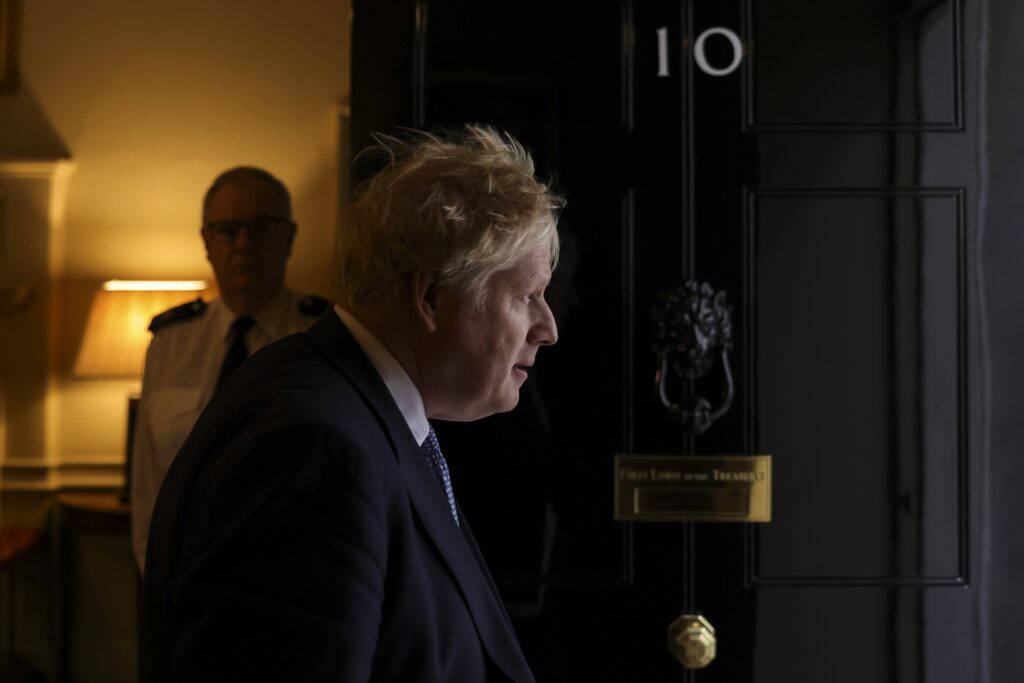
On 3 February 2022, the embattled premiership of Boris Johnson suffered a further series of blows as four of his most senior Downing Street aides resigned within hours of each other.
The exodus of staff coincided with the political fallout from the developing “partygate” scandal and a comment Johnson delivered in the House of Commons, linking the Labour leader, Keir Starmer, to the failure to prosecute the sex offender Jimmy Savile.
***
On 31 January 2022, senior civil servant Sue Gray published an update on her investigation into alleged gatherings on government premises during Covid restrictions. Gray found that some of the government’s behaviour was “difficult to justify” given the “backdrop of the pandemic”.
She pointed to “failures of leadership and judgment”.
Gray wrote: “There were failures of leadership and judgment by different parts of No 10 and the Cabinet Office at different times. Some of the events should not have been allowed to take place. Other events should not have been allowed to develop as they did.”
Responding to the interim report in the House of Commons, Johnson told MPs that he would “improve the No 10 operation and the work of the Cabinet Office”, strengthen cabinet government, and repair “the vital connection between No 10 and parliament”.
Johnson insisted that he understood the public anger, declaring: “I get it and I will fix it.”
Starmer accused the prime minister of retreating into “desperate denials”. Johnson, he argued, had fallen back on “his usual excuse: it is everybody’s fault but his”.
The Labour leader said Johnson “should do the decent thing and resign.”
He added: “Of course, [the prime minister] will not, because he is a man without shame. Just as he has done throughout the life, he has damaged everyone and everything around him along the way.”
***
Johnson responded with an aggressive – and ultimately unfounded – counterattack, directed at Starmer’s record as director of public prosecutions (DPP).
The prime minister said Starmer had “spent most of his time prosecuting journalists and failing to prosecute Jimmy Savile” during his tenure as DPP.
On 1 February, Downing Street said Johnson “stands by” his comments.
At prime minister’s questions on 2 February, Starmer accused Johnson of “parroting the conspiracy theories of violent fascists to try to score cheap political points”.
He added: “He knows exactly what he is doing. It is time to restore some dignity.”
Johnson refused to walk back his comments, which had come in for considerable criticism from across the political spectrum, declaring instead: “I am informed that in 2013 he apologised and took full responsibility for what had happened on his watch, and I think that was the right thing to do.”
Savile was a British media personality who died in 2011.
In 2012, widespread reporting emerged alleging his role in extensive sexual abuse.
Surrey police had interviewed Savile in 2007, as part of its probe into allegations of child sex abuse at Duncroft Approved School near Staines during the 1970s. It was known that he routinely visited the school during that decade. The matter was referred to the Crown Prosecution Service (CPS), which “advised there was insufficient evidence to take any further action”.
Starmer served as the director of public prosecutions from 2008 to 2013.
As DPP, Starmer responded to the Levitt inquiry report, which he commissioned, into the decision not to prosecute Savile.
In January 2013, he said: “I accept the conclusions reached by Ms Levitt QC and, in the interests of transparency and accountability I have decided to publish her report in full. In doing so, I would like to take the opportunity to apologise for the shortcomings in the part played by the CPS in these cases.
“But I also want to go further. If this report and my apology are to serve their full purpose, then this must be seen as a watershed moment. In my view, these cases do not simply reflect errors of judgment by individual officers or prosecutors on the facts before them. If that were the case, they would, in many respects, be easier to deal with.”
In February 2022, Nazir Afzal, the former chief crown prosecutor for North West England, told the BBC that Starmer wouldn’t have been aware of any decision not to prosecute Savile. “None of that would have been escalated beyond the south-east and Keir wasn’t aware of it”, Afzal said.
***
On the morning of 3 February, Munira Mirza, the head of the No 10 Policy Unit resigned over Johnson’s refusal to apologise for the Savile remark. In a letter published by the Spectator, she described the comment as a “scurrilous accusation.”
Mirza wrote: “I believe it was wrong for you to imply this week that Keir Starmer was personally responsible for allowing Jimmy Savile to escape justice. There was no fair or reasonable basis for that assertion.
“This was not the normal cut-and-thrust of politics; it was an inappropriate and partisan reference to a horrendous case of child sex abuse…
“It is not too late for you but, I’m sorry to say, it is too late for me.”
Mirza had worked for Johnson since 2008 and his tenure as mayor of London. Her departure was followed by three other senior figures: Jack Doyle as director of communications, Dan Rosenfield as chief of staff, and Martin Reynolds as principal private secretary.
While Mirza’s exit was unplanned, the other three resignations were believed to be part of a long-planned restructuring of the No 10 operation, referenced by Johnson in his commons statement on 31 January. The Downing Street overhaul formed part of a broader effort to stabilise Johnson’s position – an initiative styled as “Operation Save Big Dog” by allies of the prime minister.
Reynolds, dubbed “Party Marty” by the press, had become a central figure in the partygate scandal after a leaked email revealed he had invited over 100 staff to a “BYOB” (bring your own booze) event in the Downing Street garden on 20 May 2020. The email invited more than 100 Downing Street staff to “make the most of the lovely weather and have some socially distanced drinks”.
Dominic Cummings, the former chief adviser to the prime minister, argued that Mirza’s departure was “an unmistakable signal the bunker is collapsing and this PM is finished”.
https://x.com/Peston/status/1489335719550234629
In the days that followed, Operation Save Big Dog continued, with Johnson overseeing new appointments to his No 10 team and a mini cabinet reshuffle.
Andrew Griffith, a Conservative MP and longtime ally of the prime minister, replaced Mirza as head of policy. Johnson had used Griffith’s £9.5 million Westminster townhouse to map out his first 100 days in office, during the latter stages of the 2019 Conservative leadership election.
Griffith had previously served as one of Johnson’s two personal private secretaries.
Steve Barclay, the chancellor of the Duchy of Lancaster and Johnson ally, was appointed as chief of staff – becoming the first serving MP to hold the role. In this role, Barclay vowed to pursue “a smaller state” approach.
In a Sunday Telegraph article, Barclay wrote: “Now it is a priority to restore a smaller state – both financially and in taking a step back from people’s lives. It’s time to return to a more enabling approach.
“To trust the people, return power to communities, and free up business to deliver.”
Guto Harri, another longstanding Johnson ally, was appointed director of communications. Harri, who served as Johnson’s spokesperson and chief of staff during his first term as London mayor, reported that upon entering No 10, the prime minister greeted him by singing Gloria Gaynor’s I Will Survive.
https://x.com/bbclaurak/status/1490653617023590405
Johnson said the changes would “improve how No 10 operates, strengthen the role of my cabinet and backbench colleagues, and accelerate our defining mission to level up the country.”
He stated: “This week I promised change, so that we can get on with the job the British public elected us to do.
“We need to continue our recovery from the pandemic, help hundreds of thousands more people into work, and deliver our ambitious agenda to level up the entire country, improving people’s opportunities regardless of where they’re from.”
https://x.com/KevinASchofield/status/1489337562921684995
***
A mini cabinet reshuffle followed on 8 February.
Jacob Rees-Mogg was appointed to the newly created post of minister for Brexit opportunities and government efficiency. Although the role was at the minister of state level, it was confirmed that Rees-Mogg would attend cabinet meetings. A prominent Brexiteer, Rees-Mogg would be responsible for driving “forward the changes we are able to make now that we have left the EU, delivering on our post-Brexit agenda across Whitehall”, a Downing Street spokesperson said.
Mark Spencer moved from chief whip to become the new leader of the House. Chris Heaton-Harris was tasked with imposing greater discipline on the parliamentary party as the new chief whip.
Notably, the reshuffle also saw the promotion of Christopher Pincher, another staunch Johnson ally, to deputy chief whip.
Operation save big dog, of course, failed to secure Johnson’s position as prime minister.
On 6 June 2022, Johnson survived a vote of no confidence in his leadership of the Conservative Party by 211 votes to 148 – a victory that technically secured his position under party rules for another year. However, the scale of the revolt was far larger than had been anticipated.
On 30 June 2022, Pincher resigned as deputy chief whip following allegations that he had drunkenly groped two men at the Carlton Club in London.
Initially, Downing Street insisted that the prime minister considered the matter closed and that Pincher would remain a Conservative MP, having lost only his government job.
This position quickly became untenable as a storm of new allegations about Pincher’s past behaviour emerged over the following days. The critical political question became what Boris Johnson knew about these previous allegations when he appointed Pincher to the whips’ office in February 2022.
As Downing Street’s initial position unraveled, Sajid Javid and Rishi Sunak resigned as health secretary and chancellor respectively.
The wave of resignations that followed forced Johnson to announce his own departure, against his obstinate wish to remain in office, on 7 July.
Politics.co.uk Newsletters
DAILY
Politics@Lunch
WEEKLY
Week in Review
