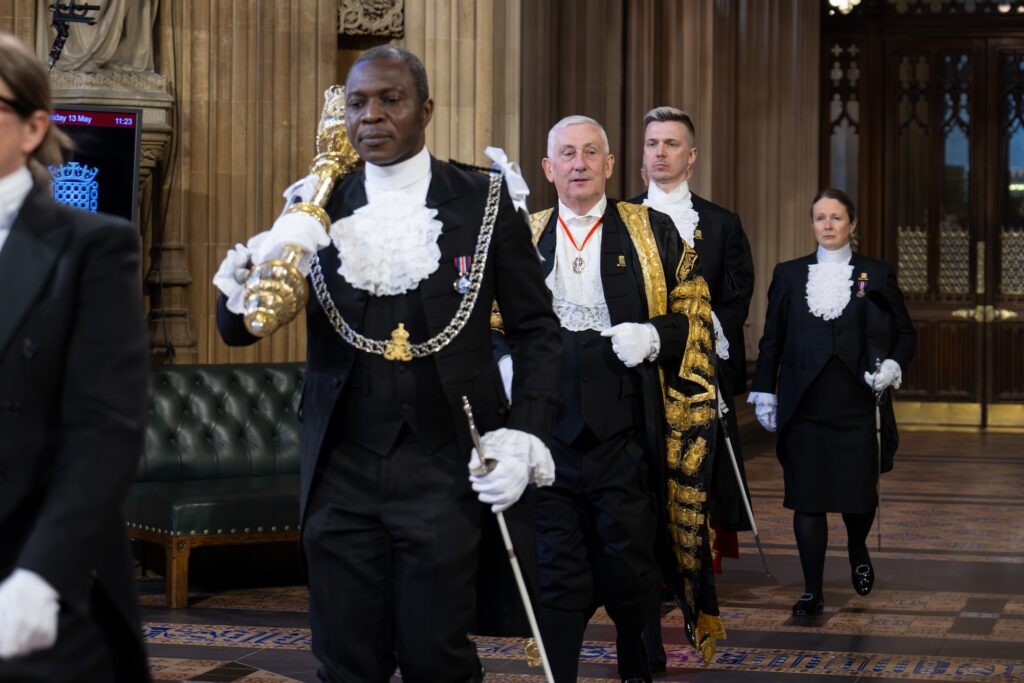
The serjeant at arms is a senior official of the House of Commons responsible for maintaining order and security in the commons chamber. The role is one of the oldest in parliament, dating back to at least the 15th century.
The serjeant remains a central figure in the House of Commons. The most visible duty of the serjeant at arms is carrying the commons ceremonial mace during the speaker’s daily procession into the chamber.
The serjeant at arms is appointed by the monarch on the recommendation of the speaker and the House of Commons commission. By tradition, the role was often held by a former senior officer from the armed forces, although this is no longer a requirement.
The serjeant at arms wears a traditional uniform, including a black wool suit and patent leather shoes. The office-holder also sports a black sword and sword sling. On special occasions, a lace collar and cuffs are worn.
The current serjeant at arms is Ugbana Oyet, who took up the post in October 2019. Oyet is the first Black serjeant at arms in the office’s 600-year history. He was previously parliament’s principal electrical engineer and programme director for the engineering infrastructure and resilience programme.
Jill Pay, the first woman to hold the office of serjeant at arms, served in the role from 2008 to 2012.
Responsibilities of the serjeant at arms
Maintaining order
The serjeant at arms is responsible for order and decorum in the House of Commons, acting on the authority of the speaker. If an MP is suspended from the House for disorderly conduct, the serjeant at arms (or a deputy) has the duty to escort them from the chamber. This function extends to the public galleries and committee rooms. The serjeant at arms’ team includes a deputy serjeant, an assistant serjeant and two associate serjeants.
Ceremonial duties
Each day the House sits, the serjeant at arms leads the speaker’s procession into the chamber, carrying the ceremonial mace over their shoulder. This procession signals the formal start of the parliamentary day. The serjeant also accompanies the speaker on other formal occasions, including for the state opening of parliament ceremony.
Wider security duties
The serjeant at arms is said to work closely with the Parliamentary Security Department to maintain security across the parliamentary estate.
History
The office of serjeant at arms originated in the late 13th century when King Edward I formed a bodyguard of 20 serjeants at arms, who performed a variety of judicial and administrative roles for the king. In 1415, one of the royal serjeants, Nicholas Maudit, was appointed to “attend upon all the parliaments as serjeant at arms for the commons coming thereto.”
Over time, the role evolved from being a royal enforcer to an officer of the House of Commons.
Historically, MPs could be committed to the custody of the serjeant at arms for disorderly conduct. The last MP to be imprisoned (in the clock tower) by the serjeant at arms was Charles Bradlaugh in 1880. Bradlaugh was barred from sitting as an MP because, as an avowed atheist, he asked to affirm his allegiance to the crown rather than take the religious oath on a Bible. For his protest, he spent a night in custody in the clock tower beneath Big Ben.
On 28 October 1908, the proceedings in the House of Commons were disrupted as two suffragettes chained themselves to the grille (iron mesh) of the Ladies’ Gallery. The serjeant at arms tried and failed to unscrew the bolts holding the iron mesh. He then led the culprits (Muriel Matters and Helen Fox) away, while they were still attached to large sections of the barrier. A blacksmith was summoned to file off the grille in a nearby committee room, successfully detaching the suffragettes.
In May 1940, Archibald Maule Ramsay, a vehement antisemite, was interned under the wartime Defence Regulation 18B, which provided for the internment of individuals suspected of being Nazi sympathisers. Ramsay appealed (unsuccessfully) to the House of Commons committee on privileges, before being taken back to prison under the watch of the serjeant at arms.
In July 1978, proceedings in the House of Commons were halted when protesters threw manure from the public gallery onto the floor of the chamber below during a debate on the Labour government’s plans for Scottish devolution. Two protesters, including Yana Mintoff, 26-year-old daughter of the Maltese prime minister, were taken into custody by the serjeant at arms as a result.
In May 2004, speaker Michael Martin suspended the sitting of the commons after Tony Blair was struck by projectiles filled with purple flour during a session of prime minister’s questions. It was found that the two men, aged 50 and 36, had gained access to the gallery after securing tickets from a Labour peer, Baroness Golding. Martin subsequently instructed the serjeant at arms to suspend “the right of members of the House of Lords to sponsor visitors for admission” to the commons.
In September 2004, the serjeant at arms asked the Metropolitan police to conduct a full investigation after five protesters burst onto the floor of the chamber during a debate on the Hunting Bill.
In late 2008, the serjeant at arms (Jill Pay) consented to a police search of Conservative MP Damian Green’s House of Commons office. Pay later expressed her regret as to her role in the events that led to Green’s arrest.
In October 2022, the serjeant at arms was asked to conduct an investigation into reports of scuffles outside the “No” lobby in the famous fracking vote which triggered Liz Truss’ downfall as prime minister. One Labour MP, Chris Bryant, alleged that he saw Tory MPs being “physically manhandled” into the government voting lobby.
The report stated: “It is very clear that the general atmosphere in the lobby was intense and several of those present found it very upsetting, both at the time and afterwards.
“However there is no evidence that anyone was bullied into voting in a particular way: two government members were particularly keen to seek clarity from the whips about the status of the vote, given the importance of fracking as an issue in their constituencies (one of whom was identified as the apparent victim of bullying).”
He added: “While there was some physical contact between members, there is no evidence from our investigation that this was any more than a gesture of comfort.”
The ceremonial mace
The mace is a symbol of royal authority in parliament. Without the mace being present on the table in the chamber, the House of Commons cannot lawfully sit, debate or pass laws. It is a silver-gilt ornamental club, around 1.5 metres long, and dates from the reign of King Charles II.
When the House prorogues or dissolves, the serjeant at arms is required to return the mace to the Jewel Tower at the Tower of London.
Removing the mace from its place while the House is sitting is considered a grave act of disorder.
On 27 May 1976, the shadow industry secretary, Michael Heseltine, seized the ceremonial Mace in the House of Commons and brandished it towards the government benches. The protest came at the climax of a chaotic debate on a government bill to nationalise large parts of the aircraft and shipbuilding industries.
In a July 2018 interview with the BBC, Heseltine said he seized the mace because he was “appalled” by the parliamentary chicanery on the government benches.
In December 2018, Labour MP Lloyd Russell-Moyle seized the ceremonial mace during an especially heated debate over the government’s Brexit policy.
Speaking to reporters afterwards, Russell-Moyle said: “The symbolic gesture of lifting the mace and removing it is that the will of parliament to govern is no longer there has been removed. I felt parliament had effectively given up its sovereign right to govern properly.
“They stopped me before I got out of the chamber and I wasn’t going to struggle with someone wearing a huge sword on their hip.”
Black Rod
The Serjeant at Arms of the Commons has a direct counterpart in the House of Lords. The Lady or Gentleman Usher of the Black Rod, commonly known as Black Rod, is a senior official in the House of Lords, responsible for its administration, security and ceremonial events. The role, which dates back to the 14th century, is one of the most ancient in the British parliament.
Appointed by the monarch, Black Rod performs three offices: lady or gentleman usher of the Black Rod, serjeant-at-arms in the House of Lords, and secretary to the Lord Great Chamberlain.
The position is best known to the public for its central role in the state opening of parliament. During the state opening ceremony, the commons serjeant at arms famously bars their counterpart in the Lords from entry into the lower chamber. Only then is Black Rod admitted and allowed to address MPs.
Additional resources
- UK Parliament – The Serjeant at Arms: https://www.parliament.uk/about/mps-and-lords/principal/serjeant-at-arms-/
- UK Parliament – Ugbana Oyet – Serjeant at Arms: https://www.parliament.uk/business/commons/the-speaker/supporting-the-speaker/serjeant-at-arms/
-
Watch – MP removes Mace from Parliament, Global News, 2018: https://www.youtube.com/watch?v=aKmLxoMScb4