The House of Commons is the primary legislative chamber of the United Kingdom parliament.
The UK parliament is a bicameral legislature, made up of the commons and House of Lords. The commons, or lower House, is the democratically elected body of 650 MPs, each representing a specific geographic constituency.
The UK operates under the principle of parliamentary sovereignty. This means that an act of parliament is the highest form of law in the land and cannot be overturned by any body other than parliament itself. Constitutionally, the source of this sovereignty is the so-called “crown in parliament” – also known as the king in parliament or the queen in parliament. This term describes the legal entity of the monarch acting on the advice and with the consent of the two Houses of Parliament – the commons and Lords.
The centre of power in this relationship has shifted over the centuries from the monarch themselves, to the Houses of Parliament together – and then to the House of Commons in particular. The pre-eminence of the commons is derived from its democratic mandate.
The UK government is formed from the party or coalition that can command the confidence of the House of Commons. By convention, the prime minister is the leader of the largest party in the House. It is widely accepted that the prime minister must also be an MP; the Marquess of Salisbury, who left office in 1902, was the last prime minister to sit in the Lords.
Most government ministers are also a member of the House of Commons, and the vast majority of legislation is introduced there.
The functions of the House of Commons
The House of Commons performs several key constitutional functions.
Its central role is to debate, scrutinise and vote on proposed legislation (bills). For a bill to become an act of parliament it must be approved by the House of Commons.
The commons also holds the government to account for its policies and actions. This is done through various mechanisms, including weekly prime minister’s questions (PMQs), questions to other ministers, formal debates and the investigative work of cross-party select committees.
Evaluation question
When the governing party has a large majority in the House of Commons, how effective are scrutiny mechanisms like PMQs and debates at genuinely holding the government to account?
The commons has the exclusive power to authorise government taxation and public spending. The House of Lords is unable to block or amend financial legislation.
The role of an MP
An MP has a dual role, working both in parliament and in their constituency.
Each MP represents the interests and concerns of their constituents, acting as a link between the public and parliament. Most MPs hold weekly surgeries in order to meet people and listen to their concerns. All MPs maintain offices in their constituency and at Westminster to deal with correspondence (or “casework”) from constituents.
However, it is a tenet of representative democracy that MPs are not “delegates” for their constituents. This means that, while the views of constituents are frequently considered, the actions of MPs are governed by their determination of the best interests of their constituency, their political party and the country as a whole.
MPs may also take on ministerial (government) or shadow ministerial (opposition) roles.
The composition and layout of the House of Commons
The political parties
Crucially, most MPs belong to political parties, without whose organisation and discipline the House of Commons could not function effectively. MPs who belong to parties are subject to control in respect of voting and, to a lesser extent, what they can say during debates. This control is exercised and enforced by the party “whips”.
Evaluation question
Does this system of discipline undermine the ability of backbenchers to independently represent their constituents and hold the government to account?
A member of a political party is said to take the party “whip”.
Whips are MPs who are appointed by their political party to enforce discipline. MPs may choose to ignore or “break” the whip by voting against the party line, but doing so can result in sanctions. The harshest official punishment a whip can impose on “rebel” MPs is suspension from the parliamentary party; this is known as the withdrawal of the whip.
Governments are usually formed by a single political party; this tends to be the one that commands a majority in the House of Commons. Coalition governments, by contrast, are formed by two or more political parties that agree to govern together.
The whipping system is crucial for a government, of whatever party or composition, to secure the passage of its legislation in the House.
Given the dominance of parties during election time, independent MPs are a rarer phenomenon.
The speaker of the House of Commons
The commons speaker is the most senior independent MP. The speaker is elected/re-elected at the start of each parliament and, upon election, must immediately renounce their party affiliation.
The speaker, perhaps best known for their shouts of “Order!”, impartially presides over debates and serves as the guardian of the House’s rules. They ensure that proceedings are conducted in an orderly manner. Sir Lindsay Hoyle was elected as speaker in November 2019.
The speaker sits in the chair at the head of the chamber, between the government and opposition MPs. They have three elected deputies, who also do not take part in debates or vote.
The speaker officially represents the commons to the monarch. Historically, the position was precarious and sometimes perilous; seven Speakers were executed by beheading between 1394 and 1535. As a result – despite the substantial salary and grand accommodation provided within the Palace of Westminster – the speaker, upon their election, still demonstrates the traditional reluctance to assume the role by being ceremonially “dragged” from the backbenches.
The speaker has the casting vote in the event of a tie. However, there are well-established conventions that guide the speaker’s conduct in such cases (which are extremely rare).
The structure of the commons
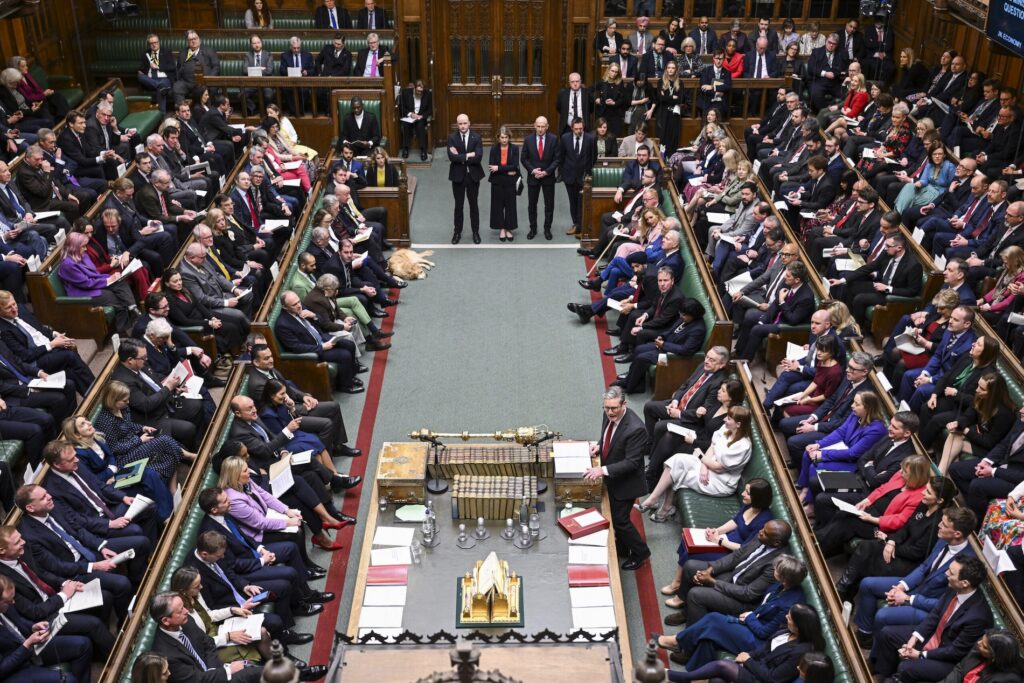
The chamber is arranged with five sets of green benches facing each other. The party of government sits on the benches to the speaker’s right, with the prime minister and senior ministers occupying the front bench (referred to as the ‘Treasury bench’). The opposition parties sit to the speaker’s left, with the official opposition on the front bench opposite the government.
Evaluation question
Does the traditional adversarial structure encourage conflict rather than the consensus-building, which might be forged in a modern hemicircle legislature?
The official opposition
His Majesty’s most loyal opposition, commonly known as the official opposition, is the largest party in the House of Commons that is not in government.
It plays a crucial role in scrutinising the government. Meanwhile, the official opposition seeks to present itself to the public as an alternative administration, hoping voters will return it to government at the next general election.
The official opposition is led by the leader of the opposition, who heads a shadow cabinet, the personnel of which mirrors the composition of the government. The existence of a formal opposition, a shadow government in effect, is considered a hallmark of Britain’s style of government.
Following the 2024 general election, the official opposition is the Conservative Party.
The shadow cabinet, like members of the governing cabinet, are referred to as “frontbenchers” because they sit on the front benches of the House of Commons, facing one another across the chamber. Frontbenchers, be they from the government or the official opposition, speak from one of the House of Commons dispatch boxes. There are government and opposition dispatch boxes, positioned opposite one another at the centre of the chamber.
Smaller parties
Members of smaller parties, such as the Liberal Democrats and Reform UK, are also seated on the opposition benches on the speaker’s left.
A guide to commons procedure and conventions
The work of the commons is governed by a combination of formal rules (listed in the House’s standing orders) and long-standing conventions.
Rules of debate
MPs must not address one another by name. Instead, they refer to each other as “the honourable member” or “the honourable member for [constituency name].”
For senior MPs who are members of the privy council, the traditional body of advisers to the sovereign, the correct form of address is “the right honourable member” or “the right honourable member for [constituency name].” Serving ministers and shadow ministers are sometimes referred to by their job title.
MPs also use the term “my honourable friend” to refer to fellow members of a political party.
In addition, the styles “honourable and gallant member…” and “honourable and learned member…” may be used to refer, respectively, to MPs who are former members of the armed forces and those who are king’s counsel (KCs).
MPs must also address their remarks to the speaker, not directly to other MPs. This means that the use of the word “you” is forbidden unless the member is referring directly to the speaker.
Language must be “parliamentary”. Any “unparliamentary language”, such as swearing, is forbidden. Because all MPs are “honourable”, it is also not acceptable to accuse another member of lying. MPs who break these rules, and refuse to rescind their remarks, can be thrown out by the speaker.
If an MP believes a rule has been broken, they may raise a “point of order.” The speaker is obliged to respond and, if they agree that a rule has been breached, issue a ruling.
MPs are expected to wear smart “business-like” attire. In 2017, the former speaker, John Bercow, controversially ruled that male MPs do not need to wear ties in the commons chamber. Lindsay Hoyle, Bercow’s successor, has taken a stricter sartorial approach, including when it comes to neckwear.
Members are expected to nod their acknowledgement to the speaker when entering and leaving the chamber.
Voting (divisions)
A division is the parliamentary term for a formal vote in the House of Commons.
It is a physical method of counting votes where MPs leave the debating chamber and walk through one of two corridors, known as division lobbies, to register their vote. Initially, the speaker, deputy speaker or the chair (if the House is in committee) “puts the question” to the House. This means asking the House to decide on a particular motion. MPs respond by shouting “Aye” or “No”.
The speaker may decide that a motion is rejected or passed based purely “on the voices”. If there is audible disagreement among MPs, then the speaker will call a division, declaring: “Division! Clear the lobbies.”
At this point, division bells are sounded throughout the parliamentary estate and in surrounding locations, such as ministerial offices. Historically, the bell sounded in some nearby pubs and restaurants to alert MPs that a vote was happening.
Timings
The word “parliament” can be used to refer to the time between two general elections. The current parliament is the 59th parliament of the United Kingdom, which first met in July 2024 following the general election. By law (Dissolution and Calling of Parliament Act 2022), a general election must take place at least every five years.
A parliament is sub-divided into several year-long “sessions”, which begin with the traditional state opening of parliament, and end with parliament’s prorogation.
Prorogation brings all parliamentary business to an end. Legislation is not carried over unless specific provision is made.
A “sitting” is the daily meeting of either House. At the end of each sitting day, the House adjourns until the next sitting.
Elections to the House of Commons
When a general election is called, the House of Commons is dissolved. The 650 seats that make up the lower chamber are then contested in individual constituency elections. Anyone who is over 18 and on the electoral roll can vote. Each voter casts one vote for an individual candidate of a registered political party or for an independent. The candidate with the most votes is returned as the MP for that constituency. This is referred to as the first past the post (FPTP) electoral system
The general election held on 4 July 2024 resulted in a spectacular landslide victory for the Labour Party, led by Keir Starmer. The contest brought 14 years of Conservative government to a definitive end. Labour secured 411 seats and a commanding House of Commons majority of 174.
Starmer was duly invited by the sovereign, King Charles III, to succeed Rishi Sunak as prime minister.
- The Conservative Party, led by Sunak, was reduced to just 121 MPs.
- The Liberal Democrats, led by Ed Davey, achieved a record result, winning 72 seats to become the largest third party in the commons in over a century.
- Reform UK, led by Nigel Farage, secured five MPs.
- The Green Party of England and Wales, under the co-leadership of Carla Denyer and Adrian Ramsay, won four seats.
- In Scotland, the Scottish National Party (SNP) saw their seat count collapse from 48 to just nine. In Wales, the Welsh nationalist party, Plaid Cymru, won four seats.
The election was also notable for the election of five independent MPs on platforms that emphasised Palestinian solidarity. One of those, former Labour leader Jeremy Corbyn, defeated his ex-party in Islington North – the constituency he has represented since 1983.
The House of Commons speaker, who stands as independent, was re-elected in his Chorley constituency. By convention, the main parties do not stand against the speaker.
The party landscape is different in Northern Ireland. Sinn Féin, a republican party that does not take up its seats in the commons, won seven seats. The Democratic Unionist Party (DUP) won five seats; the Social Democratic and Labour Party won two seats; and the Alliance party, Traditional Unionist Voice (TUV), and the Ulster Unionist Party all secured one MP each.
Composition of the commons: changes between elections
The composition of the House of Commons is also subject to change over the course of a parliament.
MPs may change their party affiliation, a move commonly referred to as defection.
There is also a mechanism known as the by-election. If an MP resigns or dies, then a by-election is held.
Technically, MPs are forbidden from directly resigning their seats. Instead, an MP who wishes to stand down uses a constitutional convention whereby they are appointed to a historical “office of profit under the crown”, such as the crown steward and bailiff of the Chiltern Hundreds or the crown steward and bailiff of the Manor of Northstead. Accepting such an office automatically disqualifies them from being an MP, triggering a by-election.
The date for the by-election is always chosen by the government but it is announced by the speaker.
On top of this, the Recall of MPs Act 2015 allows voters to remove their MP and trigger a by-election. A recall petition is initiated if an MP is imprisoned, suspended from the House of Commons for at least 10 sitting days, or convicted of providing false expenses claims. If the petition is signed by 10% of eligible voters in the constituency within six weeks, the seat becomes vacant.
This process has successfully removed an MP four out of six times, leading to by-elections to replace Fiona Onasanya (2019), Chris Davies (2019), Margaret Ferrier (2023) and Peter Bone (2023). The recall of Scott Benton’s seat in Blackpool South 2024 was terminated early as the MP resigned two weeks after the petition began to be distributed.
Official record of the House of Commons
A verbatim, official report of everything said in the House of Commons chamber is published daily. This report is known as Hansard.