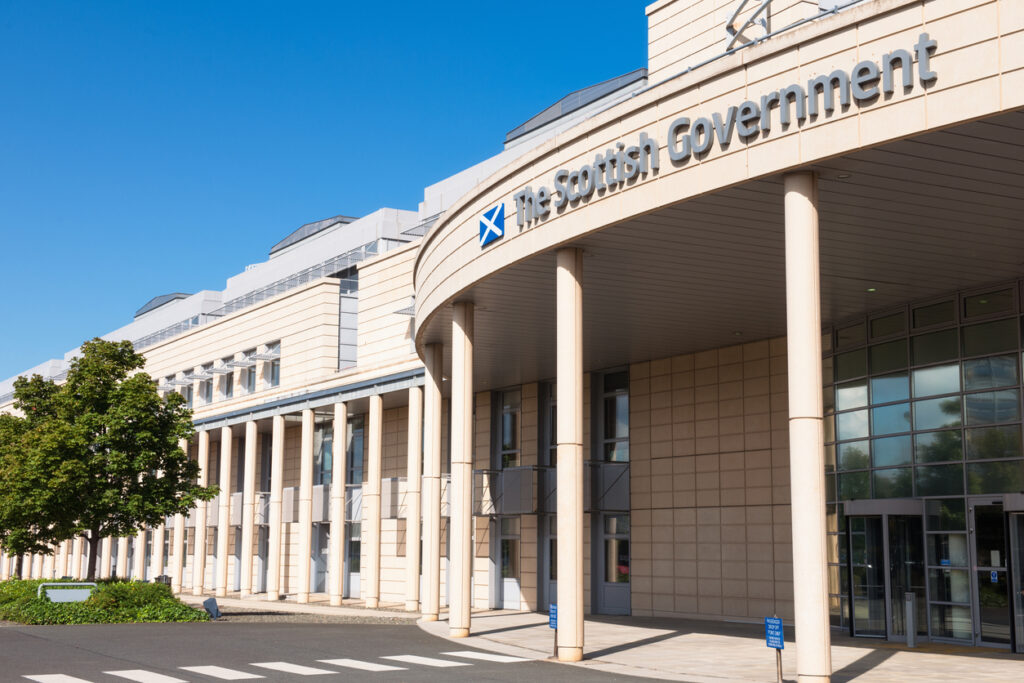
The Scottish government is the devolved government for Scotland, responsible for formulating and implementing policy on most aspects of domestic life. It is led by the first minister, who is nominated by the Scottish Parliament and formally appointed by the monarch.
The government is accountable to the Scottish Parliament at Holyrood, Edinburgh. Its ministers are drawn from members of the Scottish Parliament (MSPs). The government and parliament’s legislative competency covers areas including health, education, justice, agriculture and transport.
The headquarters of the Scottish Government is St Andrew’s House in Edinburgh.
The Scottish National Party (SNP) currently forms a minority government.
The current first minister, John Swinney, took office in May 2024. Bute House is the official residence and workplace of the first minister of Scotland.
How the Scottish government is formed
Following an election to the Scottish Parliament, the 129 MSPs vote to nominate one of their members to be first minister. Opposition parties can and do nominate their own leaders. But the first minister has only ever been the leader of the largest party at Holyrood.
The individual who secures the support of a majority of MSPs is then formally appointed by the king.
The first minister then appoints a ministerial team. This team is comprised of senior cabinet secretaries, who head the main government departments (known as portfolios), and more junior ministers. Cabinet secretaries make up the Scottish cabinet. Appointments must be approved by a vote in the Scottish Parliament.
The structure of the government
The first minister is the head of the Scottish government, chairs the cabinet, and is responsible for the government’s overall policy direction and strategy.
The cabinet is the main collective decision-making body of the Scottish government. It is comprised of the first minister, the deputy first minister, and all the cabinet secretaries.
The Scottish government is advised by two law officers. The lord advocate and the solicitor general for Scotland are the chief legal advisers to the government and also act as the heads of Scotland’s prosecution service. Law officers are appointed by the monarch on the recommendation of the first minister; they are not required to be MSPs, but they are subject to a confirmatory vote in the Scottish parliament.
The Barnett formula
The majority of the Scottish government’s funding comes in the form of a “block grant” from the UK Treasury.
The size of this grant is determined by the Barnett formula, a mechanism created in the 1970s. In simple terms, the formula adjusts the Scottish block grant each year based on changes in UK government spending in equivalent areas in England, applied on a per-capita basis.
As such, when the UK government increases spending on a devolved area in England, the devolved administrations receive a corresponding increase, referred to as “Barnett consequentials”.
How much are Scottish government ministers paid?
The basic annual salary for an MSP is £74,507.
MSPs who hold ministerial office receive an additional salary on top of the standard MSP entitlement. The first minister receives an additional £107,931, bringing their total annual salary to £182,438. A cabinet secretary (senior government minister) receives an additional £55,993, resulting in a total annual salary of £130,500.
Ministers receive an additional £35,077, bringing their total annual salary to £109,584.
History of the Scottish government
Donald Dewar and the dawn of devolution
Donald Dewar was elected as the inaugural first minister of Scotland on 13 May 1999, during an early session of the newly established Scottish parliament at its temporary home in the Assembly Hall of the Church of Scotland in Edinburgh.
Dewar’s election marked a symbolic moment in Scottish political history; he was installed as the head of the country’s first executive in almost 300 years.
Dewar secured the post following a vote by the 129 newly elected MSPs. The vote took place one week after the first Scottish parliament election, in which the Labour party won the most seats (56) but fell short of an overall majority.
To form a stable administration, Labour entered into a coalition partnership with the Liberal Democrats, who had won 17 seats. The agreement, reached shortly before the vote, created a comfortable majority in the new parliament and secured Dewar’s position.
In the formal vote for first minister, Dewar defeated the leader of the SNP, Alex Salmond, by 71 votes to 35. Conservative party leader David McLetchie secured 17 votes, while independent MSP Dennis Canavan won the support of three colleagues.
In his address, Dewar said: “All my political life, I have worked with others to achieve this parliament. Many of my allies and many colleagues in that cause are here today.
“I am proud of what we have done, and I am proud of what Scotland has done. Scotland’s parliament is no longer a political pamphlet, a campaign trail or a waving flag. It is here; it is real.”
He added: “We are indeed a country with a past. The past has shaped us, but our task now is to shape the future. I hope that we can all co-operate to do that.”
The result was announced by the parliament’s new presiding officer, Sir David Steel, and received with a standing ovation.
In his first speech as the newly elected first minister, Dewar said: “It is a great privilege to lead the first government of this parliament. This is a privilege that carries great responsibility and I have no doubt about that.
“The people of Scotland look to us to give them a better life and of that, I think we have a common aim.”
Dewar received the royal warrant of appointment from the Queen at the Palace of Holyroodhouse, her official Edinburgh residence, on 17 May. The ceremony officially signified his status as first minister.
Dewar announced his first cabinet 19 May 1999, which included two Liberal Democrat MSPs and two future first ministers in Henry McLeish and Jack McConnell. Jim Wallace became deputy first minister and minister for justice; fellow Liberal Democrat Ross Finnie was appointed as minister for rural affairs.
This Lib-Lab partnership proved remarkably stable, lasting through two elections and three different Labour first ministers (Dewar, Henry McLeish, and Jack McConnell) until the SNP’s rise to power in 2007.
The SNP ascendancy
In the 2007 Holyrood election, the SNP emerged as the largest party, winning 47 seats and unseating the Labour Party, which had governed Scotland since the dawn of devolution.
Alex Salmond, the leader of the SNP since September 2004, was appointed as the first non-Labour first minister of Scotland. From 2007 to 2011, Salmond led a minority SNP government.
Four years later in 2011, the SNP won an unprecedented overall majority in the Scottish parliament election, confounding pollsters and expectations. The SNP secured 69 of the 129 seats at Holyrood – a majority of four. It was an outcome that the parliament’s additional member voting system was designed to prevent. Under Holyrood’s additional member system (AMS), voters in Scotland are given two ballots: one to elect 73 constituency members under the first past the post (FPTP) system; and a second to elect 56 ‘additional’ MSPs, seven for each of eight regions. In 2011, the SNP took 45.4% of the constituency vote and 44.7% of the regional vote, increasing their number of MSPs by 22 (compared to the notional 2007 base, adjusted for boundary changes).
David Cameron, the prime minister, congratulated the SNP leader for an “emphatic win”.
The result fundamentally altered the constitutional debate in the UK, setting Scotland on a direct path to the 2014 independence referendum. In January 2012, after Cameron called for greater clarity as to the SNP’s intentions, Salmond set out his intention to hold an independence referendum in the autumn of 2014. The UK government did not stand in its Scottish counterpart’s way.
The people of Scotland voted to remain part of the United Kingdom in the Scottish independence referendum, a central pledge of the SNP. The ‘No’ campaign won with 2,001,926 votes (55.3%) against 1,617,989 votes (44.7%) for the ‘Yes’ campaign. The result was delivered on an exceptionally high national turnout of 84.6%.
The defeat of the independence cause in 2014 precipitated Salmond’s resignation as SNP leader and first minister. He was replaced in both roles by Nicola Sturgeon.
The Bute House Agreement
The SNP went into the 2021 Scottish Parliament elections actively campaigning for a second referendum on Scottish Independence. The SNP won 64 of the 129 seats, one short of an overall majority.
From 2021 to 2024, the SNP governed with the support of the pro-independence Scottish Green Party through a power-sharing deal known as the Bute House Agreement. Two Green MSPs, Patrick Harvie and Lorna Slater, were appointed as ministers. Under the deal, Green ministers attended cabinet meetings at least twice a year.
The deal was not presented as a formal coalition. The SNP and Greens (both pro-independence parties) agreed several prominent exceptions to the principle of collective responsibility. The pact was referred to as a “cooperation agreement”.
Referring to the Greens in government, the agreement stated: “These ministers will, as a consequence of the agreed processes for cooperation and collaboration as set out in co-operation and collaboration, observe the principle of collective responsibility, except in respect of excluded matters.”
This coalition government, citing its electoral mandate, formally initiated its campaign for a second independence referendum. In June 2022, Sturgeon unveiled a series of papers titled Building a New Scotland, which were designed to build a fresh case for independence. She announced her intention to hold a consultative referendum on 19 October 2023.
However, the crucial question of the legality of the Scottish Parliament legislating for such a referendum without the consent of the UK parliament remained a significant obstacle. The Scotland Act 1998, which established the Scottish Parliament, reserves matters relating to the Union of the Kingdoms of Scotland and England to the UK parliament in Westminster.
To proceed with a legally binding referendum, a Section 30 order from the UK government would be required, a power the Conservative government at Westminster, under successive prime ministers Boris Johnson, Liz Truss, and Rishi Sunak, consistently refused to grant.
In an attempt to circumvent this, the Scottish government sought a ruling from the UK’s supreme court on whether the Scottish parliament had the authority to legislate for a consultative referendum on its own. In November 2022, the Supreme Court delivered a unanimous verdict, ruling that the Scottish Parliament does not have the power to legislate for a referendum on Scottish independence without the consent of the UK parliament. The court determined that any referendum, even a consultative one, would relate to the reserved matter of the Union and was therefore outside the legislative competence of Holyrood.
This ruling was a significant blow to the SNP’s strategy. In response, Nicola Sturgeon declared that the 2024 UK general election would be treated as a “de facto referendum” on Scottish independence. This new approach was met with some internal debate within the SNP.
The political landscape saw a further significant shift in February 2023, when Sturgeon, after eight years as first minister, announced her resignation citing the personal toll of leadership and the need for a fresh voice. Sturgeon’s departure followed the political trauma of the supreme court ruling and the controversy over the Gender Recognition Reform Bill, which sought to amend the Gender Recognition Act 2004, making it simpler for people to change their gender without having to obtain a medical diagnosis. The UK government at Westminster, led by Rishi Sunak, intervened to block the bill from receiving royal assent, making use – for the first time – of a section 35 order under the Scotland Act 1998.
On top of this, the ongoing developments of Operation Branchform – a Police Scotland investigation into the SNP’s finances and the handling of funds raised for a future independence referendum campaign – were an increasingly destabilising backdrop. The probe, launched in 2021, intensified in early 2023.
Sturgeon’s successors: Yousaf and Swinney
Humza Yousaf defeated rivals Kate Forbes and Ash Regan in the 2023 SNP leadership election, succeeding Sturgeon as first minister.
Yousaf secured 26,032 votes (52.1%) in the second round. He narrowly defeated Forbes, who secured 23,890 votes (47.9%). Regan was defeated in the first round, having only secured 5,599 votes (11.1%). Regan had resigned from the Scottish government in October 2022 over the Gender Recognition Reform Bill. In her resignation statement, Regan said her “conscience” could not allow her to vote for the gender reform proposals.
In April 2024, Yousaf’s disastrous decision to end the power-sharing agreement with the Scottish Greens led to a vote of no confidence. The Scottish Greens, the SNP’s former pro-independence partners in government, were lined up to vote against Yousaf, alongside the Scottish Conservatives, Scottish Labour and the Scottish Liberal Democrats.
The Alba Party, which had one MSP in Ash Regan (who had defected from the SNP), appeared to hold the casting vote. Alba was formed by Alex Salmond in 2021. Its formation was fuelled by a breakdown in the relationship between Salmond and Nicola Sturgeon, then the first minister of Scotland. In 2019, Salmond was arrested and charged with sexual assault and attempted rape for allegations that were said to have occurred during his tenure as first minister. In March 2020, Salmond was acquitted of all charges at trial.
In the ‘no-confidence’ vote in Yousaf’s government, if Regan sided with the SNP, the result would have been a 64-64 tie. According to precedent, the parliament’s presiding officer would then have cast their deciding vote against the motion of no-confidence. At the time, Salmond referred to Regan as the “most powerful MSP in the Scottish Parliament”.
On 28 April, Salmond said his party was “prepared to assist” Yousaf “as long as independence is restored as the key priority of the Scottish government.” The intervention came after Yousaf reportedly ruled out a pro-independence SNP-Alba pact.
On 29 April, Yousaf resigned as first minister of Scotland, saying he was not willing “to trade my values and principles – or do deals with whomever – simply for retaining power.”
The no-confidence vote in the Scottish government was subsequently rejected by 70 votes to 58. In the wake of Yousaf’s resignation, the Scottish Greens voted against the motion.
Following Yousaf’s brief tenure, John Swinney, a veteran of the SNP and a former deputy first minister under both Salmond and Sturgeon, was elected as the new leader of the SNP unopposed and became Scotland’s first minister in May 2024 – just weeks before a UK general election was called for 4 July. Swinney appointed Forbes as deputy first minister.
On 10 May, Swinney admitted that the SNP government’s proposed gender recognition reforms could not be “implemented.”
Additional resources
- The Scottish Government: https://www.gov.scot/

