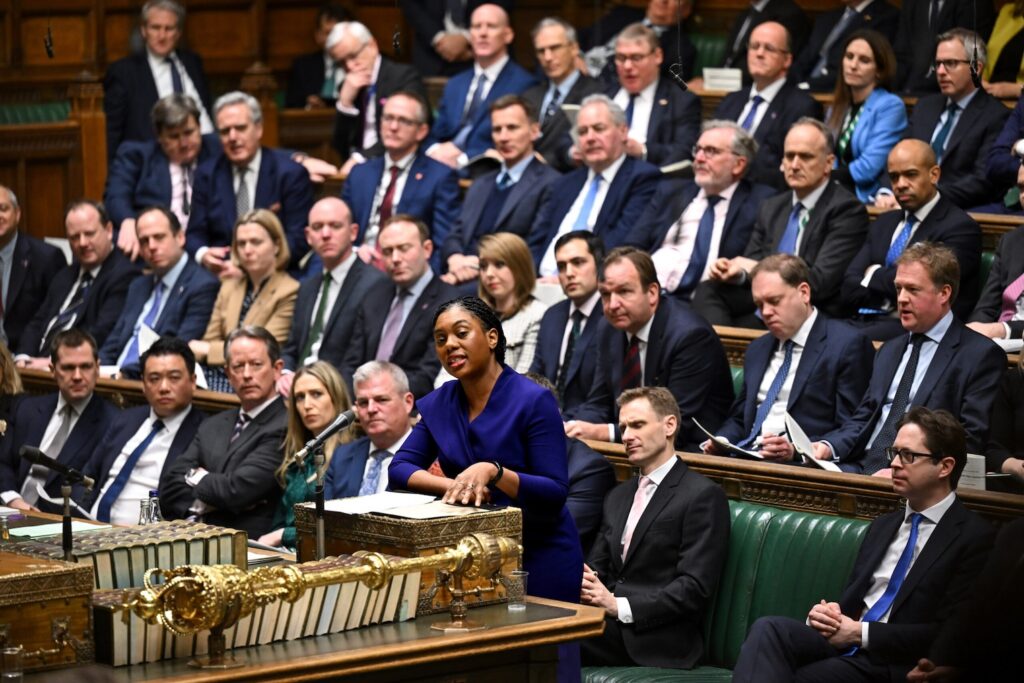
His Majesty’s most loyal opposition, commonly known as the official opposition, is the largest party in the House of Commons that is not in government.
It plays a crucial role in scrutinising the government. Meanwhile, the official opposition seeks to present itself to the public as an alternative administration, hoping voters will return it to government at the next general election.
The official opposition is led by the leader of the opposition, a position recognised in statute. The leader of the opposition heads a shadow cabinet, the personnel of which mirrors the composition of the government. The existence of a formal opposition, a shadow government in effect, is considered a hallmark of Britain’s style of government.
Following the 2024 general election, the official opposition is the Conservative Party. It marked the first time in 14 years that the party had held the position in parliament. The Conservatives are led by Kemi Badenoch as leader of the opposition. She was elected as Tory leader in November 2024.
Opposition parties receive state funding to help them carry out their parliamentary duties. This funding, known as short money, is available to all parties that secured at least two seats, or one seat and more than 150,000 votes, at the previous election. The amount is calculated using a formula based on the number of seats and votes each party won.
The official opposition, as the largest non-government party in the commons, receives the largest share of short money available. This money is provided to assist an opposition party in carrying out its parliamentary business among other reasons.
On top of this, in the financial year commencing 1 April 2025, the leader of the opposition’s office received £1,064,739.30.
The constitutional function of the official opposition
The official opposition questions and scrutinises the work of the government, holding ministers to account for their decisions and actions. It does this through parliamentary questions and debates on the floor of the House of Commons.
In a more abstract sense, the opposition also postures as an alternative government-in-waiting. The opposition develops its own policies and uses its platform in parliament to explain to the public what it would do if it were in power, thereby providing voters with a clear choice at the next general election.
The shadow cabinet
The leader of the opposition appoints a team of senior MPs and peers to form the shadow cabinet. Each member is assigned a portfolio that “shadows” a specific government department and its secretary of state.
For example, the shadow chancellor of the exchequer is responsible for challenging the chancellor and scrutinising the government’s economic policy.
The leader of the opposition also appoints junior shadow ministers, who serve under shadow secretaries of states and do not attend cabinet. The shadow frontbench is also supported by opposition whips and parliamentary private secretaries (PPSs).
Shadow ministers are expected to support the official political line taken by the opposition in parliament and beyond.
The official opposition and parliamentary procedure
To enable it to function effectively, the official opposition is granted specific rights and resources by parliament.
Opposition days
In each parliamentary session, 20 days are set aside for opposition parties to choose the subject of debate. Of these so-called opposition days, 17 are allocated to the leader of the opposition. This mechanism, which results in a vote on an opposition motion, provides a significant platform for an opposition party to raise an issue of their choosing.
Prime minister’s questions (PMQs)
During the weekly 30-minute session of prime minister’s questions, the leader of the opposition has the right to ask six questions. This is a key opportunity to challenge the prime minister directly on matters of government policy.
Urgent questions (UQs)
Opposition frontbenchers (shadow ministers), like all other MPs, have the right to petition the speaker to grant an urgent question on a subject of their choosing. Provided the speaker accepts the request, opposition frontbenchers are given the opportunity to question the government from the opposition dispatch box in the House of Commons.
Debates
Shadow ministers are called to respond to debates in the same way government ministers are. This is the case in the House of Commons, the House of Lords and the debating chamber in Westminster Hall. Shadow ministers also respond on behalf of the opposition in debates on legislation in the commons and Lords chambers.
The leader of the opposition
The leader of the opposition is a formal, salaried role.
In addition to their basic salary as an MP, the incumbent receives a further salary set by the Ministerial and other Salaries Act 1975. They are also appointed to the privy council, the formal body of advisers to the sovereign, upon taking office. This allows them to receive confidential security briefings from the government.
The opposition in the House of Lords
The largest party not in government also forms an official opposition in the upper chamber. The official opposition in the Lords is led by the leader of the opposition in the Lords (or shadow leader of the House of Lords). They appoint a team of frontbench spokespeople who scrutinise the work of government ministers there.
Additional resources
- UK Parliament – His Majesty’s Official Opposition: The Shadow Cabinet: https://members.parliament.uk/Opposition/Cabinet
- The Conservative Party: https://www.conservatives.com/

