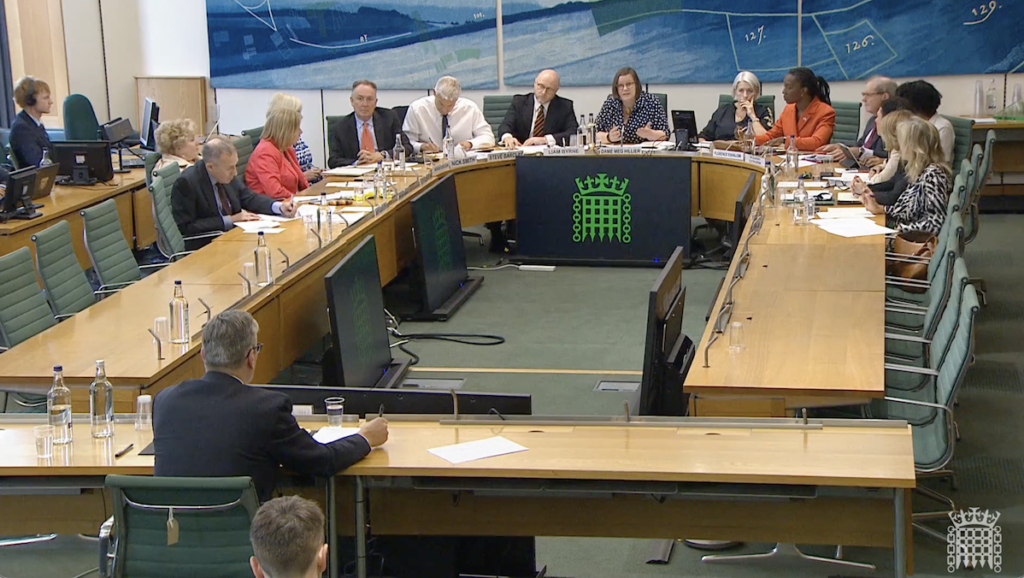
House of Commons select committees are cross-party groups of backbench MPs responsible for producing reports and acting collectively. Most commons select committees scrutinise the work of government departments and examine specific areas of public policy.
Committees conduct inquiries into topics of their choosing, gathering written and oral evidence from ministers, civil servants, experts and the public. At the end of an inquiry, they produce a detailed report with findings and recommendations for action. Crucially, the government is required to publish a formal response to these reports.
The influence and independence of select committees have grown significantly since 2010. This follows reforms that allow their chairs to be elected by a secret ballot of the whole House of Commons.
What is the purpose of select committees? How do they operate?
Scrutiny
The core function of most select committees is to examine the spending, administration and policy of a specific government department. For example, the House of Commons health and social care select committee scrutinises the work of the Department of Health and Social Care and its associated bodies, including the NHS.
Departmental select committees hold regular, dedicated sessions to scrutinise the work of government departments, specifically calling on the relevant secretary of state and permanent secretary (senior civil servant) to answer questions on the work of the department.
Conducting inquiries
Committees can choose their own subjects for inquiry. This can range from an examination of a piece of proposed legislation to an investigation into an area of perceived policy failure or a matter of public concern.
Select committees have the formal power to “send for persons, papers and records.” This means they can compel witnesses from within the UK to attend an evidence session and can require the production of documents. If a prospective witness or official disregards this request, the committee may report to the House, recommending that they have committed a “contempt”. But this reprimand does not come with any formal sanctions.
Erskine May, the authoritative account of parliamentary procedure, states: “The use of such a power is considered as a last resort… only where a witness has refused repeated invitations, and his or her evidence is vital to an inquiry in progress, is a formal summons contemplated.”
The government usually has within two months to reply to a committee’s report/recommendations. The government may seek the committee’s agreement for a longer deadline.
Commons committees have the power to appoint specialist advisers to assist with their inquiries. They may also travel or meet outside the parliamentary estate, including to gather evidence and as part of inquiries.
Pre-appointment hearings
Certain select committees have the power to hold pre-appointment hearings, allowing them to take evidence before candidates assume public office. Committee members question the candidate in public and publish a report outlining their suitability. However, such hearings and any recommendations are non-binding.
The current system of pre-appointment hearings was introduced in 2008 as part of a package of reforms spearheaded by Gordon Brown as prime minister.
Of the 258 hearings held between July 2007 and the end of the 2019-2024 parliament, there were eight occasions when the committee recommended against a government appointment. In five of these cases, the government went ahead with the appointment anyway.
Different types of select committees
Departmental select committees
A departmental select committee scrutinises each of the main government departments. Their membership reflects the political party balance of the House of Commons as a whole. Examples include the House of Commons Treasury select committee, the commons home affairs select committee and the defence Committee.
Non-departmental or ‘cross-cutting’ select committees
Other “cross-cutting” committees have a remit that spans across government and departments. They may focus on specific issues rather than a single policy portfolio. Some of the most prominent cross-cutting committees are the House of commons public accounts committee (PAC) and the public administration and constitutional affairs committee (PACAC).
The public accounts committee is the oldest and arguably one of the most powerful select committees in the House of Commons. Its primary function is to scrutinise the value for money of public spending, ensuring taxpayers’ money is spent wisely. First established in 1857, the committee does not examine the merits of government policy, only the cost and effectiveness of its implementation.
PACAC examines how the country is run, covering both the machinery of government and the UK’s constitutional rules. It is also the principal select committee to which Cabinet Office ministers are accountable.
Internal select committees
Some select committees are focused on the functioning of parliament rather than the direct scrutiny of ministers. These include the administration committee, the finance committee, the modernisation committee (chaired by the leader of the commons), the backbench business committee, and the standards and privileges committees.
The chair of the standards and privileges committees must be a member of the official opposition.
The liaison committee
The liaison committee holds a unique place in parliament’s committee structure. This so-called “committee of committees” or “super committee” is composed of the cross-party chairs of all the other commons select committees. It has a broad oversight role, but is best known for its questioning of the prime minister in sessions that take place two or three times a year.
A full list of active parliamentary committees, including select committees, can be found here.
Departmental select committees chairs:
- Business and trade: Liam Byrne (Labour)
- Energy security and net zero: Bill Esterson (Labour)
- Culture, media and sport: Dame Caroline Dinenage (Conservative)
- Defence: Tanmanjeet Singh Dhesi (Labour)
- Education: Helen Hayes (Labour)
- Environment, food and rural affairs: Alistair Carmichael (Liberal Democrat)
- Foreign affairs: Emily Thornberry (Labour)
- Health and social care: Layla Moran (Liberal Democrat)
- Home affairs: Dame Karen Bradley (Conservative)
- Housing, communities and local government: Florence Eshalomi (Labour)
- International development: Sarah Champion (Labour)
- Justice: Andy Slaughter (Labour)
- Northern Ireland affairs: Tonia Antoniazzi (Labour)
- Science, innovation and technology select committee: Chi Onwurah (Labour)
- Scottish affairs: Patricia Ferguson (Labour)
- Transport: Ruth Cadbury (Labour)
- Treasury: Dame Meg Hillier (Labour)
- Welsh affairs: Ruth Jones (Labour)
- Women and equalities: Sarah Owen (Labour)
- Work and pensions: Debbie Abrahams (Labour)
Non-departmental select committee chairs:
- Administration committee: Nick Smith (Labour)
- Environmental audit: Toby Perkins (Labour)
- Finance committee: Steve Barclay (Conservative)
- Modernisation committee: Alan Campbell (Labour)
- Procedure: Cat Smith (Labour)
- Public accounts (PAC): Sir Geoffrey Clifton-Brown (Conservative)
- Public administration and constitutional affairs (PACAC): Simon Hoare (Conservative)
- Statutory instruments (select committee): Sir Bernard Jenkin (Conservative)
- Statutory instruments (joint committee): Sir Bernard Jenkin (Conservative)
- Petitions: Jamie Stone (Liberal Democrat)
- Committee on standards: Alberto Costa (Conservative)
- Committee of privileges: Alberto Costa (Conservative)
- Backbench business: Bob Blackman (Conservative)
- Selection: Jessica Morden (Labour)
- Liaison: Dame Meg Hillier (Labour)
How select committees are formed
Following the Wright committee reforms of 2010, the process for selecting committee chairs and members was made significantly more democratic and independent from party leaders.
Election of chairs
At the start of a new parliament, the chairs of the departmental and some other select committees are elected by a secret ballot of the whole House of Commons.
Evaluation question
What impact has the move to secret ballots for electing select committee chairs had on the balance of power between the executive and backbenchers?
The number of chairs allocated to each political party is agreed beforehand, reflecting the party balance in the House. A motion is put to the House to allocate the chair of each committee to a specific party.
Those seeking election must secure the signatures of 15 MPs elected to the Commons as members of the same political party as the candidate (or 10% of the political party, whichever is lower).
The secret ballot takes place 14 days after the approval of the motion. The vote generally takes place in one of the committee rooms on the parliamentary estate along the committee corridor. MPs are given separate ballot papers for each committee.
Committee chairs are elected using the alternative vote (AV). So MPs must rank as many candidates as they wish in order of preference.
This election by the whole House gives the chairs a personal mandate, enhancing their independence from the party whips.
Election of committee members
The members of each committee (other than the chair) are elected from within their respective parliamentary parties. For example, the Labour members of the Treasury Committee are chosen by a ballot of all Labour MPs. This reduces the power of party leaders to place favoured MPs on committees.
A motion is then approved regarding a committee’s membership in the House.
The process for getting appointed to a select committee varies from party to party.
A departmental committee typically has around 11 members. Some are larger. The environmental audit committee and public accounts committee have 16 members.
The Wright committee reforms
The Wright committee, named after its chair (former MP Tony Wright), was appointed by the House of Commons on 20 July 2009. As part of its remit, it was asked to consider the appointment of members and chairmen of select committees.
The committee was created on the recommendation of Gordon Brown as prime minister. It followed the 2009 MPs’ expense scandal. These disclosures sparked a wave of public anger and precipitated significant public demand for wide-ranging political reforms.
The committee reported to the House on 4 November 2009 with 50 recommendations. Its report was officially titled: Report of the Reform of the House of Commons Committee, Rebuilding the House.
The Wright report argued that, “at a time when the House of Commons is going through a crisis of confidence not experienced in our lifetimes… largely, but not exclusively, because of the revelations about members’ expenses… both structural and cultural change” were required.
As a result, the backbench business committee was established shortly after the 2010 general election, giving backbench MPs some limited control over the parliamentary agenda.
Crucially, it also recommended the election of select committee chairs by the whole House of Commons.
The cross-party group stated: “The committee recommends that the chairs of departmental and similar select committees be directly elected by secret ballot of the House using the alternative vote.
“The distribution of individual chairs between parties should be agreed as now by the parties, on the basis of a proportionate division conveyed to them by the speaker, and put to the House for its agreement.
“Candidates for chairs would be required to have a minimum level of support from within their party as well as being free to demonstrate support from other members.”
In February 2026, the procedure committee recommended introducing reforms to regulate campaigning for select committee chair elections. The chair of the procedure committee, Labour MP Cat Smith, proposed reforms to prevent another “select committee chair silly season”, citing concerns among MPs about excessive canvassing and campaign literature.
The perceived need for such reforms underlines the importance MPs attach to securing election as a select committee chair. It may reflect the enhanced status and influence of committees within parliament, especially after the Wright reforms strengthened their independence and authority.
The prominence of select committees and their chairs
In recent years, a number of MPs have carved out prominent and relatively independent roles as select committee chairs – sometimes achieving a public profile that rivals frontbench figures.
For example, Yvette Cooper, as chair of the home affairs select committee (2016-2021), became a significant voice in scrutinising the then Conservative government. Meg Hillier, as a long-serving chair of the public accounts committee (2015-2024), developed significant expertise and a reputation for effective scrutiny of public spending and administration.
More recently, particularly following Keir Starmer’s appointment as prime minister, a number of select committee chairs have moved into ministerial office – reflecting the subject-matter expertise and departmental knowledge they acquired through scrutiny work. Examples include Darren Jones (former business and trade committee chair), Catherine McKinnell (former education committee chair), and Stephen Timms (former work and pensions committee chair).
Select committee chairships have also provided a platform for former frontbenchers, such as Emily Thornberry and Liam Byrne (who served as committee chairs after leaving a frontbench role).
Joint committees: collaboration between the commons and Lords
Joint committees are made up of MPs and peers (members of the House of Lords). There are permanent joint committees, including the joint committee on human rights and the joint committee on statutory instruments (JCSI), as well as temporary joint committees.
The joint human rights committee is responsible for examining matters relating to human rights within the United Kingdom, as well as scrutinising every government bill for its compatibility with human rights.
The JCSI checks whether a piece of secondary legislation (a statutory instrument) is legally sound. It examines if the SI complies with the powers given in its parent act (a piece of primary legislation) and if its drafting is clear. It may make recommendations regarding an SI if it identifies an issue.
Temporary joint committees are appointed for specific purposes. They may examine draft proposals for bills on subjects, ranging from modern slavery to stem cell research.
Joint committees appoint a single chair who may be a member of the commons or Lords.
Certain types of legislation are scrutinised in joint committees, such as consolidation bills. The joint committee of consolidation bills exists for this purpose. It considers bills which bring together a number of existing acts of parliament on the same subject into one act without amending the law.
What is a public bill committee? What’s the difference?
A public bill committee is a temporary committee of MPs set up by the House of Commons to scrutinise the text of a specific bill after it has passed its second reading. During the bill’s “committee stage”, the cross-party group examines the proposed legislation line by line and clause by clause, taking evidence from experts and stakeholders, while considering proposed amendments.
This stage is a crucial part of the legislative process. It represents the most detailed scrutiny a bill will receive in the House of Commons.
Raab faces select committee grilling over Afghanistan withdrawal (2021)
On 1 September 2021, the foreign secretary, Dominic Raab, appeared before the foreign affairs select committee to account for the government’s handling of the withdrawal from Afghanistan. The hearing marked Raab’s first appearance before MPs following the fall of Kabul to the Taliban on 15 August, and the subsequent chaotic evacuation of British nationals and newly vulnerable Afghans. The UK’s ‘Operation Pitting’ evacuation mission ended just days earlier on 28 August.
The cross-party committee, chaired by the Conservative MP Tom Tugendhat, pressed Raab on why the UK had been caught by surprise by the collapse of the Afghan government.
Tugendhat described the role played by the UK in the Afghanistan crisis as the “biggest foreign policy failure since Suez”.
Raab’s central defence was that the government’s intelligence assessments indicated that Kabul was “unlikely” to fall at the time. “The central assessment remained until late that the deterioration would be incremental”, he added.
Responding directly to Tugendhat’s characterisation of the crisis, Raab said: “I am afraid I struggle with the Suez analogy but I understand what you are really searching for is to learn the lessons and even more generally find a path forward for Afghanistan.”
Conservative MP Bob Seely asked Raab why the evacuation had gone “so badly wrong”.
The foreign secretary blamed “optimism bias”.
He said: “I think there is a whole range of assumptions. One, there was an optimism bias about what the US might or might not do.”
Across the two-hour evidence session, Raab also faced criticism over his personal conduct. The foreign secretary was on holiday in Crete as the Taliban were advancing across Afghanistan. Throughout the crisis and its aftermath, he was roundly criticised for staying there until after Kabul fell, returning at 1:40 am on 16 August.
Labour MP Chris Bryant asked whether Raab was already on the Greek island on 11 August when the US was warning the group was likely to take power.
The foreign secretary insisted that he would not answer such a question, labelling it a “fishing expedition”.
Stewart McDonald, a Scottish National Party (SNP) MP, doubled down on this line of questioning. He asked repeatedly when he left the UK to go on holiday to a luxury hotel in Crete. The foreign secretary dismissed McDonald’s questioning, describing it as “pretty partisan” and a “political attack”.
He insisted he was contactable “at all material times”.
Bryant also questioned Raab over how he could have challenged his department in the lead up to the crisis, particularly with regard to the intelligence he was receiving. The foreign secretary countered that no one in the Foreign Office “thinks I do not challenge official advice rigorously – I do. If anything, I get accused of being over-inquisitorial.”
Under concreted questioning, Raab was unable to say how many Afghans who aided Britain’s efforts in Afghanistan – individuals who were therefore vulnerable under Taliban rule – had been left behind when the final UK troops were evacuated.
Raab said he could not produce a “definitive figure”.
But, under question from Labour MP Neil Coyle, he admitted that some of those left behind included Afghans who worked as guards at the British embassy in Kabul.
The Afghanistan withdrawal was deeply damaging to the foreign secretary. Two weeks later, on 15 September 2021, Boris Johnson demoted Raab to the role of justice secretary. In the surrounding cabinet reshuffle, Raab was also made deputy prime minister – an appointment that cushioned his fall from the Foreign Office.
A subsequent report by the foreign affairs committee described the UK government’s leadership during the Afghanistan withdrawal as “missing in action”.
Rupert Murdoch hit by foam pie in committee hearing (2011)
On 19 July 2011, media mogul Rupert Murdoch was hit by a shaving foam ‘pie’ while giving evidence to a commons select committee hearing on the phone-hacking scandal at his company, News Corporation.
Murdoch, alongside his son James, had been facing intense questioning from a joint session of the culture, media and sport committee and the home affairs committee over allegations of phone hacking at the now-defunct News of the World. The hearing was described by the media mogul, 80, as the “most humble day of my life”.
During the evidence session, Rupert Murdoch insisted that the News of the World was “just 1%” of his global business, and that he was not ultimately responsible for what happened at the tabloid.
James Murdoch, the chief executive of News Corporation, apologised to victims of phone hacking and their families. “These actions do not live up to the standards our company aspires to”, he said. “It is our determination both to put things right, make sure these things don’t happen again, and to be the company that I know that we have always aspired to be.”
Rupert Murdoch was given the hardest time by Tom Watson. The Labour MP asked Murdoch whether he had been “misled” by senior employees. “Clearly”, he responded.
Watson stated that former News International chief executive Rebekah Brooks had admitted in 2003 that police were paid for information. “I am now aware of that, I was not aware at the time”, Murdoch said. “I’m also aware that she amended that considerably very quickly afterwards.”
Watson said: “I think she amended it seven or eight years afterwards but did you or anyone else in your organisation investigate it at the time?”
Murdoch replied: “No. I didn’t know of it.”
He added: “The News of the World is less than 1% of our company. I employ 53,000 people around the world who are proud and great and ethical and distinguished people, professionals in their work. Perhaps I am spread watching and appointing people whom I trust to run those divisions.”
Murdoch denied ever imposing preconditions on political leaders for newspaper support.
Towards the end of the session, Jonathan May-Bowles, a comedian and activist known as Jonnie Marbles, approached the witness table and threw the foam pie towards Rupert Murdoch.
Mere seconds after the pie was thrown, Murdoch’s wife, Wendi Deng – who was seated directly behind him – lunged forward and over the ensuing huddle. She successfully struck May-Bowles before he could be apprehended by police. Deng then picked up the discarded ‘pie’ and hurled it at the original assailant.
The committee hearing was subsequently suspended for 10 minutes while order was restored and the foam cleaned up. Deng attended to her husband’s foam-flecked face.
At the end of the questioning, Watson told Murdoch: “Your wife has a very good left hook.”
Blair defeated in commons over committee ‘control freakery’ (2001)
On 16 July 2001, Tony Blair’s government suffered a significant defeat in the House of Commons, as scores of its own backbenchers joined forces with opposition parties to reject attempts to remove two independently-minded select committee chairs.
The Labour government was re-elected with a 167-seat majority at the 2001 general election in a second successive landslide. In the wake of this victory, Downing Street moved to install its preferred candidates as chairs of key select committees – using the traditional system where committee membership was determined by the party whips.
The government’s proposed slate notably excluded Gwyneth Dunwoody and Donald Anderson, the formidable chairs of the transport committee and foreign affairs committee in the 1997-2001 parliament.
The move, widely interpreted as an attempt to oust parliamentarians known for their robust scrutiny in favour of more compliant figures, sparked anger across the House. A substantial Labour rebellion followed. A total of 308 MPs voted against Dunwoody’s exclusion, with 221 in favour. Anderson’s exclusion was outvoted by 301 to 232.
More than 100 Labour MPs are said to have rebelled in the face of Blair’s perceived “control freakery”.
It was a deeply embarrassing outcome for the government, which was forced to accept the reappointment of Dunwoody and Anderson. The government’s critics celebrated the result as a victory for parliamentary scrutiny in the face of a significant majority – and a defeat for executive overreach.
The furore even led to the intervention of Baroness Boothroyd, commons speaker from 1992 to 2000, who urged MPs to reassert their independence by reinstating the independent-minded chairmen.
Baroness Boothroyd stated: “It seems that the government is manipulating parliament. Select committees are not an arm of government. They are a mechanism of parliament to scrutinise government…
“It is outrageous that the government cannot stand the heat of a bit of criticism. This is what their jobs should be about – to speak out when there is a need to speak out.”
The episode fuelled the growing movement for reform of how committee chairs and members were selected – a sentiment that eventually led to the implementation of the Wright committee reforms.
Keir Starmer’s welfare debacle: the influence of select committee chairs (2025)
On 1 July 2025, Keir Starmer as prime minister was forced into a dramatic climbdown over his government’s flagship welfare reform bill, just 90 minutes before voting began in the House of Commons. The controversy centred on the government’s proposals to reform eligibility for personal independence payments (Pip) and universal credit (UC).
In the days leading up to the vote, a rebel ‘reasoned amendment’ to the Universal Credit and Personal Independence Payment Bill secured over 120 signatures from Labour MPs. Had the amendment been put to a vote and passed, it would have rejected the bill outright.
The reasoned amendment was tabled in the name of Meg Hillier, the influential and longstanding chair of the public accounts committee. She was supported by several other Labour select committee chairs, including Debbie Abrahams as chair of the work and pensions select committee.
The amendment was signed by at least 11 serving select committee chairs. Helen Hayes (education), Sarah Owen (women and equalities), Florence Eshalomi (housing, communities and local government), Paulette Hamilton (health and social care), Tan Dhesi (defence), Cat Smith (procedure committee), Ruth Cadbury (transport), Patricia Ferguson (Scottish affairs), and Ruth Jones (Welsh affairs) were among the signatories.
The seniority of such figures signalled that the rebellion extended well into the mainstream of the parliamentary party.
Starmer initially described the burgeoning rebellion as “noises off” – a comment that saw his political judgement placed under renewed scrutiny.
Days of negotiations with the rebel group, led by Hillier and Abrahams, resulted in a significant concession. On 26 June, it was announced that no existing Pip claimants of the payment would be subject to new, stricter eligibility rules. The government also reversed some of the planned universal credit cuts.
The partial U-turn appeased some of the bill’s critics. But it was not enough to suppress the rebellion.
As a result, just 90 minutes before MPs were due to vote, work and pensions minister Stephen Timms told the commons that changes to restrict Pip would be delayed until after his review of the disability benefit. Originally, the Pip changes were due to come in from November 2026.
A total of 49 Labour MPs voted against the bill’s second reading – a still sizable rebellion given the scale of concessions made. The vote, and the tumultuous 24 hours that preceded it, represented a serious dent in the prime minister’s authority.
Amber Rudd resigns after committee hearing (2018)
On 29 April 2018, Amber Rudd resigned as home secretary, admitting that she had “inadvertently misled” the home affairs select committee over the existence of targets for the removal of illegal immigrants.
Her departure came at the height of the Windrush scandal, which had revealed that hundreds of Commonwealth citizens, who had a legal right to live in the UK, had been wrongly detained, denied legal rights, and in some cases deported.
Rudd had initially denied the existence of removal targets in an appearance before the select committee, telling its chair and Labour MP Yvette Cooper on 25 April “that’s not how we operate”.
But a December 2015 inspection report was soon leaked, which referred to immigrant removal targets. Rudd responded by appearing before parliament to correct the record, to say that “local” targets did exist.
The Guardian subsequently reported a six-page leaked memo prepared for Rudd and other senior ministers which said the Home Office had set “a target of achieving 12,800 enforced returns in 2017-18”. The home secretary said she had not seen the memo.
Then a further Guardian story, published on 29 April, detailed a letter in which Rudd spoke to an “ambitious but deliverable” aim to deport 10% more illegal immigrants over the “next few years”, addressed to Theresa May as prime minister. The revelations appeared to be at odds with Rudd’s denials that she was aware of deportation targets, precipitating her resignation.
In her letter of resignation to May, Rudd said she had “become aware of information provided to my office which makes mention of targets. I should have been aware of this, and I take full responsibility that I was not.”
She added: “Since appearing before the select committee, I have reviewed the advice I was given on this issue and become aware of information provided to my office which makes mention of targets.”
Additional resources
The UK Parliament website provides detailed information on all House of Commons Select Committees, including their membership, current inquiries, and published reports.
- UK Parliament – Committees: https://committees.parliament.uk/
- UK Parliament – Watch Committees: https://www.parliament.uk/visiting/visiting-and-tours/watch-committees-and-debates/committees/
- House of Commons Library – Select committees: election of chairs and members https://commonslibrary.parliament.uk/research-briefings/cbp-7176/
- House of Commons Library – Chairs of Commons select committees since 2010 https://commonslibrary.parliament.uk/research-briefings/sn04400/

