A point of order is a formal appeal to the speaker of the House of Commons from an MP who believes that the rules, procedures or conventions of the House have been breached.
It is a key mechanism to ensure that the established rules of debate and conduct are being followed correctly.
A genuine point of order draws attention to a breach of parliamentary procedure that requires a ruling from the speaker. Most points of order raised by MPs do not meet this standard.
Crucially, a point of order should not be used to make political arguments, to prolong debate, or simply to comment on another member’s speech. The speaker will cut short and/or dismiss any intervention that is not considered to be a genuine question about parliamentary procedure.
Points of order are regularly used by MPs to register a protest and possibly generate media coverage for a political concern or point of debate.
How an MP raises a point of order
An MP raises a point of order by standing and declaring “point of order.” The speaker then has the discretion to hear the member’s question.
An MP may give the speaker’s office advance notice of their intention to raise a point of order. This is typically done for more substantial points of order, which are usually taken after oral questions and ministerial statements or urgent questions have concluded.
When making their intervention, an MP begins by saying, “On a point of order, Mr Speaker…”.
The MP must then explain which rule or practice they believe has been breached, framing their intervention as a direct question to the speaker.
Erskine May, the crucial guide to parliamentary practice, maintains that it is the right of any member who thinks that a breach has occurred “to rise in their place, interrupting any member who may be speaking, and direct the attention of the chair to the matter.”
It adds: “A member speaking to order must simply direct attention to the point complained of, and submit it to the decision of the speaker. If the speaker is of the opinion that the words or conduct complained of are disorderly, the member will be called upon to conform to the rules of the House.”
The role of the speaker
The speaker has absolute authority in dealing with points of order raised by MPs. They can summarily dismiss an MP’s contribution if they detect a spurious point or a repetition of a previous contribution.
Where an MP has given the speaker advance notice of their intention to raise a point of order, the chair may issue a longer statement setting out their ruling or position. The speaker will typically thank the MP for the notice, which allows time to seek advice or consult the relevant rules.
An impromptu point of order, usually raised during a debate, still requires an immediate response from the chair.
The speaker may rule that a breach has occurred and state what action should be taken. Alternatively, they may rule that the issue is a matter of political debate, not procedure, or that no breach has taken place. The speaker’s ruling is final and cannot be challenged or debated further.
The speaker can continue to take points of order for as long as they please, although they tend to deny repeated requests for a ruling on a single issue.
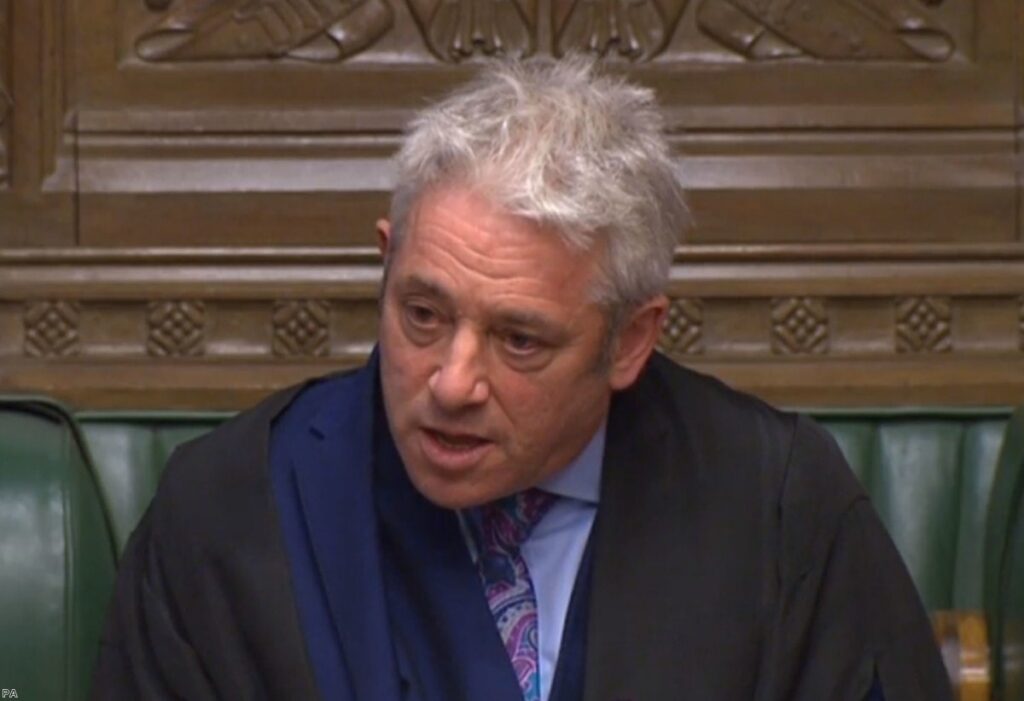
MPs have at times used points of order as a means of holding the speaker to account. This tactic was employed frequently by Conservative MPs who objected to rulings made by John Bercow during his speakership, and between the years 2017 and 2019 especially.
On 9 January 2019, Bercow answered points of order for a total of one hour and seven minutes.
This points of order “spiral” related to his controversial ruling allowing an amendment from Tory rebel Dominic Grieve to a business motion. The speaker’s unprecedented decision to allow an amendment to a motion that was to be put “forthwith” – believed to mean without debate or amendment – was met with vehement opposition from Tory MPs.
Spurious points of order
While points of order must be framed in procedural terms, they are often used tactically by MPs to draw attention to a particular issue.
Erskine May states: “The speaker has deprecated the practice of members raising points of order on political issues which have nothing to do with the chair, and has expressed the hope that points of order will not be used as an extension of question time.”
The following is a typical response by the speaker to a spurious point of order: “Order. We both know that that is not a point of order… it is a continuation of questions that finished quite a long time ago.
“You have made the point that you were not able to get the question in, and we will leave it at that. I am not opening up that debate at this stage.”
In December 2025, on a point of order, Labour MP John Slinger asked the deputy speaker, Nus Ghani, if she could confirm “whether any points of order raised by members of this House since this parliamentary session began have actually been deemed to be points of order.”
The deputy speaker responded: “I am grateful to the honourable member for giving notice of his point of order on points of order. I can say that his point of order was most definitely not a point of order.
“For clarity, and for the benefit of the honourable member, a point of order should in principle draw the chair’s attention to a possible breach of the House’s rules of order, which his point of order failed to do.
“I would not like to speculate on how many points of order actually have served this purpose – I am sure many now will – but the honourable member raises an interesting question. Hansard can point out how many points of orders have been raised that, like his, were obviously not points of order.”
Common reasons for raising a point of order
- To object to the perceived use of unparliamentary language
- To complain when a government department has failed to answer a written parliamentary question within the required timeframe
- To seek clarification on the schedule of business or the procedure for an upcoming vote
- To seek to correct the record
- To deliver a personal apology
- To urge the speaker to ask another member to correct the record
- To object to the conduct of a parliamentarian
- To contribute to a debate, if the MP on their feet has refused to give way
The speaker would dismiss several of these issues on the grounds that they are matters of debate.
Points of order spiral (March 2019): Bercow rules out third ‘meaningful vote’ on same Brexit deal
The period of protracted parliamentary deadlock over Brexit saw points of order and the speaker’s interpretation of procedure become central to the political process.
One especially significant intervention came on 18 March 2019, when the then-speaker, John Bercow, made a landmark ruling on the “same question” convention.
The ruling came after prime minister Theresa May’s Brexit deal had already been defeated twice by historic margins. Nevertheless, the government was reportedly intending to bring it back for a third vote.
In a shock move, Bercow ruled that this would not be permitted. Citing a convention from 1604, he announced that a motion that was “substantially the same” as one already defeated could not be brought forward again in the same session.
He said: “One of the reasons why the rule has lasted so long is that it is a necessary rule to ensure the sensible use of the House’s time and proper respect for the decisions that it takes. Decisions of the House matter. They have weight…
“It has been strongly rumoured, although I have not received confirmation of this, that a third, and even possibly a fourth, meaningful vote motion will be attempted. Hence this statement, which is designed to signal what would be orderly and what would not.”
The speaker’s ruling was immediately challenged through a succession of Points of Order from Conservative MPs. The points of order spiral effectively turned into a question-and-answer session between backbenchers and the chair.
Conservative MP Neil O’Brien questioned why Bercow was “rigidly sticking with precedents from 1604” and urged him to be a “modern speaker for modern times”.
Robert Halfon questioned whether the ruling also applied to calls for a second referendum which he said had been “rejected by the House of Commons in a vote last week”.
Bercow used his responses to defend his decision.
Further points of order were raised by MPs who supported the speaker’s ruling.
Labour MP Angela Eagle argued that the rules Bercow cited existed to “stop the bullying of the legislature by the executive”.
On a point of order, the leader of the House, Andrea Leadsom, suggested that she had lost confidence in the speaker. She said that she “would not be confident” that a speaker’s council under his chairmanship would treat colleagues with “courtesy and respect.”
The contribution came after Liberal Democrat MP Ed Davey, via a point of order, suggested that a speaker’s conference could be use to “bring together all parties in the House under your chairmanship to try to find a way forward”.
Responding to Leadsom, Bercow said: “Well, so be it. I treat the House with respect. I have treated its members with respect. I chaired a previous speaker’s conference, and there was no criticism of the way in which I did so.”
Additional resources
- MPs’ Guide to Procedure – Points of order: https://guidetoprocedure.parliament.uk/articles/f1OqrfIi/points-of-order

