The House of Lords includes up to 26 Church of England bishops. The United Kingdom is the only Western democracy to grant religious representatives an automatic place in its legislature.
Known as the lords spiritual, their presence is a contested feature of the UK’s constitutional settlement. Proponents of the practice say the bishops bring a moral and ethical perspective to political debates.
Public opinion on the issue is clear. A YouGov poll from October 2024 found that 52% of the British public believe bishops should not have an automatic right to sit in the House of Lords, with just 22% supporting the current arrangement.
Who are the lords spiritual and what do they do?
The 26 places for the lords spiritual are allocated by seniority. Five seats are reserved for the Archbishops of Canterbury and York, and the Bishops of London, Durham, and Winchester. The remaining 21 seats are taken by the longest-serving and most senior diocesan bishops of the Church of England.
The bishops are organised in the House by a convenor, a role somewhat analogous to a party’s chief whip, who coordinates their contributions to parliamentary business. The Archbishop of Canterbury appoints the convenor and the position changes when the incumbent convenor retires.
They are not the same as the independent crossbenchers. Just like a party political group in the House of Commons, the lords spiritual sit in their own defined position, as one block to the right of the throne.
The bishops also carry out their parliamentary work alongside their existing diocesan responsibilities, so they do not attend the House full time.
Bishops retire from the House of Lords at the age of 70.
The Lords Spiritual (Women) Act 2015 gives female bishops priority in appointments to the House of Lords. When a vacancy arises, any eligible woman must be appointed; if multiple women are eligible, the position is filled according to length of service.
The legislation was initially set to remain in force until 2025. The Lords Spiritual (Women) Act 2015 (Extension) Act, which received royal assent in January 2025, means the original legislation will remain in force until 2030.
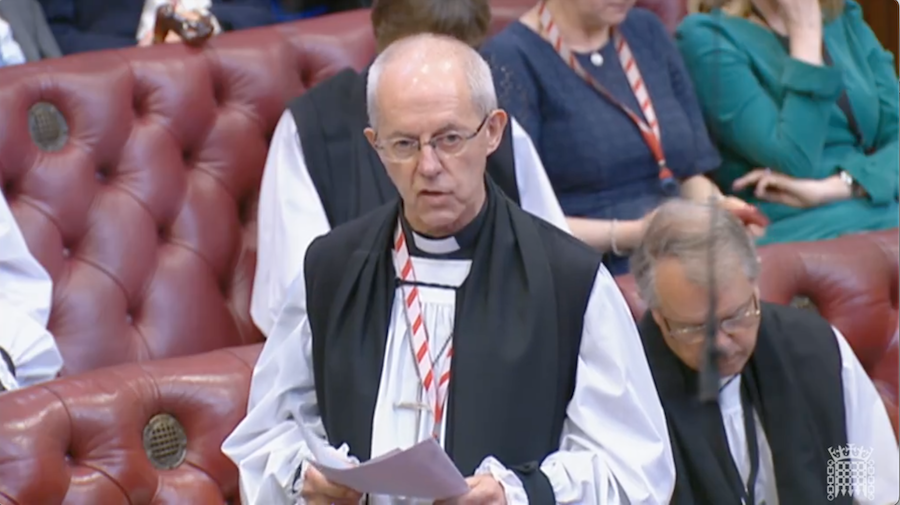
Bishops get some unique privileges as a member of the House of Lords. If a bishop stands up to speak during a debate, it is convention for other peers in attendance to resume their seats and listen. The lords spiritual also wear distinct clerical attire, traditionally consisting of a rochet and chimere, when present in the upper chamber.
One of the specific duties of the lords spiritual is to lead prayers at the start of each parliamentary day.
Otherwise, the bishops perform the same role as other peers; they scrutinise legislation, participate in debates and vote on new laws. In the 2022-23 session, the lords spiritual asked 782 written questions and 204 oral questions. A total of 10,809 written questions and 7,641 oral questions were asked in the upper chamber over this same period.
Like other peers, the lords spiritual have the right to introduce their own private members’ bills (PMBs). The Lord Bishop of St Albans introduced the Coroners (Determination of Suicide) Bill, which received its first reading in the upper chamber on 6 June 2021.
The Public Worship Regulation Act 1874 was first introduced as a private member’s bill by the then Archbishop of Canterbury, Archibald Campbell Tait. The legislation, supported by Conservative prime minister Benjamin Disraeli, was designed to suppress the growth of ritualism in the Church of England.
The case for retaining the bishops
A moral and ethical perspective
Proponents of the lords spiritual argue that they provide an ethical perspective in parliamentary discussions. It is argued that their experience as community leaders across every region of England gives them a unique, non-partisan insight.
Representing faith in society
While they represent the established church, proponents of the lords spiritual argue that they also perform a wider role in representing faith in a broader sense. The House of Lords draws on a wide variety of expertise and experience; the lords spiritual arguably represent a logical extension of this principle, providing insight from the perspective of the churches and faiths of the United Kingdom.
Historical tradition
The presence of bishops in parliament dates back to the 14th century. Supporters would suggest that their presence therefore represents a long historical tradition and an important part of the UK’s constitutional settlement, which does not maintain a strict separation between church and state. It is also suggested that the lords spiritual provide an institutional expression of the christian heritage and history of the United Kingdom.
The case against the lords spiritual
An anachronism
The principal argument against the lords spiritual is that granting privileged access to one denomination is indefensible in a multi-faith and increasingly secular country. Critics point to the fact that only one other sovereign state, Iran, provides reserved seats for religious clerics in its legislature.
The 2021 census for England and Wales showed for the first time that less than half the population (46.2%) identified as Christian, a 13.1 point decrease from 59.3% in 2011. The number of people reporting “no religion” rose to 37.2% from 25.2%.
Evaluation question
If less than half the population of England and Wales now identifies as Christian, to what extent can the privileged legislative status of one Christian denomination still be justified?
A YouGov poll in November 2024, conducted on behalf of Humanists UK, found that only 22% of respondents wanted to keep bishops in the House of Lords, while 52% wanted their removal.
Undemocratic and unaccountable
Criticism of the lords spiritual aligns with broader arguments in favour of reform of the upper chamber. As with all members of the House of Lords, the bishops are unelected and are not accountable to the public at the ballot box.
Religious exclusivity
Opponents question why the Church of England should be privileged over other major faiths in the UK, such as Roman Catholicism, Islam, Hinduism, or Judaism – none of which have automatic representation. It is argued that this undermines the principle of religious equality.
Representation of other religious figures in the House of Lords
Beyond the lords spiritual, numerous Christian clergy from various denominations have been appointed as lords temporal (officially the secular members of the upper chamber). This includes Anglican priests, Church of Scotland ministers, and Methodist leaders.
Roman Catholic clergy, however, have not served since the Reformation; although several Cardinals were reportedly offered peerages, they declined due to Canon Law restrictions that prohibit ordained ministers from exercising civil power in secular governments.
Jewish rabbis have also been appointed to the House of Lords. Notable figures such as chief rabbis Lord Jakobovits and Lord Sacks, as well as Reform rabbi Baroness Neuberger, have been elevated to the peerage.
Evaluation question
To what extent does the appointment of other religious figures as life peers adequately address the lack of diversity? Placement after “…elevated to the peerage.”
History of the bishops in parliament
The presence of bishops in parliament dates back to the very origins of the English parliamentary system in the 11th century.
In the 14th century, when the two distinct houses of parliament emerged, the upper chamber was composed of religious leaders (lords spiritual) and magnates (lords temporal). The lords spiritual initially outnumbered the lords temporal.
Only after the dissolution of the monasteries between 1536 and 1540 under Henry VIII did the secular lords temporal form a majority in the upper chamber.
The bishops were then briefly removed from parliament in 1642 as a consequence of the Clergy Act 1640 (or Bishop Exclusion Act) passed by the Long Parliament. Prior to the act, bishops of the Church of England accounted for 22 of a total membership of between 60 and 70 peers.
Following the Restoration, the bishops returned to the upper chamber under the 1661 Clergy Act, which “repealed, annulled and made void to all intents and purposes” the civil war-era legislation.
In the 1830s, a series of bills introduced in the House of Commons to exclude the Bishops were defeated.
In 1847, the number of Bishops in the House of Lords was cut to 26 as a consequence of the Ecclesiastical Commissioners Act (or the Bishopric of Manchester Act). This remains the last time that the constitutional position of the bishops was altered.
In 1968, Harold Wilson’s Labour government attempted to limit the number of bishops in the upper chamber to 16 under the Parliament (No. 2) Bill. Wilson announced his intention to abandon the proposed reforms in April 1969.
The House of Lords (Reform) Bill, introduced by Labour MP Kenneth Lomas in February 1979, proposed to reduce the number of bishops to 10.
In 1985, Conservative MP Richard Holt attempted to reduce the number of Church of England bishops from 26 to 14. Under the Amendment of the Constitution of the House of Lords (Bishops) Bill, Holt also planned to introduce nine seats for the representatives of other faith groups.
The bishops remained unscathed by the House of Lords Act 1999, which reduced the number of hereditary peers to 92.
The House of Lords Reform Bill in 2012, proposed by the Conservative-Liberal Democrat coalition government, sought to reduce the number of bishops in the House of Lords from 26 to 12.
Gavin Williamson vs the lords spiritual
In late 2024, during the committee stage of the House of Lords (Hereditary Peers) Bill, Conservative MP Gavin Williamson tabled an amendment that sought to abolish the lords spiritual.
Speaking during the bill’s committee stage, Williamson characterised the presence of bishops in the upper chamber as “fundamentally unfair”. He argued that it was wrong that a “bloc of clerics… have a right and a say over our legislation – over the way that my constituents live.”
Williamson, who identified himself as an Anglican, questioned why members of his own church should enjoy greater representation than adherents of other denominations
He also dismissed arguments based on historical precedent, remarking: “I am often told, ‘The bishops have been there since the Reformation.’ Well, lots of things were happening around the Reformation that I am not that keen to see happening today.”
He further noted that the 26 bishops sitting in the Lords were drawn solely from England, adding: “The composition of those bishops is probably not reflective of today’s world.”
Williamson acknowledged the right of bishops to contribute to public debate, but he said this should occur “from the pulpit, not in parliament”
He added: “Less than 2% of the British population attend Anglican services on a Sunday. By taking this action to remove the bishops, we recognise that Britain is a changed country.”
Conservative MP Andrew Murrison, who also identified himself as an Anglican, said that while he valued the views of bishops, it was not right to “have them being politicians in dog collars generally propagating a left liberal world view.”
Murrison added: “I would much rather that they were in their dioceses engaged in the cure of souls.”
Conservative MP John Hayes rose to the defence of the bishops, and treated Williamson to a “short lecture on the character of conservatism”.
Hayes told MPs: “[Williamson] needs to understand that the collective wisdom of ages, vested in great institutions like the monarchy – which, by the way, is hereditary – the church, this parliament and the small institutions that Burke called the ‘little platoons’, transmitted in age-old form is always more important than the fads and fashions of any one generation at any point in time.
“If he understood that, he would understand why he is a Conservative.”
Cabinet Office minister Ellie Reeves spoke in opposition to Williamson’s amendment, arguing it would alter a “focused bill that delivers on a manifesto commitment to bring about immediate reform.”
Williamson’s amendment was ultimately defeated by 378 votes to 41.
Lords spiritual and the assisted dying debate
The lords spiritual have acted as a united bloc in opposing assisted dying legislation.
During the passage of the Assisted Dying Bill, a private member’s bill introduced by Baroness Meacher in 2021, the lords spiritual voiced their vehement opposition.
The then Archbishop of Canterbury, Justin Welby, led the response but spoke of the “unanimity” of the Lords Spiritual in opposition to the proposed legislation. He argued that the bill was “unsafe”, adding: “No amount of safeguards can perfect the human heart.”
Welby added: “All of us here are united in wanting compassion and dignity for those coming to the end of their lives. But it does not serve compassion if by granting the wishes of one closest to me, I expose others to danger.”
The Lord Bishop of Durham maintained that the “scope for abuse and pressure for people to end their lives is significant” and spoke of the bill’s “cultural implications”.
He told the House: “Who are we to put a value on human life or determine that, in some instances, the person is not worth the cost? Let us not abandon the imperative principle that is innate to us of valuing every human life and protecting and caring for the vulnerable.”
The Lord Bishop of Carlisle referred to the “profound opposition” of his fellow prelates. He argued that the opposition of the lords spiritual was rooted in “theological” arguments as well as their “pastoral experience… in hospitals and hospices”.
The Lord Bishop of Chichester stated: “God does not inflict evil on people… The sanctity of life is central to Christian faith.”
Baroness Meacher’s bill ultimately did not progress beyond its second reading in the House of Lords.
The lords spiritual restated their opposition to assisted dying during the debates over the Terminally Ill Adults (End of Life) Bill, introduced by Labour MP Kim Leadbeater in the commons.
Speaking during the bill’s second reading debate in September 2025, the Lord Bishop of London argued that, if passed, the bill would “signal that we are a society that believes that some lives are not worth living.”
The Lord Bishop of Newcastle declared: “Proponents of the bill say that it is about choice, yet I cannot see how this is true when it is both unsafe and unworkable in its current form.”
Justin Welby vs Suella Braverman
On 10 May 2023, Justin Welby expressed his opposition to the Illegal Migration Bill, the Conservative government’s flagship bill to prevent anyone arriving in the UK via irregular routes.
Welby’s contribution came after the home secretary, Suella Braverman, and the justice secretary, Alex Chalk, wrote an article for the Times, urging peers not to deny the “will of the people”.
The archbishop of Canterbury nevertheless described the bill as “morally unacceptable and politically impractical”. Welby argued that the proposed legislation risked “great damage to the UK’s interests and reputation”.
He added: “Our interests as a nation are closely linked to our reputation for justice and the rule of law, and to our measured language, calm decision and careful legislation. None of those is seen here.”
In a subsequent speech to the National Conservatism Conference on 15 May, Braverman criticised the “experts and elites” who opposed the Illegal Migration Bill.
Braverman said opponents of the bill held “luxury beliefs” and promoted “seductive but irresponsible ideas, safe in the knowledge that their privilege will insulate them from any collateral damage.”
The Illegal Migration Bill was subjected to a record 20 defeats during its report stage in the House of Lords over hostile amendments. Welby proposed an amendment which called on the government to draw up a 10-year strategy to work with other countries to tackle the refugee crisis. Welby’s fellow peers voted to back the amendment, but it was rejected by ministers.
Evaluation question
Does the Archbishop of Canterbury’s public opposition to a flagship government policy from their parliamentary platform represent a legitimate exercise of spiritual leadership, or a departure from its traditional boundaries?
The Illegal Migration Act received royal assent on 20 July 2023.
A report in the House magazine, published in September 2023, said Braverman had turned down multiple invitations to meet Welby over his concerns about her approach to immigration.
A spokesperson for Lambeth Palace told the magazine: “The archbishop would be happy to meet the home secretary to discuss issues of mutual interest and concern. In the past the archbishop has met other home secretaries. It is not unusual.”
Quotes
“I am looking forward to serving Parliament and my fellow Lords Spiritual in this role. I have greatly enjoyed the past five years as a bishop in the Lords, working on a variety of issues and areas of importance for our common life, speaking up for those on the margins and informed by the people and communities of Manchester. In the Lords I hope to continue with Bishop Alan’s work in encouraging and mentoring new arrivals to the Bench, as well as being a voice for us among the different parties and groupings in the House. There are many challenges facing us as a country and I believe that bishops have a vital role to play in working for the common good, as well as fulfilling our spiritual and constitutional role in Parliament.” – Bishop of Manchester David Walker, commenting after his appointment as convenor of the Lords Spiritual (April 2025).
“The automatic presence of the bishops in the House of Lords is not just a harmless legacy of a medieval constitution but a present example of discrimination, religious privilege, and undemocratic politics. We campaign for a secular state with inclusive, shared public institutions so that everyone is treated equally, regardless of religion or belief. As a result, we campaign to see the bishops no longer have an automatic right to seats. If religious representatives wish to be in the House of Lords they should seek to gain representation through the same channels as everyone else. In whatever future package of Lords reform comes before Parliament, we are determined to see these so-called Lords Spiritual removed.” – position adopted by Humanists UK.