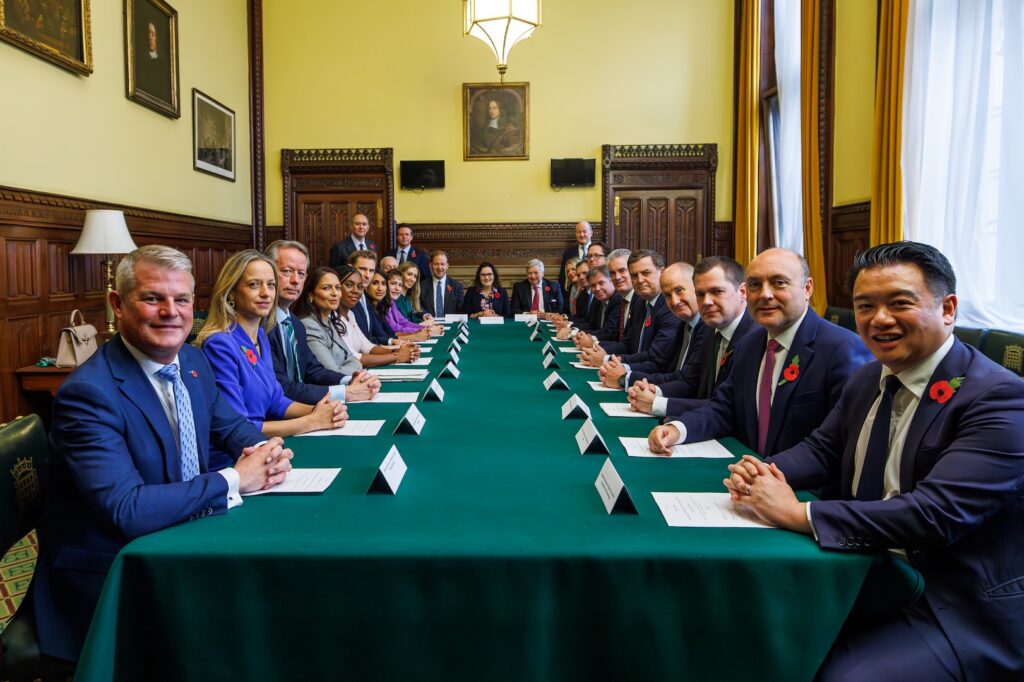
The shadow cabinet is the team of senior spokespeople chosen by the leader of the official opposition to mirror the government’s actual cabinet.
The shadow cabinet is composed of MPs and peers from the largest political party that is not in government. Each member is assigned a portfolio that “shadows” a specific government department and its secretary of state.
The shadow cabinet’s primary role is to scrutinise the work of the government and to hold it to account. It also serves as a “government-in-waiting” responsible for developing alternative policies and presenting itself to the public as a credible alternative to the incumbent government.
The term “shadow cabinet” reportedly first appeared in the press in 1910. It is now a staple of Britain’s unwritten constitution.
Following the 2024 general election, the official opposition is the Conservative Party. Kemi Badenoch is the leader of the opposition.
What is the composition of the shadow cabinet?
Kemi Badenoch appointed her shadow cabinet on 5 November 2024 following her election as Conservative leader. She conducted her first shadow ministerial reshuffle as leader in July 2025.
The current shadow cabinet is as follows:
- Leader of the opposition: Kemi Badenoch
- Shadow chancellor of the Duchy of Lancaster, shadow secretary of state for Northern Ireland and deputy leader of the Conservative Party: Alex Burghart
- Shadow chancellor of the exchequer: Andrew Griffith
- Shadow secretary of state for foreign, commonwealth and development affairs: Tom Tugendhat
- Shadow secretary of state for the home department: Chris Philp
- Shadow secretary of state for defence: James Cartlidge
- Shadow minister for policy renewal: Neil O’Brien
- Chairman of the Conservative Party: Kevin Hollinrake
- Shadow secretary of state for business, innovation, science and trade: Claire Coutinho (cover while on maternity leave: Julia Lopez)
- Shadow secretary of state for work and pensions: Helen Whately
- Shadow secretary of state for energy security: Andrew Bowie
- Shadow secretary of state for education: Laura Trott
- Shadow secretary of state for justice: Nick Timothy
- Shadow secretary of state for health and social care: Damian Hinds
- Shadow secretary of state for environment, food and rural affairs: Victoria Atkins
- Shadow secretary of state for transport: Richard Holden
- Shadow secretary of state for housing, communities and local government: Katie Lam
- Shadow secretary of state for culture, media and sport: Rebecca Paul
- Shadow secretary of state for Scotland: Harriet Cross
- Shadow secretary of state for Wales: Mims Davies
- Shadow secretary of state for women and equalities: Joy Morrissey
- Shadow chief secretary to the treasury: Richard Fuller
- Shadow leader of the House of Commons: Jesse Norman
- Shadow leader of the House of Lords: Lord True
- Opposition chief whip: Rebecca Harris
What does the shadow cabinet do?
Members of the shadow cabinet are appointed to “shadow” a member of the cabinet. For example, the shadow chancellor of the exchequer is responsible for challenging the chancellor and scrutinising the government’s economic policy.
Shadow cabinet ministers serve as the lead speakers for the opposition, speaking from the opposition dispatch box, during parliamentary debates and in response to ministerial statements.
The opposition dispatch box is also a platform from which to pose urgent questions. The speaker may be more likely to grant an urgent question if it comes from an official shadow spokesperson.
Moreover, in each parliamentary session, 20 days are set aside for opposition parties to choose the subject of debate. Of these so-called opposition days, 17 are allocated to the leader of the opposition. This mechanism, which results in a vote on an opposition motion, provides a significant platform for an opposition party to raise an issue of their choosing. The relevant shadow cabinet minister is expected to lead an opposition debate.
Shadow cabinet ministers also “shadow” their opposite number beyond parliament in a more unofficial sense, responding to government announcements in media interviews and in press releases.
The shadow cabinet must follow the official line set out by the leader of the opposition, adhering to “collective responsibility”. While the opposition frontbench is not governed by official rules (such as the ministerial code), shadow ministers who do not follow collective responsibility are expected to resign or face dismissal.
The leader of the opposition has the sole power to appoint and dismiss the shadow cabinet. But shadow cabinet ministers may be influential and powerful figures in their own right, with a support base among the parliamentary party or the grassroots. Appointing a shadow cabinet and maintaining unity is therefore a key test of any leader of the opposition.
Historically, the Labour Party used a system where its MPs elected the shadow cabinet. The leader of the opposition would then assign roles. This system was abolished in 2011.
The shadow cabinet, like the cabinet itself, holds meetings to discuss policy.
Is the shadow cabinet paid?
Most members of the shadow cabinet do not receive any additional salary for their role.
The only posts that receive a statutory additional salary are the leader of the opposition, the opposition chief whip and the deputy chief whip.
Can other parties have a shadow cabinet?
Strictly speaking, the answer is no.
In a formal parliamentary sense, the title of shadow cabinet is reserved exclusively for the official opposition as the second-largest party in the House of Commons.
Smaller parties, however, such as the Liberal Democrats and the Scottish National Party (SNP), have historically appointed senior figures to lead on specific policy areas. These are traditionally referred to as “frontbenchers” or “spokespeople”.
Crucially, these appointees do not use the opposition dispatch box or exercise the specific parliamentary rights afforded to the official opposition.
This settlement was challenged in February 2026 when Reform UK unveiled its own so-called “shadow cabinet.” The announcement followed a series of high-profile defections from the Conservative Party.
The shadow cabinet, unveiled by Reform leader Nigel Farage, served as an argument that his party had supplanted the Conservatives as the true government-in-waiting.
Robert Jenrick was announced as “shadow chancellor”, Suella Braverman was appointed as “shadow education secretary”, Richard Tice as “shadow business, trade and energy secretary”, and Zia Yusuf as “shadow home secretary”.
At the time, Farage stated: “With Labour’s growing instability, and Keir Starmer’s leadership on the verge of collapse, it is vital we prepare seriously for government.
“I am bringing together a strong, disciplined and experienced team ready to rebuild Britain. The British people deserve a real alternative. Today we are demonstrating that Reform UK is ready to provide it.”
Additional resources
- UK Parliament – His Majesty’s Official Opposition: The Shadow Cabinet https://members.parliament.uk/opposition/cabinet