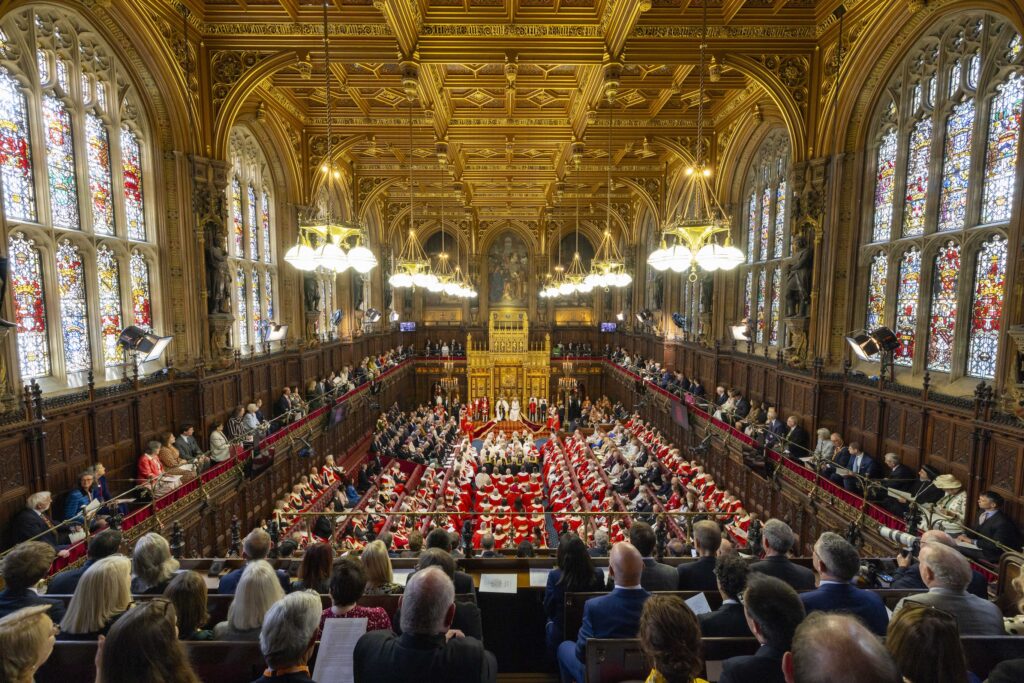
Hereditary peers are members of the aristocracy who inherit their titles, such as Duke, Marquess, Earl, Viscount or Baron, from a relative. Historically, all hereditary peers were entitled to sit and vote in the House of Lords.
The House of Lords Act 1999 fundamentally reformed this principle. While hundreds of hereditary titles still exist in the UK, the act removed the automatic right of their holders to a seat in parliament.
As a result of a compromise made during the passage of that act, 92 seats in the House of Lords were reserved for hereditary peers. According to this settlement, when one of those peers died or retired, a replacement was chosen in a unique by-election where only other hereditary peers can vote.
The Labour Party’s manifesto for the 2024 general election featured a pledge to introduce “legislation to remove the right of hereditary peers to sit and vote in the House of Lords.” This led to the introduction of the House of Lords (Hereditary Peers) Act 2026, which successfully removed the remaining 92 hereditary peers from the chamber.
Under the act, the remaining 92 hereditary peers were not “abolished” in an absolute sense. They still retain their titles; however, they have lost their right to sit in the House of Lords.
The House of Lords (Hereditary Peers) Act 2026
Following the 2024 general election, which resulted in a Labour landslide victory, all hereditary by-elections were formally suspended. Initially, the House of Lords amended the standing orders, changing the requirement to hold a by-election within three months of a vacancy to 18 months. The amendment had cross-party and crossbench support. (On 22 October 2025, the House extended the pause to 36 months through a further amendment to the standing orders.)
In September 2024, the government introduced legislation to implement its manifesto pledge to remove the hereditary peers from the upper chamber.
In July 2025, the House of Lords approved a major amendment, tabled by Conservative peer Lord Parkinson, which replaced clause one of the bill. Parkinson’s amendment instead proposed that the current excepted hereditary peers would remain in the House for life, but no new hereditary peers could join, permanently ending the system of by-elections. Parkinson argued this approach effectively fulfilled the government’s manifesto pledge while allowing peers to “say farewell to our colleagues in a more organic way”.
The amendment passed by 280 votes to 243.
In September 2025, the House of Commons formally rejected the Lords’ amendment, insisting on the immediate removal of all hereditary peers. The minister on duty, Nick Thomas-Symonds, argued that Parkinson’s amendment could allow the youngest hereditary peers, then aged 39, to remain for “decades to come”.
Thomas-Symonds noted that the Labour manifesto promised “immediate” reform, and that Parkinson’s amendment therefore breached the Salisbury-Addison convention, under which peers approve bills that fulfil manifesto pledges.
The Lords’ amendment was decisively rejected by 336 votes to 77.
On 10 March 2026, the House of Lords passed the Hereditary Peers Bill, marking the final abolition of the hereditary principle in the British parliament. The legislation fulfilled Labour’s manifesto commitment from the 2024 general election and effectively completed the reform process initiated by the House of Lords Act 1999.
The act removed the right of the remaining 92 excepted hereditary peers – comprising various ranks of Dukes, Earls, Viscounts and Barons – to sit and vote in the upper chamber.
Thomas-Symonds characterised the reform as the removal of an “archaic and undemocratic principle”.
He stated: “Hereditary peerages are an archaic and undemocratic principle. I am proud that we have fulfilled a key manifesto pledge of this government.
“Our parliament should always be a place where talents are recognised and merit counts. It should never be a gallery of old boys’ networks, nor a place where titles, many of which were handed out centuries ago, hold power over the will of the people.”
The act stipulated that the rights of hereditary peers would expire at the end of the 2025-2026 parliamentary session. The act also permanently abolished the system of hereditary by-elections, which had been used to fill vacancies among the 92 since 1999.
The government agreed to offer additional life peerages to the official opposition in the House and crossbenchers to compensate for the loss of hereditary representatives.
The House of Lords Act 1999 and the ‘Weatherill amendment’
Before the 1999 reforms, the House of Lords had over 1,300 members. When the act came into force in November 1999, a total of 667 hereditary peers ceased to be members of the House of Lords.
The passage of the legislation through parliament was marked by intense political machination.
In the end, the initial proposal to remove all hereditary peers was modified by a crucial compromise, known as the Weatherill amendment, agreed between the government and Viscount Cranborne, the then Conservative leader in the House of Lords. The amendment permitted 92 hereditary peers to retain their seats. The amendment was named after Lord Weatherill, then convenor of the crossbench or independent peers and previously speaker of the House of Commons.
A standing order adopted before the House of Lords received royal assent specified the mechanism for filling the 92 seats.
- two were held ex officio by the Earl Marshal and the Lord Great Chamberlain for ceremonial duties;
- 15 were elected by the whole House;
- and 75 were elected by the hereditary peers of their respective party or crossbench group.
Elections were held in October and November 1999. Peers ranked the candidates in order of preference for the number of places available. The candidates with the highest number of votes were declared elected, and the ranked preferences were only examined in the event of a tie.
Initially, vacancies among the 92 hereditary peers were filled by elevating the nearest runner-up from the 1999 ballots. This system operated until the 2002-03 session. Since then, vacancies have been filled through a by-election held among either the whole House or the relevant party or group, depending on the seat being replaced. For example, if a Conservative hereditary peer retires, the electorate to choose their replacement would consist of those Conservative hereditary peers currently in the House.
The candidates for these by-elections are drawn from a register of individuals who have formally proven their claim to an existing hereditary peerage. Individual vacancies are filled using the alternative vote (AV) system, while elections involving multiple vacancies use the single transferable vote (STV).
The hereditary peers: the anatomy of an anachronism
Female hereditary peers only gained the right to take their seats following the Peerage Act 1963. This came five years after female life peers were able to sit in the Lords under the Life Peerages Act 1958.
However, the system of male-preference primogeniture, which governs the succession of almost all hereditary titles, means that women are effectively excluded from the process. Between 1963 and 1999, only 25 female hereditary peers were admitted to the House of Lords.
In December 2021, Labour peer Lord Grocott highlighted the absence of female hereditary peers as a key reason to end hereditary peer by-elections. He noted that, since 1999, the number of women among hereditary peers steadily declined – from five to none – with all by-election winners being men.
He referred to a by-election held on 16 June 2021, following the retirement of the Countess of Mar, the last remaining woman hereditary Peer.
He said: “Need I say that in the by-election to replace Lady Mar, all 10 candidates were men? Steadily, over 22 years, this ridiculous system has not just remained ridiculous, it has actually become more ridiculous.”
Grocott, a Downing Street adviser at the time of the House of Lords Act, also highlighted that of the 43 hereditary peers elected since 1999, there had been no ethnic minorities, a disproportionate number from London and the South East and a strong overrepresentation of business, industry, finance and elite education. A full 45% of hereditary peers elected from 1999 to 2021 attended Eton College.
Grocott’s speech came as he introduced a private member’s bill to abolish the hereditary peer by-election system. The Labour peer has repeatedly brought forward such bills since 2016; under this proposed scheme, when a hereditary peer leaves the House, they would not be replaced, and the hereditary element would eventually disappear through natural attrition.
Grocott’s bill was consistently blocked from progressing to the statute book by opponents.
The by-election system was abolished under the terms of the House of Lords (Hereditary Peers) Act 2026.
House of Lords reform (1958-1997)
The Life Peerages Act, passed by Harold Macmillan’s Conservative government in 1958, allowed for the creation of non-hereditary members. It gave prime ministers the power to appoint individuals of apparent distinction from fields such as science, business, the arts, and public service for “life”. Before the Life Peerages Act, membership of the upper chamber was overwhelmingly determined by hereditary title. A few exceptions to this principle existed, notably the lords spiritual.
The first 14 life peers were announced on 24 July 1958.
The Peerage Act 1963 enabled hereditary peers to disclaim their titles for their lifetime within twelve months of inheriting them (or within twelve months of the act for existing peers). The legislation was the culmination of Labour MP Tony Benn’s campaign to disclaim the title (Viscount Stansgate) that he inherited upon the death of his father in November 1960.
After Macmillan resigned as prime minister in October 1963, two Conservative peers (the Earl of Home and Viscount Hailsham) announced they would renounce their titles with a view to contesting the coming leadership vacancy. Both peers accepted the convention that the prime minister should be a member of the House of Commons.
The practice of appointing hereditary peers virtually ceased in 1964 upon the start of Harold Wilson’s government. Macmillan, upon accepting an earldom 20 years later after his resignation as prime minister, became the last non-royal recipient of a hereditary peerage.
The passage of the House of Lords Reform Act
In its 1997 general election manifesto, the Labour Party under Tony Blair’s leadership committed to ending “the right of hereditary peers to sit and vote in the House of Lords will be ended by statute”. It vowed to do so by way of “an initial, self-contained reform, not dependent on further reform in the future”.
The party added: “This will be the first stage in a process of reform to make the House of Lords more democratic and representative.”
The 1998 Queen’s speech promised a bill “to remove the right of hereditary peers to sit and vote in the House of Lords” as “the first stage in a process of reform to make the House of Lords more democratic and representative.” The 1998 legislative programme also announced the establishment of a royal commission “to review further changes and speedily to bring forward proposals for reform.”
William Hague, the Conservative leader, characterised the government’s plans for removing the hereditary peers as “constitutional vandalism”. Norman Fowler, Conservative MP and future lord speaker, argued the government intended to “introduce an assembly of appointees and placemen: a giant, ermine-clad quango.”
The so-called Weatherill amendment was the consequence of a series of clandestine meetings between Viscount Cranborne and the government. Conservative leader William Hague, upon learning of these clandestine meetings, attempted to expose it and embarrass Blair in a session of prime minister’s questions.
On 2 December 1998, Hague asked whether Blair would be “happy to see nearly 100 hereditary peers continue to sit in the House of Lords” – the central measure in the proposed cross-party pact. Blair turned the fire back on Hague. “In fact”, he said, the negotiations proved that “even when hereditary Conservative peers are prepared to agree to change, the right honourable gentleman is not.”
Hague then addressed Conservative peers to set out his opposition to the compromise; they responded by backing Cranborne’s negotiated settlement by 80 votes to 20. “For Tory peers, brought up on loyalty to the party, it was the nearest thing to a mutiny that any had experienced”, the Independent reported.
Hague subsequently fired Cranborne for his ermine-clad subterfuge. The outgoing Tory leader in the Lords told reporters he had been “sacked for running in like an ill-trained spaniel” to try and secure a deal with Blair.
At least four Conservative frontbenchers in the House of Lords resigned in protest at Cranborne’s sacking. Hague was ultimately forced to appoint Lord Strathclyde, an ally of Cranborne’s, as his successor as Tory leader in the upper chamber.
In December 1998, the government published its white paper, Modernising Parliament: Reforming the House of Lords, which served as the formal blueprint for fulfilling its manifesto commitment.
The paper proposed the abolition of the right of hereditary peers to sit and vote in the Lords, arguing that their position, based solely on birthright, had “no democratic legitimacy” and was an indefensible anachronism in a modern state. This move was explicitly framed as a self-contained “stage one” reform, designed to remove the large, inbuilt Conservative “3 to 1 built-in majority over the Labour Party” before proceeding to a more comprehensive overhaul.
Critically, the white paper said the government was minded to accept an amendment that would “allow a small number of hereditary peers to sit temporarily” in what it referred to as a “transitional House”.
On 26 October 1999, the House of Lords Act secured its third reading in the upper chamber by 221 votes to 81.
On 11 November, the leader of the House of Lords, Baroness Jay, addressed her fellow peers just moments before the House of Lords Act received royal assent.
She said: “This is the last time the House of Lords will sit in its present form… A reform that has been discussed for more than 100 years will finally take effect. In the last year of the 20th century, this can only be right.
“The step-by-step approach towards this achievement was the proper one.”
Jay issued a final defence of the government’s reforms, while praising those who did not seek or secure election as one of the 90 “excepted hereditary peers”. She then reiterated to her closing remarks during the House of Lords Bill’s third reading stage: “Thank you and goodbye.”
Despite the initial intention to follow the act with comprehensive “stage two” reforms, the second step never materialised.
On 7 November 2001, the government produced a further white paper, The House of Lords – Completing the Reform, which vowed to equip the “British people with a Parliament and a constitution fit for the 21st century.”
On 11 December 2002, the joint committee published its first report, which set out “an inclusive range of seven options for the composition of a reformed House of Lords”. They were:
- Fully appointed
- Fully elected
- 80 per cent appointed/20 per cent elected
- 80 per cent elected/20 per cent appointed
- 60 per cent appointed/40 per cent elected
- 60 per cent elected/40 per cent appointed
- 50 per cent appointed/50 per cent elected
Indicative free votes held in February 2003 saw MPs reject every option presented, including Tony Blair’s preferred model of a fully appointed chamber.
The Weatherill amendment in hindsight
In an interview with the Financial Times in November 2021, the 7th Marquess of Salisbury (Cranborne) recalled that his primary strategy during the 1999 negotiations was to “make their flesh creep.”
He said: “I threatened them with the Somme and Passchendaele. I didn’t mean it – it would have been a constitutional outrage! But I said it.”
Salisbury also recounted that when the government offered 15 hereditary peers, he responded ambitiously: “How about 100?”
He stated that the rationale for the eventual arrangement – based on 75 being roughly 10% of the existing hereditary peerage plus 15 with experience running committees – was “frightful bulls***”.
Speaking to the Guardian in March 2025, Salisbury admitted that if the government had “held their nerve” he would have “crumbled”.
He added: “I thought the 92 hereditary peers might last only a few more months, not 26 years.”
Evaluation question
Why did the “temporary” arrangement of 92 hereditary peers prove so durable, and what does this reveal about the political obstacles to achieving comprehensive House of Lords reform?
Lord Grocott confirmed that the government took Salisbury’s threats seriously and felt they “couldn’t take the risk” of total legislative deadlock.
He argued that the House of Lords Act, including the provision to retain the 92 hereditary peers, was effectively “passed under duress.”
Evaluation question
When major constitutional reforms are shaped by hard-fought compromises, made under the threat of deadlock, is the resulting settlement necessarily incomplete and incoherent?
The Peerage Act 1963, Tony Benn and the hereditary principle
Tony Benn was first elected to parliament as the MP for Bristol South East in 1950, becoming the “Baby of the House” as its youngest member.
However, following the death of his father, William Wedgwood Benn, in November 1960, he inherited the title of Viscount Stansgate. As a peer of the realm, Benn was disqualified from sitting or voting in the House of Commons, and his seat was automatically declared vacant.
In April 1961, the commons privileges committee produced a report finding that “peerages cannot be surrendered.”
The committee cited the opinion of John Doddridge, a former justice of the king’s bench, who in 1626 held that a peerage is “a personal dignity annexed to posterity and fixed in the blood.” It also referred to the view of Arthur Onslow, a former commons speaker, who in 1760 stated that “attendance in both Houses is considered a service and the two services are incompatible with each other.”
The House endorsed the committee’s report by 204 votes to 126, resolving that Benn was indeed disqualified from membership.
The writ was formally moved for a by-election in Bristol South East on 18 April.
Benn stood to fill the vacancy created by his viscounty in the 1961 Bristol South East by-election. He placed first, winning 23,275 votes (69.5%) on a swing of 13.3 points from the Conservatives. His rival candidate, Malcolm St Clair, won 10,231 votes (30.5%).
Benn’s re-election in Bristol South East, however, had no bearing on his legal disqualification to sit in the commons.
On 8 May 1961, Benn returned to the commons to take the oath of allegiance. He was confronted by the House doorkeeper and told that the commons speaker, Harry Hylton-Foster, had “given instructions that physical force should, if necessary” be used to prevent him entering.
Benn addressed the House in a letter, calling on the speaker to “countermand” his order. He requested the opportunity to address MPs at the bar of the House to explain “why I should be permitted to take the oath following my election by an overwhelming majority of the people of Bristol South East, whose servant I am.”
The House divided and rejected Benn’s request by 250 votes to 177.
This development coincided with Malcolm St Clair, the Conservative runner-up in the 1961 Bristol South East by-election, initiating formal proceedings to challenge the result.
An election court ultimately ruled against Benn, who represented himself in the case (Re Bristol South-East Parliamentary Election), and the seat was awarded to St Clair.
St Clair, therefore, won the 1961 Bristol South East by-election with a majority of -13,044 over Benn – on a swing of -13.3. The disqualified Labour incumbent lost with 69.5% of the vote. Technically, he would have lost with 100% of the vote.
Benn, meanwhile, set about trying to force a change in the law. His agitation ultimately provoked the Peerage Act 1963.
The act, which received royal assent shortly after 06:00 pm on 31 July 1963, enabled hereditary peers to disclaim their titles for their lifetime within 12 months of inheriting them (or within 12 months of the act for existing peers).
The act also ended the election of the 16 “Scottish representative peers”, which followed each dissolution of parliament. The system had been established under the terms of the 1706 Treaty of Union. Scottish peers would now sit in the upper chamber on the same terms as their counterparts from the rest of the United Kingdom.
In addition the legislation also gave female hereditary peers the right to take their seats in the House of Lords. The Life Peerages Act 1958 allowed all life peers, both men and women, to sit in the House.
Benn became the first peer to renounce his title under the Peerage Act 1963, doing so at 06:22 pm on 31 July. St Clair, who was himself the heir to a peerage, stood down as the MP for Bristol South East to trigger a second by-election. Both the Conservative and Liberal parties stood aside.
The result, delivered on 20 August, was a resounding victory for Benn. He secured 20,313 votes (79.7%) – a majority of 15,479 over Edward Martell in second place. Martell, one of three independent candidates who challenged Benn, stood on a “National Fellowship Conservative” platform.
The by-election was a significant personal vindication for Benn. His parliamentary exile was at an end.
The act that emancipated Benn also had an immediate impact on the leadership of the Conservative Party – and the governance of the country.
The succession scramble that followed Harold Macmillan’s resignation as prime minister in October 1963 on grounds of ill-health featured two peers, the Earl of Home and Viscount Hailsham, who both renounced their titles. By this point, it was considered constitutionally inappropriate for a prime minister to sit in the unelected House of Lords.
In the end, Alec Douglas-Home “emerged” – somewhat acrimoniously – ahead of the rival candidates.
On 18 October, Macmillan – still confined to his hospital bed – advised a 37-year-old Queen Elizabeth II to send for Home.
Benn died on 14 March 2014, aged 88. He remains a much-celebrated figure on the Labour left.
His two sons, Hilary and Stephen, have both sat in parliament. Hilary as an MP, and Stephen as the 3rd Viscount Stansgate.
Stephen was elected unopposed to the House of Lords on 10 July 2021, under the hereditary peer by-election process, filling the vacancy left by Lord Rea’s death in 2020.
Stephen was made a life peer in May 2026 after the House of Lords (Hereditary Peers) Act 2026.