Truss criticised for Macron ‘jury’s out’ remark
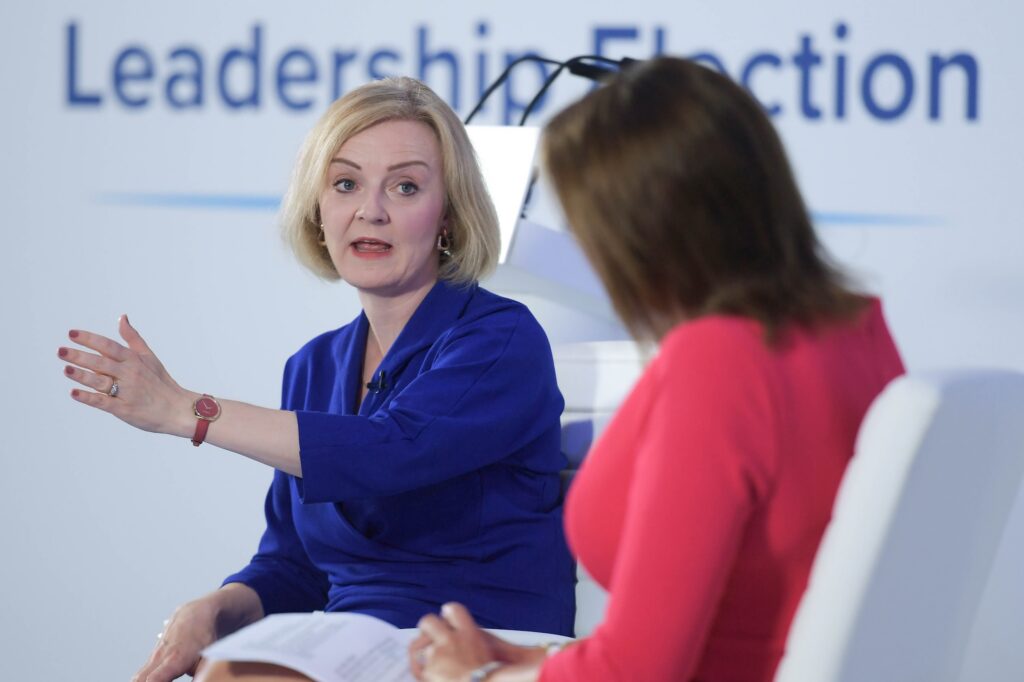
In late August 2022, the foreign secretary and Conservative leadership frontrunner, Liz Truss, was asked at a hustings event in Norwich whether she considered the French president, Emmanuel Macron, to be a “friend or foe”.
Truss replied: “The jury’s out. But if I become prime minister, I would judge him on deeds, not words.”
The remark, delivered during the final stages of the July-September 2022 Conservative leadership contest, prompted an immediate political and diplomatic backlash.
***
President Macron responded directly on 26 August, stating that the UK was an ally “sometimes in spite of its leaders.”
He said: “Listen, it’s never good to lose your bearings too much in life. If one asks the question – which is how I will answer you – whoever is considered for the leadership in Great Britain I won’t ponder it for a single second.
“The United Kingdom is a friend of France, and you know we live in a complicated world, there are more and more liberals, authoritarian democracies, so there is a sense of imbalance.
“If the French and British are not capable of saying whether we are friends or enemies – the term is not neutral – we are going to have a problem.
“So yes, of course the British people, the nation which is the United Kingdom, is a friend, strong and allied, whoever its leaders are, and sometimes in spite of its leaders, and the small mistakes they can make in their speeches.”
Truss’ stance was nonetheless typical of the political strategy that ultimately secured the Conservative leadership – an unapologetic attempt to appeal to the eurosceptic wing of her party. In fact, her “jury’s out” remark was applauded by those Tory members in attendance at the Norwich hustings.
Truss’ leadership rival, former chancellor Rishi Sunak, described Macron as a “friend.”
The Conservative leadership frontrunner’s position was also seen to embody the strained post-Brexit relationship between the UK and France. Macron’s relationship with Boris Johnson, the outgoing prime minister, suffered from periodic difficulties.
Nonetheless, when questioned as to the comments of his eventual successor, Johnson referred to the French president as a “très bon buddy”.
He declared: “I think I’ve always had very good relations with Emmanuel Macron, and Emmanuel Macron est un tres bon buddy de notre pays.”
Johnson added that relations between the UK had been “of huge importance… They have been very for a long time, ever since the Napoleonic era, basically, and I think we should celebrate that”.
However, in his 2024 memoir Unleashed, Johnson claimed that Macron wanted to “punish” Britain for Brexit, describing the French president as a “positive nuisance”.
He claimed Macron “would not hesitate to put his Cuban-heeled bootee into Brexit Britain”.
***
Responding to Truss’ comment, former Foreign Office minister Alistair Burt said the Conservative leadership frontrunner had made a “serious error”.
https://x.com/alistairburtuk/status/1562936462085165056
David Lammy, the shadow foreign secretary, said: “Liz Truss using the last weeks of her leadership campaign to insult the president of one of Britain’s closest allies shows a woeful lack of judgement.
“We need a prime minister working in the national interest, not attempting to score cheap points from the Tory base.”
Gavin Barwell, who served as chief of staff to Theresa May as PM, questioned Truss’ judgement, stating: “You would have thought the foreign secretary was aware we are in a military alliance with France.”
Former cabinet minister David Gauke said: “There’s playing to the gallery and then there’s letting the prejudices of the gallery go to your head, especially when now is one of the worst times to try to fragment the West.”
Lord Ricketts, the former UK ambassador to France, described the remark as “plain irresponsible”.
He said: “We are at the stage of the Tory leadership contest where the contestants need to start seeing themselves, and behaving, as future leaders of the country.
“France is our closest defence and security ally. We have a 50-year-old commitment to test our nuclear warheads in France. As Britain’s foreign minister, as its probable future prime minister, to insult the president of France, make a joke, indulge in silly point-scoring for cheap laughs, is just plain irresponsible.”
Upon becoming prime minister, Truss’ remark was seen as a significant diplomatic gaffe. Ahead of a meeting with Macron in October, she adopted a more cordial stance.
Truss responded that the French president was “a friend” when presented with an opportunity to restate her position.
Speaking on 5 October, Truss said: “We’re both very clear the foe is Vladimir Putin, who has through his appalling war in Ukraine threatened freedom and democracy in Europe and pushed up energy prices which we’re now all having to deal with.”
***
A fortnight before Truss delivered this clarification, her chancellor, Kwasi Kwarteng, had unveiled a programme of sweeping tax cuts.
The ‘mini-budget’, as the fiscal package became known, immediately spooked the financial markets. A series of damaging U-turns followed; Kwarteng was dismissed as chancellor on 14 October.
Then, on 20 October, after just 44 days in office, Truss announced her resignation as prime minister.
In an expedited contest among Conservative MPs, Sunak was selected as the party’s next leader; he was appointed prime minister on 25 October.

Politics.co.uk Newsletters
DAILY
Politics@Lunch
WEEKLY
Week in Review
