Liz Truss becomes prime minister, succeeding Johnson
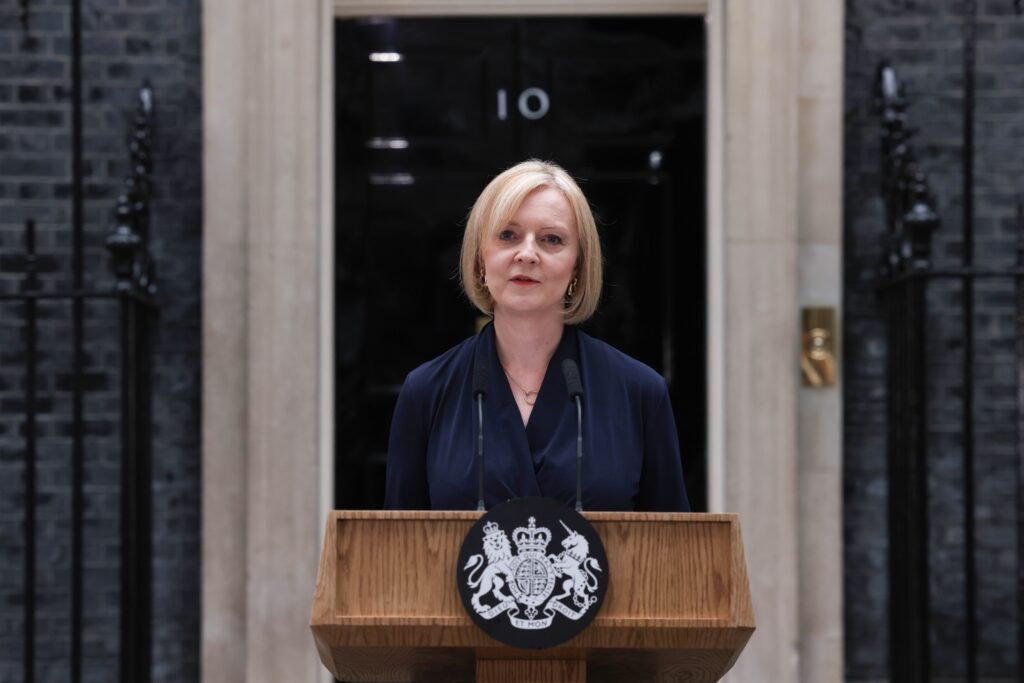
On 6 September 2022, Liz Truss became prime minister, succeeding Boris Johnson.
Truss’ appointment followed her victory in the July-September 2022 Conservative Party leadership contest, where she defeated the former chancellor, Rishi Sunak. Truss secured 81,326 votes (57.4%) from the party membership, compared with Sunak’s 60,399 (42.6%).
The contest was triggered by Johnson’s resignation as Conservative leader and prime minister. Johnson finally succumbed to an unprecedented governmental collapse on 7 July 2022. In just 48 hours, over 60 ministers, parliamentary private secretaries, and aides resigned.
Truss was not part of the ministerial exodus; however, she later issued a statement calling Johnson’s departure “the right decision” and for “calmness and unity”.
Sunak’s resignation as chancellor, meanwhile, was one of the triggers of the mass revolt that eventually forced Johnson from office. Truss was widely seen to have benefitted from a “stop Rishi” campaign, which was encouraged by Johnson’s allies.
The leadership race was contested by a series of senior party figures besides Sunak and Truss, including Sajid Javid, Suella Braverman, Grant Shapps, Kemi Badenoch and Nadhim Zahawi.
During the contest, Truss and Sunak clashed repeatedly over her proposed economic programme – termed ‘Trussonomics’. The serving foreign secretary also responded that the “jury’s out” when asked whether Emmanuel Macron, the French president, was a “friend or foe”.
Truss was declared the new Conservative leader on 5 September.
On the morning of 6 September, she travelled to Balmoral Castle in Scotland, where Queen Elizabeth II, in a break with tradition, formally invited her to form a government.
This audience – just two days before the Queen’s death – made Truss the 15th and final prime minister of her reign.
***
In her first speech outside 10 Downing Street, Truss pledged to deliver a “bold” economic agenda.
She paid tribute to Johnson, her predecessor, for having “delivered Brexit, the Covid vaccine, and stood up to Russian aggression.”
She added: “History will see him as a hugely consequential prime minister.”
Truss declared that the “time to tackle the issues that are holding Britain back” has arrived, adding: “We need to build roads, homes and broadband faster. We need more investment and great jobs in every town and city across our country.
“We need to reduce the burden on families and help people get on in life.”
She stated: “We will transform Britain into an aspiration nation… with high-paying jobs, safe streets and where everyone everywhere has the opportunities they deserve. I will take action this day, and action every day, to make it happen…
“I am confident that together we can: ride out the storm, we can rebuild our economy, and we can become the modern brilliant Britain that I know we can be.”
Truss then went about selecting her cabinet, which she saturated with allies. Kwasi Kwarteng was appointed as chancellor, Thérèse Coffey as deputy prime minister, Jake Berry as Conservative chairman, Jacob Rees-Mogg as business secretary and Simon Clarke as levelling up secretary.
In one of her first moves as prime minister, Truss sacked the Treasury’s most senior civil servant, Tom Scholar.
Truss had repeatedly railed against what she called “Treasury orthodoxy” during the July-September Conservative leadership election. Sacking Scholar, the long-serving public servant, was a symbolic statement of intent.
The sacking was confirmed with a summary announcement from the Treasury. It read: “The chancellor has asked the cabinet secretary to begin the recruitment process for a new permanent secretary to the Treasury to succeed Tom Scholar.”
In a statement, Scholar said Kwarteng had decided it was time for “new leadership”.
He commented: “It has been the privilege of my career to lead this great institution since 2016. I wish the Treasury all the best for the times ahead, and I will be cheering on from the sidelines.”
The sacking was a prelude to the fiscal and political trauma that followed.
Shortly after Scholar’s sacking, Westminster was convulsed with news emanating from Balmoral.
Upon Elizabeth’s death, Truss delivered a statement on the steps of Downing Street. “Queen Elizabeth II was the rock on which modern Britain was built”, she said.
“Our country has grown and flourished under her reign. Britain is the great country it is today because of her… Through thick and thin, Queen Elizabeth II provided us with the stability and the strength that we needed. She was the very spirit of Great Britain, and that spirit will endure.”
The Queen’s death, at the age of 96, suspended politics for the following fortnight.
***
Truss’ premiership was defined by the mini-budget delivered by her chancellor, Kwasi Kwarteng, on 23 September 2022.
The fiscal package, officially called the Growth Plan, announced £45 billion of unfunded tax cuts, including the abolition of the 45p top rate of income tax, all without an accompanying independent forecast from the Office for Budget Responsibility (OBR).
The mini-budget followed the announcement of a new “energy price guarantee”. Under the plan, the government would pay a subsidy to energy and gas suppliers in order to limit typical household energy costs to £2,500 per year. The Institute for Fiscal Studies (IFS) estimated its cost at over £100 billion per year.
Almost immediately, the 23 September package provoked a market meltdown. The value of sterling fell sharply, and the cost of government borrowing (gilt yields) soared.
The Bank of England was forced to launch an emergency intervention to buy government bonds and stabilise the market.
Truss’ political authority collapsed in tandem with the Conservative Party’s economic credibility. She was forced to sack Kwarteng on 14 October and appoint Jeremy Hunt as chancellor, who proceeded to reverse almost all of the mini-budget’s policies.
Hunt told MPs on 17 October: “We are a country that funds our promises and pays our debts. When that is questioned, as it has been, the government will take the difficult decisions necessary to ensure that there is trust and confidence in our national finances.
“That means decisions of eye-watering difficulty”.
A further farce, a botched whipping operation over an ‘opposition day’ fracking vote, finally felled Truss as prime minister.
On 19 October, the Labour Party triggered a debate on fracking in order to drive a wedge between the government and more “green” Conservative MPs. The Truss government, despite having been elected on a manifesto commitment to maintain the fracking moratorium, lifted it upon entering office.
The Labour motion effectively forced Conservative MPs to either back fracking or rebel against their government.
In response, the government whips’ office, led by Wendy Morton as chief whip, attempted to maximise pressure on backbench MPs to prevent any rebellion. Senior government figures briefed that the vote was being treated as a vote of confidence in the prime minister. Under such terms, any Conservative MP who abstained or voted with Labour would likely face expulsion from the parliamentary party.
This strategy led to chaos on the floor of the commons. Shortly before the vote, the climate minister, Graham Stuart, announced that “quite clearly, this is not a confidence vote”. The calculated intervention directly contradicted the instruction delivered by the whips, causing widespread confusion. This was followed by angry scenes in the voting lobbies. One Labour MP, Chris Bryant, alleged that he saw Tory MPs being “physically manhandled” into the government voting lobby.
The government defeated the Labour motion by 326 votes to 230. However, in the immediate aftermath, both Morton, and her deputy, Craig Whittaker, were widely reported to have resigned. They were then reported to have un-resigned, following conversations with and pressure from Downing Street.
Veteran Conservative backbencher Charles Walker famously voiced his anger at the perceived incompetence of the government.
He told BBC News: “I’m livid and I really shouldn’t say this but all those people that put Liz Truss in No 10, I hope it was worth it, it was worth it for the ministerial red box, as it was worth it to sit round the cabinet table, because the damage they have done to our party is extraordinary.”
Truss subsequently announced her resignation on 20 October.
In doing so, Truss became the shortest-serving prime minister in British history, lasting just 49 days in office (excluding the brief caretaker period before her successor took over). The previous record was held by George Canning, who died in office after 119 days in 1827.
In November 2022, Sir Graham Brady, the influential chair of the 1922 committee of Conservative backbenchers, said he had decided to call Downing Street to tell Truss her position was “unsustainable” following the “utter chaos” in the commons.
Morton, who was a key political ally of Truss, later said that the vote amounted to “chaos”.
She said she initially resigned as chief whip “on the basis that No 10 were interfering” in the vote.
She added: “I feel so strongly about the integrity of the chief whip and the red lines that I have… But the prime minister would not accept my resignation so I continued.”
In October 2022, the serjeant at arms was asked to conduct an investigation into reports of scuffles outside the “No” lobby.
The report stated: “It is very clear that the general atmosphere in the lobby was intense and several of those present found it very upsetting, both at the time and afterwards.
“However there is no evidence that anyone was bullied into voting in a particular way: two government members were particularly keen to seek clarity from the whips about the status of the vote, given the importance of fracking as an issue in their constituencies (one of whom was identified as the apparent victim of bullying).”
He added: “While there was some physical contact between members, there is no evidence from our investigation that this was any more than a gesture of comfort.”
***
The Truss premiership was widely ridiculed, most notably by a Daily Star livestream which charted whether she would outlast a bewigged leaf vegetable.
The lettuce, famously, prevailed.
Truss’ downfall was quickly followed by a second Conservative leadership contest. Johnson initially expressed interest in standing as a candidate, but proved unable to secure the necessary support.
Rishi Sunak, having won the argument over Trussonomics, was appointed prime minister on 25 October.
Liz Truss was one of many high-profile Conservative MPs to lose their seats at the 2024 general election.

Politics.co.uk Newsletters
DAILY
Politics@Lunch
WEEKLY
Week in Review
