Sunak and Truss clash in first head-to-head Tory leadership debate
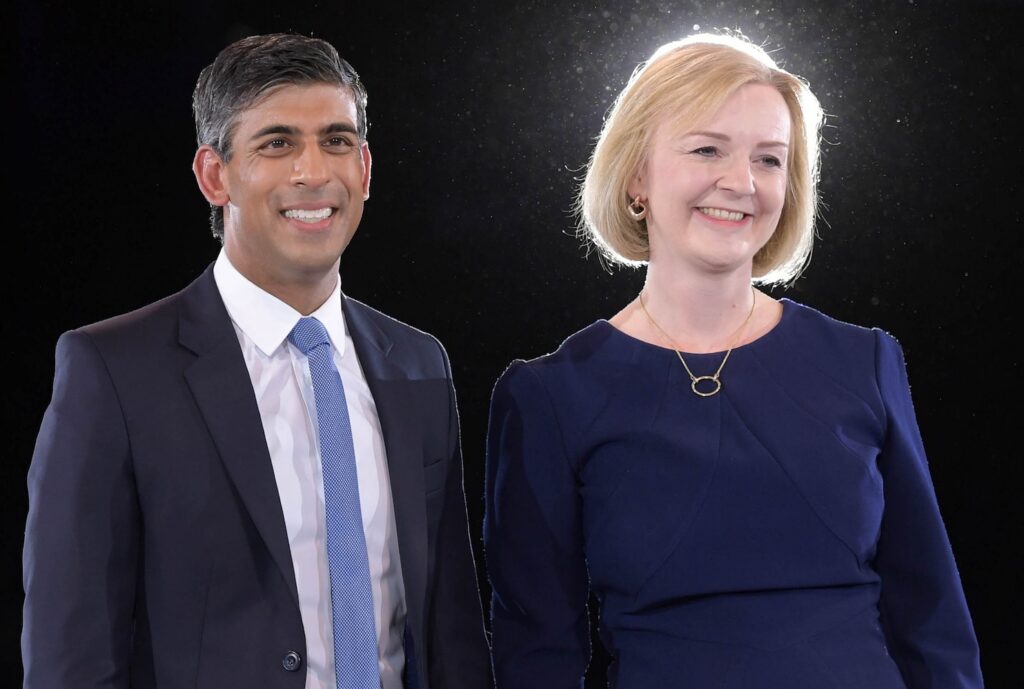
On 25 July 2022, the two final candidates in the Conservative party leadership contest, Rishi Sunak and Liz Truss, engaged in their first head-to-head television debate, hosted by the BBC in Stoke-on-Trent.
The July-September 2022 Conservative leadership election featured a series of acrimonious televised debates. The second such debate, held on 17 July, featured five candidates for the Tory leadership, namely Liz Truss, Rishi Sunak, Kemi Badenoch, Penny Mordaunt and Tom Tugendhat.
Truss, the foreign secretary, accused Sunak of planning to “choke off” growth with tax rises. Truss said Sunak had “raised taxes to the highest level in 70 years”, arguing that this would not “drive economic growth”.
Sunak, the former chancellor, said his onetime cabinet colleague was peddling “something-for-nothing economics”.
He declared: “This something-for-nothing economics isn’t Conservative. It’s socialism.”
Sunak, meanwhile, accused Mordaunt of a “dangerous” plan to scrap his fiscal rule of only borrowing to invest. Badenoch accused Sunak of not taking her seriously when she raised concerns about Covid loan fraud. The debate was so bitter that Sky News cancelled a subsequent debate after Sunak and Truss both pulled out, fearing more “blue-on-blue” infighting.
***
A further debate on 25 July came after the conclusion of the parliamentary voting rounds, which had successively eliminated Tugendhat, Badenoch and Mordaunt. The final, decisive round was the members voting stage.
Truss entered the debate as the clear frontrunner among party members. Sunak, desperately looking for a ‘moment’ to shift the dynamics of the race, pressed Truss on her economic policy. He condemned the foreign secretary’s alleged £40 billion of unfunded tax cuts as immoral, warning the “sugar rush” of borrowing could push interest rates as high as 7%.
Sunak said: “It’s not moral to pass on the tab to our children for bills we aren’t prepared to pay… I don’t think it’s right, I don’t think it’s responsible, and it’s certainly not Conservative.”
The former chancellor characterised his opponent’s plan as a “short-term sugar rush of unfunded tax cuts followed by the crash of higher prices and higher mortgage rates”.
He added: “Does anyone think that the sensible thing to do is go on a massive borrowing spree worth tens of billions of pounds and fuel inflation even further?
“If we do that all it’s going to mean is inflation stays here for longer and interest rates go up.”
Truss insisted her plans were funded and necessary to stimulate growth. She accused Sunak of pursuing “project fear” economics – comparing his warnings to those used by the ‘Remain’ campaign during the 2016 Brexit referendum.
Truss responded: “This is scaremongering, this is project fear.”
The foreign secretary even likened Sunak to Gordon Brown, questioning how high tax is “going to lead to economic growth”.
She said: “This is the same line that we heard from Gordon Brown when he was in the Treasury.”
***
The debate reflected a bitter ideological battle.
gested Conservative voters felt Truss had performed better.
Truss had succeeded in avoiding major errors, and had not come off worse in the adversarial exchanges. The foreign secretary maintained her position as favourite over the following months and, on 5 September 2022, was declared leader of Conservative Party. She secured 57.4% of the members’ vote to Sunak’s 42.6%.
Truss was appointed prime minister the following day, 6 September.
On 23 September the new chancellor, Kwasi Kwarteng, unveiled a series of tax cuts – including the abolition of the top rate of income tax. The ‘mini-budget’, as the fiscal package became known, immediately spooked the financial markets. A series of damaging U-turns followed; Kwarteng was dismissed as chancellor on 14 October.
Then, on 20 October, after just 44 days in office, Truss announced her resignation as prime minister. Her departure triggered another leadership election.
In an expedited contest among Conservative MPs, Sunak was selected as the party’s next leader; he was appointed prime minister on 25 October.
Truss may have won the debate, therefore, but Sunak won the argument

Politics.co.uk Newsletters
DAILY
Politics@Lunch
WEEKLY
Week in Review
