Amber Rudd resigns as home secretary over Windrush scandal
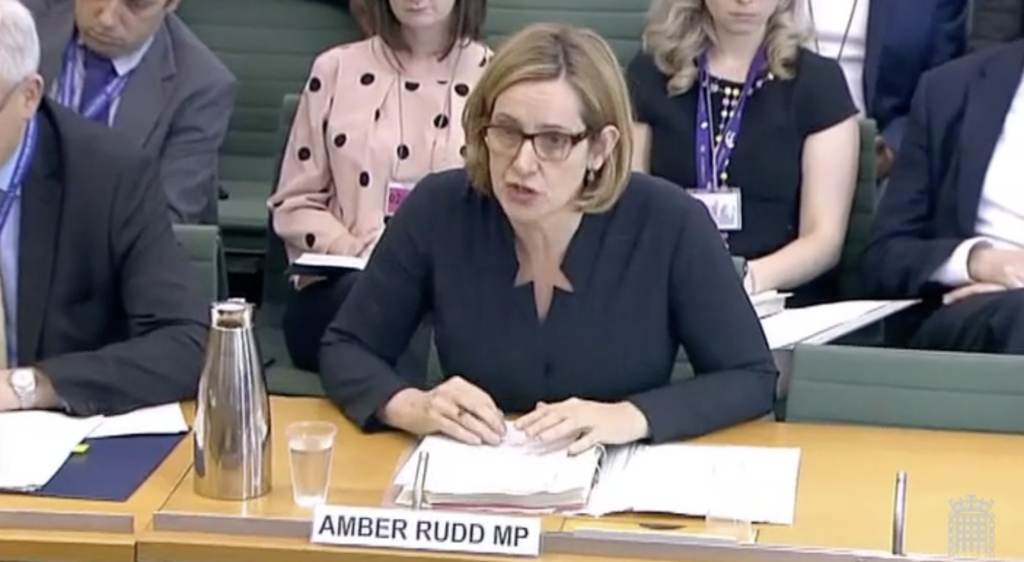
On 29 April 2018, Amber Rudd resigned as home secretary, admitting that she had “inadvertently misled” the home affairs select committee over the existence of targets for the removal of illegal immigrants.
Rudd’s departure came at the height of the Windrush scandal, which had revealed that hundreds of Commonwealth citizens, who had a legal right to live in the UK, had been wrongly detained, denied legal rights, and in some cases deported.
Rudd famously stood in for the prime minister after May refused to attend a BBC general election debate in May 2017.
***
Rudd had initially denied the existence of removal targets in an appearance before the select committee, telling its chair and Labour MP Yvette Cooper on 25 April “that’s not how we operate”.
But a December 2015 inspection report was soon leaked, which referred to immigrant removal targets. Rudd responded by appearing before parliament to correct the record, to say that “local” targets did exist.
She said: “I have never agreed that there should be specific removal targets and I would never support a policy that puts targets ahead of people.
“The immigration arm of the Home Office has been using local targets for internal performance management. These were not published targets against which performance was assessed, but if they are used inappropriately, then I am clear that this will have to change.”
The Guardian subsequently reported a six-page leaked memo prepared for Rudd and other senior ministers which said the Home Office had set “a target of achieving 12,800 enforced returns in 2017-18”. The home secretary said she had not seen the memo.
Then a further Guardian story, published on 29 April, detailed a letter in which Rudd spoke to an “ambitious but deliverable” aim to deport 10% more illegal immigrants over the “next few years”, addressed to Theresa May as prime minister. The revelations appeared to be at odds with Rudd’s denials that she was aware of deportation targets, precipitating her resignation.
In her letter of resignation to May, Rudd said had “become aware of information provided to my office which makes mention of targets. I should have been aware of this, and I take full responsibility that I was not.”
She added: “Since appearing before the select committee, I have reviewed the advice I was given on this issue and become aware of information provided to my office which makes mention of targets.
“I should have been aware of this, and I take full responsibility for the fact that I was not.”
May, considered a close political ally of Rudd, responded that she believed the outgoing home secretary had given her evidence to the home affairs committee “in good faith”, but that she could “understand why, now you have had chance to review the advice that you have received on this issue, you have made the decision you have made, and taken responsibility for inadvertently misleading the home affairs select committee”.
***
Sajid Javid succeeded Rudd as the new home secretary.
Javid delivered his first remarks to the commons as home secretary on 30 April. It came in response to an urgent question tabled by Diane Abbott, the shadow home secretary, which called for a statement on the “government’s handling of the Windrush crisis”.
In the statement, Javid emphasised his identity as a second-generation migrant, telling MPs: “When I heard that people who were long-standing pillars of their communities were being impacted for simply not having the right documents to prove their legal status in the UK, I thought that that could be my mum, my brother, my uncle or even me.”
Javid also paid tribute to Rudd’s “hard work and integrity and to all that she has done and will continue to do in public service.”
Scottish National Party (SNP) MP Joanna Cherry said Rudd was right to resign.
But she added: “It was her misfortune to preside over a mess of the prime minister’s making.”
Rudd’s resignation was widely seen as a win for parliamentary scrutiny, with the former home secretary having faced difficult questioning first at the home affairs select committee and subsequently in the House of Commons.
Rudd was reappointed to the cabinet as work and pensions secretary in November 2018. It came after Esther McVey’s resignation.
Rudd subsequently became a champion of a “soft Brexit” in cabinet. She abstained over an amendment to a government motion that sought to block a “no-deal” Brexit in March 2019.
In September 2019, during Boris Johnson’s tenure as prime minister, Rudd resigned from the cabinet and surrendered the Conservative whip. She called the expulsion of the 21 Tory MPs – who had voted to block a no-deal Brexit – an “act of political vandalism” and stated she no longer believed “leaving with a deal is the government’s main objective.”
Rudd stood down from parliament at the 2019 general election.

Politics.co.uk Newsletters
DAILY
Politics@Lunch
WEEKLY
Week in Review
