David Davis resigns as Brexit secretary over ‘Chequers plan’
On 8 July 2018, the secretary of state for exiting the European Union, David Davis, resigned from the cabinet. The resignation was a direct protest against the so-called Chequers plan – a compromise agreement on the future UK-EU relationship that had been revealed to the cabinet just two days earlier by prime minister Theresa May.
***
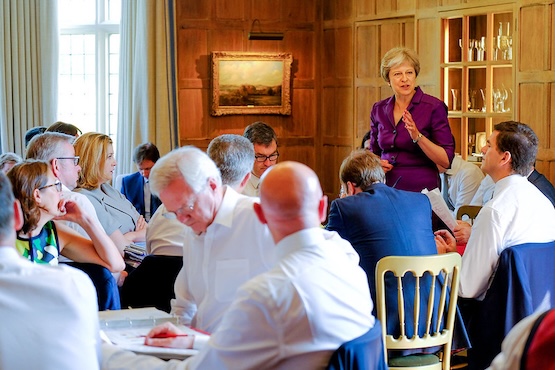
On 6 July, the cabinet met at Chequers, the country house of the UK prime minister, to agree May’s Brexit strategy. The plan proposed a “common rulebook for all goods” for goods, the “continued harmonisation” with EU rules, a “joint institutional framework” to interpret UK-EU agreements, and an end to free movement, “giving the UK back control over how many people enter the country”.
As such, May rejected the EU’s suggestion of a standard “free trade agreement for Great Britain, with Northern Ireland carved off in the EU’s customs union and elements of the single market, separated from the United Kingdom’s own internal market.”
The government said that the plans, published ahead of a fuller Brexit white paper, represented “a precise and responsible approach to the final stage of the negotiations”.
Initially, the proposals were not met with public criticism from cabinet ministers. The undramatic deliberations suggested May could well have achieved the impossible: Brexit consensus. Michael Gove, the Brexit-supporting environment secretary, was reportedly among the first to back the scheme during the discussions at Chequers.
Michel Barnier, the European Union’s chief Brexit negotiator, also reacted positively to the proposals.
In a letter to Conservative MPs, May suggested the agreement marked the moment cabinet collective responsibility would be reimposed.
The prime minister wrote: “During the EU referendum campaign collective responsibility on EU policy was temporarily suspended. As we developed our policy on Brexit I have allowed cabinet colleagues to express their individual views.
“Agreement on this proposal marks the point where that is no longer the case and collective responsibility is now fully restored.”
The briefing from the government was also bullish.
A senior Downing Street source reportedly warned that May had lined up replacements for what a source described as a “select number of narcissistic, leadership-dominated cabinet ministers”. The message further specified that taxi numbers for Aston, the local cab company, would be in reception at Chequers if anyone decided to walk out.
But the prime minister failed to beat her Brexit-backing ministers into total submission. And the relative silence was shattered two days later by the announcement of Davis’ resignation.
***
In his resignation letter, Davis told the prime minister he would not be a “reluctant conscript” to the plan agreed at Chequers. He argued that “the current trend of policy and tactics” was making it “look less and less likely” that the UK would leave the customs union and single market.
Davis added: “In my view the inevitable consequence of the proposed policies will be to make the supposed control by parliament illusory rather than real… I am also unpersuaded that our negotiating approach will not just lead to further demands for concessions.”
https://x.com/jeremycorbyn/status/1016104220594982913
Davis later told BBC Radio 4‘s Today programme that he had objected to May’s Brexit plan during the Chequers meeting, telling cabinet colleagues at the outset that he was “the odd man out”.
He said he was “unpersuaded” that the government’s negotiating approach “will not just lead to further demands for concessions” from Brussels.
Steve Baker, a junior Brexit minister, resigned alongside Davis.
In her reply to Davis’ resignation letter, May emphasised he had quit “when we are only eight months from the date set in law” for the UK to leave the EU.
Davis’ resignation put his former Brexit-supporting colleagues in the cabinet under significant pressure.
The following day, 9 July, May suffered her second and most significant cabinet resignation when Boris Johnson, the former London mayor, announced his decision to step down as foreign secretary.
Johnson claimed the Chequers plan meant the UK was “heading for a semi-Brexit” that would leave it as a “colony” of the EU.
In his resignation letter, Johnson argued that the “Brexit dream is dying, suffocated by needless self-doubt”. He accused the prime minister of “sending our vanguard into battle with the white flags fluttering above them”.
The prime minister replied: “I am sorry – and a little surprised – to receive it after the productive discussions we had at Chequers on Friday, and the comprehensive and detailed proposal which we agreed as a cabinet…
“If you are not able to provide the support we need to secure this deal, in the interests of the United Kingdom, it is right that you should step down.”
Johnson’s resignation came just minutes before May addressed the 1922 committee of Conservative backbenchers. The prime minister told the gathering of Tory MPs that “to lead is to decide”. She raised the prospect of a Jeremy Corbyn-led government in an attempt to appeal for unity on Brexit.
May appointed Dominic Raab, a vocal Brexiteer, to succeed Davis as Brexit secretary.
Jeremy Hunt, the longserving health secretary, replaced Johnson at the Foreign Office. Hunt was succeeded by Matt Hancock at the Department of Health.
Johnson delivered a personal statement in the House of Commons on 18 July addressing his resignation and the Chequers scheme. He said the government had allowed “a fog of self-doubt” to fall on its negotiations.
The Conservative MP said the government had “allowed the question of the Northern Irish border, which had hitherto been assumed on all sides to be readily soluble, to become so politically charged as to dominate the debate”.
He added: “No one on either side of this House or anywhere wants a hard border. We could not construct one if we tried. However, there certainly can be different rules north and south of the border to reflect the fact that there are two different jurisdictions…
Johnson compared the Chequers scheme to May’s landmark Lancaster House speech, delivered in January 2017.
He told the House: “Lancaster House said that laws will once again be made in Westminster. Chequers says that there will be ‘ongoing harmonisation’ with the common EU rulebook. Lancaster House said that it would be wrong to comply with EU rules and regulations ‘without having a vote on what those rules and regulations are.’”
The former foreign secretary concluded: “It is not too late to save Brexit. We have time in the negotiations. We have changed tack once, and we can change again…
“There is time, and if the prime minister can fix that vision before us once again, I believe that she can deliver a great Brexit for Britain with a positive, self-confident approach that will unite this party, unite this House and unite the country as well.”
***
The resignation of two of the most senior Brexit-supporting ministers threw the political viability of the Chequers plan into doubt.
May’s draft withdrawal agreement, unveiled in November 2018, broadly reflected the framework set out in the Chequers scheme.
However, its publication precipitated four further resignations – including those of two serving cabinet ministers, Raab (Brexit secretary) and Esther McVey (work and pensions secretary). Suella Braverman and Shailesh Vara also stepped down as Brexit and Northern Ireland ministers respectively.
In his resignation letter, Raab stated that he could “not in good conscience” support the deal. Raab argued that the Northern Ireland backstop presented a “very real threat to the integrity of the United Kingdom.”
May initially delayed a vote on her Brexit deal before subjecting it to three defeats from January to March 2019.
Davis voted for the deal in the second and third “meaningful votes”. Johnson only voted for the deal at the third time of asking.
But it was not enough.
The prime minister’s inability to secure parliament’s support for her Brexit deal precipitated her resignation in May.

Politics.co.uk Newsletters
DAILY
Politics@Lunch
WEEKLY
Week in Review