David Cameron suspends collective responsibility for Brexit referendum
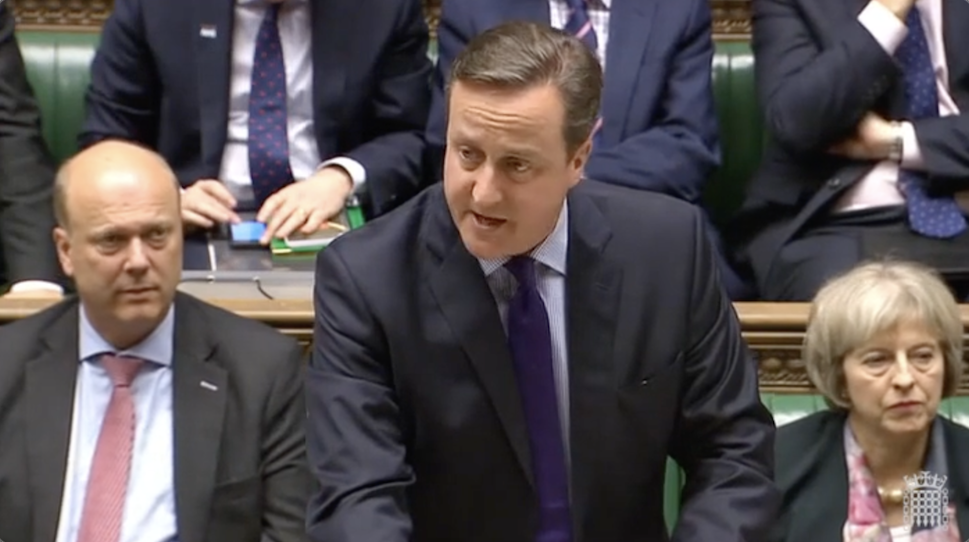
On 5 January 2016, David Cameron announced that government ministers would be free to campaign for either side of the referendum on Britain’s membership of the European Union (EU) – a significant departure from the principle of cabinet collective responsibility.
The prime minister pledged in January 2013 to hold an ‘in-out’ vote if the Conservative Party won the 2015 election.
The subsequent suspension of collective responsibility – a doctrine that normally requires all ministers to publicly support the government’s position – followed a precedent set by Harold Wilson for the 1975 referendum on Britain’s membership of the European Economic Community (EEC). In 1975, the Labour government was officially in favour of remaining in, but Wilson granted his ministers a rare “agreement to differ”.
Speaking in the House of Commons in January 1975, Wilson said cabinet ministers would be “free to support and speak in favour of a different conclusion in the referendum campaign”. Of the 23 members of Wilson’s cabinet, seven did not support the government’s pro-EEC position.
***
Cameron’s announcement, set out in a statement to the House of Commons, was widely seen as the unofficial starting gun for the referendum campaign.
The ministerial statement reportedly came after showdown talks with Chris Grayling, the eurosceptic leader of the House of Commons.
The move allowed Conservative ministers to publicly support the “Leave” or “Remain” camps without having to resign from the government. It marked an attempt to manage the inevitable divisions that would emerge within the Conservative Party over the course of the coming referendum campaign.
The prime minister told MPs: “It is the nature of a referendum that it is the people not the politicians who decide.
“And as indicated before Christmas, there will be a clear government position, but it will be open to individual ministers to take a different personal position while remaining part of the government.”
In response to questions from MPs, Cameron also insisted that he would not resign if voters decided to quit the EU.
He said: “Our aim is to set forward a choice for the British people that they want. They can choose either to stay in a reformed European Union or to leave the European Union.
“Come what may, I will continue to lead the government in the way I have.”
On 11 January 2016, Cameron wrote to ministers, urging them to treat each other “with appropriate respect and courtesy” during the forthcoming referendum campaign.
Cameron set out the details of his “wholly exceptional” decision to suspend collective responsibility.
He wrote: “We all recognise that the UK’s membership of the EU is an issue on which some colleagues have long-standing, deeply-held positions of conviction – hence my decision to set aside, on a highly exceptional basis, the normal rules of collective responsibility.
“But throughout this period, and in its aftermath, we will continue to have responsibility for governing the country and serving the public who elected us. This can only be done effectively if we remain, despite differences on this one issue, a united, harmonious, mutually respectful team.”
***
Grayling subsequently confirmed he planned to support the Leave campaign.
In an article for the Daily Telegraph, published 14 January, Grayling wrote: “I am someone who believes that simply staying in the EU with our current terms of membership unchanged would be disastrous for Britain.
“That’s why I have always believed that it is imperative that his renegotiation takes place and delivers as much potential change as possible. It is in the interests of all eurosceptics and of our country.
“I want Britain to choose between a changed relationship and leaving, and not between the current situation and leaving.”
Damian Green, a senior Conservative europhile, responded that Grayling had walked the “tightrope of overtly breaking” Cameron’s rules.
Green said: “He is peddling myths about Britain in Europe, fascinating that he says carrying on would be disastrous for Britain.
“He and I fought a successful election campaign saying we would create more jobs, we kept inflation down, we brought the deficit down, we created millions of apprenticeships – we did all that as members of the EU.
“It seems to be a bit odd to say nine months later ‘oh it is all disastrous’.”
In response to Cameron’s commons statement, Kenneth Clarke, the veteran europhile and former cabinet minister, argued that frontbenchers should resign if they disagreed with the government.
He also called for rules to ensure cabinet ministers campaigned “moderately” and did not “get carried away”.
Of the prime minister’s position, Clarke told BBC Radio 4: “He probably has been forced into it, as people have been saying, because one or two of them are obviously already briefing the newspapers and have been for some time.”
He added: “You don’t stay in office and campaign against the government of which you serve…
“It’s most unfortunate that David [Cameron] is really now seeing the beginning of what is going to be a very difficult task for him to avoid splitting the party as he goes into this referendum campaign.”
Graham Brady, the chairman of the influential 1922 committee of Conservative backbenchers, responded that Cameron had made “exactly the right call”.
He commented: “I think it is a mature approach to politics. It shows respect for the British public.”
***
After a rare Saturday cabinet meeting on 20 February 2016, following the conclusion of Cameron’s EU renegotiation, six cabinet ministers broke ranks to join the Vote Leave campaign.
This ‘gang of six’ comprised Grayling, as well as Michael Gove, the justice secretary; Iain Duncan Smith, the work and pensions secretary; John Whittingdale, the culture secretary; Theresa Villiers, the Northern Ireland secretary; and Priti Patel, the minister of state for employment (who attended cabinet).
Gove, a close political ally of Cameron, released a 1,500-word essay outlining what he called “the most difficult decision of my political life.”
He wrote: “It pains me to have to disagree with the prime minister on any issue. My instinct is to support him through good times and bad.
“But I cannot duck the choice which the prime minister has given every one of us. In a few months time we will all have the opportunity to decide whether Britain should stay in the European Union or leave. I believe our country would be freer, fairer and better off outside the EU. And if, at this moment of decision, I didn’t say what I believe I would not be true to my convictions or my country.”
Boris Johnson, coming to the end of his second term as mayor of London, announced that he would campaign for Britain to leave the EU on 21 February.
In his memoirs, published December 2019, Cameron recalls that Gove promised to assume a low-profile role in the referendum. The battles that followed – which featured Gove at the forefront – placed significant strain on the integrity of the Conservative government.
The prime minister, however, did not go so far as to sack any of his cabinet colleagues.
***
On 23 June 2016, the United Kingdom voted to leave the European Union by 51.9% to 48.1%. Cameron announced his intention to resign as prime minister in the immediate aftermath of the result.
In his speech outside 10 Downing Street, he said: “The British people have made a very clear decision to take a different path and as such I think the country requires fresh leadership to take it in this direction.”

Politics.co.uk Newsletters
DAILY
Politics@Lunch
WEEKLY
Week in Review