Boris Johnson joins campaign to leave European Union
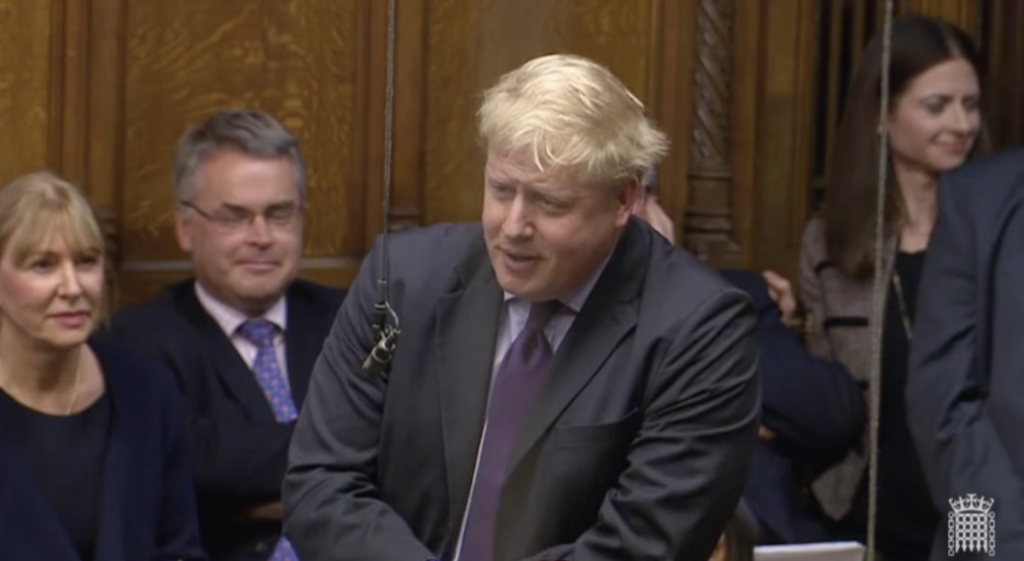
On 21 February 2016, Boris Johnson announced that he would campaign for Britain to leave the European Union (EU) – a dramatic intervention that proved to be a major boost to the Leave campaign in the upcoming referendum.
The decision marked a severe blow to David Cameron, the prime minister, who was leading the effort to keep the UK in the EU. Johnson, coming to the end of his second term as mayor of London, soon assumed the position as de facto leader of the Leave campaign.
Johnson was elected as the MP for Uxbridge and South Ruislip at the 2015 general election. The Conservatives fought that campaign on a promise, first set out in Cameron’s 2013 Bloomberg speech, to renegotiate Britain’s terms of membership and hold an “in-out” EU referendum.
***
On 5 January 2016, Cameron announced that government ministers would be free to campaign for either side of the referendum. In an article for the Daily Telegraph, published 14 January, Chris Grayling became the first cabinet minister to commit to supporting the Leave camp.
Then, after a rare Saturday cabinet meeting on 20 February 2016, following the conclusion of Cameron’s EU renegotiation, the official ‘Vote Leave’ campaign unveiled a “gang of six” supporters. This comprised Grayling, the leader of the commons, as well as Michael Gove, the justice secretary; Iain Duncan Smith, the work and pensions secretary; John Whittingdale, the culture secretary; Theresa Villiers, the Northern Ireland secretary; and Priti Patel, the minister of state for employment (who attended cabinet).
Johnson, who sat in political cabinet, declared his support for Brexit the following day on 21 February.
Announcing his decision outside his home in London, Johnson said that “after a huge amount of heartache” he had concluded that the EU was “in danger of getting out of proper democratic control”.
He told reporters that the decision was “not about whether you love Europe or not. Actually, I love Brussels, I used to live in Brussels – fantastic city, wonderful place – and I love European culture and civilisation.”
But Johnson argued that the surrounding political project was in “real danger of getting out of proper democratic control. That is my view, and it’s a view I’ve held for a long time – I’ve written a huge number of articles about it.”
He declared: “I will be advocating Vote Leave, or whatever the team is called – I understand there are many of them – I think that is basically, because I want a better deal for the people of this country, to save them money, and to take back control.
“That’s really I think what this is all about.”
The London mayor also vowed not to take “part in loads of blooming TV debates against other members of my party.”
Downing Street issued a statement in response to Johnson’s announcement.
A spokesperson said: “Our message to everyone is we want Britain to have the best of both worlds: all the advantages of the jobs and investment that come with being in the EU, without the downsides of being in the euro and open borders.”
Explaining his decision in his Daily Telegraph column, Johnson wrote: “There is only one way to get the change we need – and that is to vote to go; because all EU history shows that they only really listen to a population when it says no.”
Johnson’s declaration was widely seen as reflecting a degree of political ambition on his part. Cameron, addressing the commons on 22 February, told MPs that he had “no other agenda than what is best for our country” – remarks widely interpreted as an oblique reference to Johnson’s leadership ambitions.
In his statement, Cameron also ridiculed the idea that backing Brexit could deliver better terms from the EU. “And we should be clear that this process is not an invitation to re-join; it is a process for leaving”, the prime minister told MPs.
“Sadly, I have known a number of couples who have begun divorce proceedings, but I do not know any who have begun divorce proceedings in order to renew their marriage vows.”
Johnson reportedly responded by shaking his head and shouting “rubbish” from the backbenches.
Following that statement, the mayor of London asked Cameron “to explain to the House and the country in exactly what way this deal returns sovereignty over any field of lawmaking to these Houses of Parliament?”
The prime minister responded: “This deal brings back some welfare powers, it brings back some immigration powers, it brings back some bail-out powers, but more than that, because it carves us forever out of ever closer union, it means that the ratchet of the European Court taking power away from this country cannot happen in future.”
Johnson went on to play a starring role in the referendum campaign.
On 21 June 2016, just two days before the national vote, the BBC broadcasted its final, climactic television debate of the European Union referendum campaign in front of a 6,000-strong audience at Wembley Arena. Johnson was among the three Brexit-supporting voices on the stage, alongside Andrea Leadsom and Gisela Stuart.
Britain ultimately voted to leave the EU by 51.9% to 48.1%. The result, on a turnout of 72.2%, overturned the 1975 decision to remain in the bloc and triggered a period of immense political turmoil.
The result precipitated Cameron’s resignation as prime minister and the 2016 Conservative leadership contest. Johnson opted not to stand in the 2016 race, having faced a full-frontal assault on his character and ability by Gove, his pro-Brexit partner set to become chancellor of the exchequer.
Johnson was appointed prime minister after emerging victorious in the 2019 Conservative leadership contest.
***
Shortly before Johnson’s announcement, Conservative MP Nicholas Soames posted to Twitter (now X): “Whatever my great friend Boris decides to do I know that he is NOT an outer.”
It later emerged that Johnson, before issuing his pro-Brexit proclamation in February 2016, had written two separate Telegraph columns: one arguing to remain and one to leave, before making his final choice. In the remain-supporting column, Johnson criticised the renegotiation carried out by Cameron as prime minister. He argued that the new terms did not amount to “a fundamental reform of Britain’s position in the EU, and no-one could credibly claim it is.”
But the London mayor questioned whether, “despite all the defects and disappointments of this exercise – do you really, truly, definitely want Britain to pull out of the EU?”
He added: “There are some big questions that the ‘out’ side need to answer. Almost everyone expects there to be some sort of economic shock as a result of a Brexit. How big would it be? I am sure that the doomsters are exaggerating the fallout – but are they completely wrong? And how can we know?…
“Shouldn’t our policy be like our policy on cake – pro having it and pro eating it? Pro Europe and pro the rest of the world?”
Writing in his memoir, published September 2019, Cameron argued that Johnson did not believe in Brexit during the referendum campaign and backed the Leave campaign “because it would help his political career”.
The former prime minister wrote: “It soon became clear this issue was secondary to another concern for Boris: what was the best outcome for him?
“Whichever senior Tory politician took the lead on the Brexit side – so loaded with images of patriotism, independence and romance – would become the darling of the party. He didn’t want to risk allowing someone else with a high profile – Michael Gove in particular – to win that crown…
“The conclusion I am left with is that he risked an outcome he didn’t believe in because it would help his political career.
“One of the greatest miscalculations I made was that I thought moderate Eurosceptics would see, like me, that staying in and fighting, with new reforms agreed, with all the opt-outs secured, with all the advantages over trade and co-operation, was the right course.”

Politics.co.uk Newsletters
DAILY
Politics@Lunch
WEEKLY
Week in Review
