Cameron demotes Michael Gove in tense pre-election reshuffle
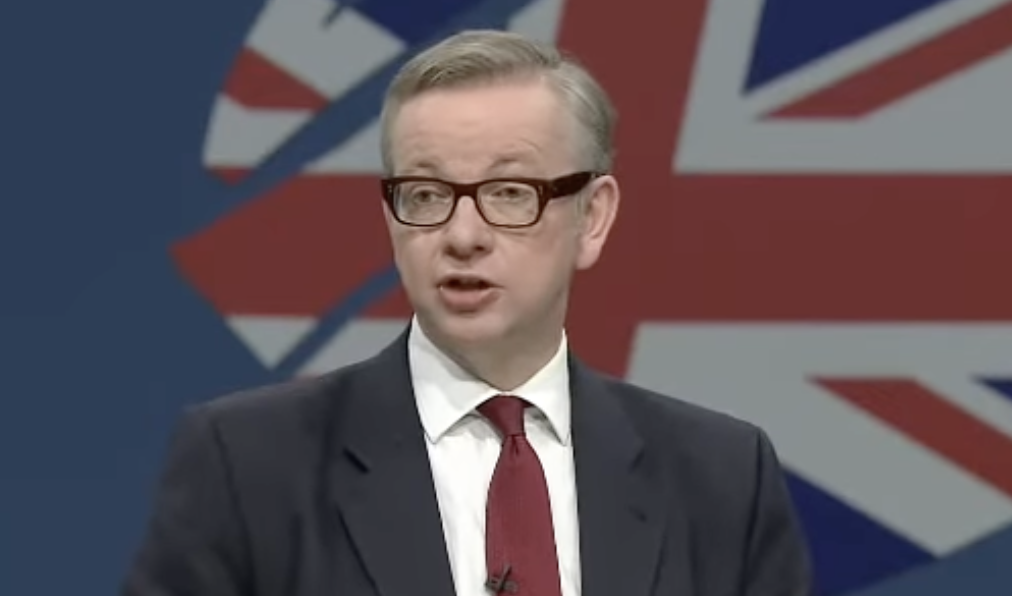
On 15 July 2014, prime minister David Cameron conducted a wide-ranging cabinet reshuffle, which featured the demotion of Michael Gove from his post as education secretary. The changes were seen as an attempt to freshen the government image ahead of the 2015 general election.
***
Gove, upon his election to parliament following the 2005 general election, was immediately appointed to the Conservative frontbench. He became a close ally of Cameron during his tenure as leader of the opposition, and was promoted to the shadow cabinet as early as 2007, serving as shadow secretary of state for children, schools and families.
In the wake of the 2010 general election and the formation of the Conservative-Liberal Democrat coalition, Gove was appointed as education secretary.
In this role, Gove was widely regarded as one of the coalition’s most proficient and energetic ministers. He oversaw a programme of school reforms that was lauded by ministers as transformative.
Gove’s tenure as education secretary was nonetheless marked by conflict with teaching unions. The education secretary was accused of taking a deliberately confrontational stance in his struggles with “The Blob” – the name he and his allies gave to the educational establishment.
Gove’s appointment as chief whip, a backroom party-management position, meant his removal from the political frontline. He was replaced as education secretary by Nicky Morgan, the former financial secretary to the treasury. Morgan’s promotion was part of an effort by Cameron to increase female representation at the cabinet table, and adopt a more congenial stance on education policy.
Gove’s removal was deeply politically sensitive.
In his memoirs, published in December 2019, Cameron noted a conversation with Gove in which he said he would “love to be chief whip”. He also recalled telling Gove of his plans at the start of July – and receiving his approval.
Gove changed his mind, however.
Upon receiving Gove’s second thoughts, the then prime minister responded: “I don’t accept your email. You have agreed to do this job. I’ve told you everything we’re planning. I accept your withdrawal of the email, and I expect to speak to you later on today about how we are going to finalise the reshuffle.”
He added: “You must realise that I divide the world into team players and w*****s. You’ve always been a team player. Please don’t become a w*****.”
Cameron sensed Gove’s former adviser, Dominic Cummings, was influencing his thinking.
Allies of the new chief whip were also said to have been angered by reports that Lynton Crosby, the Conservative campaign director, warned No 10 that Gove was “toxic” in polls.
At the time of the reshuffle, Gove’s private misgivings manifested in public when his wife, Daily Mail columnist Sarah Vine, shared an op-ed on social media which described the ministerial changes as a “shabby day’s work” and her husband’s demotion as “worse than a crime”. Cummings, meanwhile, accused the prime minister of surrendering to the education establishment. “We got away with subverting every [Whitehall and] No 10 process, & it took [Cameron] 4 yrs to surrender”, he blogged.
Publicly, both Gove and Cameron dismissed suggestions that the former’s removal as education secretary was a demotion.
But it was plain that the former had, at least, mixed emotions over the move. He told the BBC that it was a “wrench” to leave his education post but whether you called it “demotion, emotion, locomotion” it was “exciting to be given a role at the heart of government”.
Gove is said to have been bruised by the fact his new role only attended cabinet, rather than being a full member. It also involved a £36,000 pay cut.
***
The reshuffle was relatively wide-ranging.
Philip Hammond, the defence secretary, was promoted to the Foreign Office – replacing former Conservative leader William Hague, who was appointed as leader of the House of Commons and first secretary of state. This rejig came as Hague announced his intention to stand down from parliament at the 2015 general election.
Under the Fixed Term Parliaments Act 2011, the next general election was scheduled for 7 May 2015. The frontbench changes were clearly crafted with the forthcoming campaign in mind.
The cabinet reshuffle was dubbed the “cull of the pale, male, and stale” by commentators – reflecting Cameron’s continued attempts to change the face of British Conservatism.
Among those who were deprived of ministerial office included Kenneth Clarke (minister without portfolio), Owen Paterson (environment secretary), David Jones (Wales secretary), Andrew Lansley (commons leader), George Young (chief whip), Dominic Grieve (attorney general), and Damian Green (policing minister).
As a result of the reshuffle, Cameron’s ministerial ranks were now replete with individuals who would go on to play significant roles in the years to come. Among those promoted were Liz Truss (environment secretary), Esther McVey (employment minister), Priti Patel (Treasury minister), Penny Mordaunt (communities minister), Amber Rudd (climate minister), Mel Stride (whip), Therese Coffey (whip), and Ben Wallace (whip).
The Daily Mail seized upon the promotion of women in the reshuffle with a widely condemned report on the “Downing St catwalk” – a reference to ministers journeying to No 10 to hear news of their appointments.
Some reports likened the reshuffle to Harold Macmillan’s decision to sack one third of his cabinet in 1962. Cameron had previously cited Macmillan, prime minister from 1957 to 1963, as his political hero.
Cameron’s changes did not amount to a “night of the long knives”-style furore. But the reshuffle generated broader sensitivities beyond Gove’s demotion.
Paterson took his sacking as environment secretary especially badly, and former defence secretary Liam Fox is said to have felt “humiliated” by the offer of a junior Foreign Office position. Paterson styled his sacking as a sacrifice to the “green blob”.
To smooth the way for some sackings, three ousted ex-ministers (Alan Duncan, Hugh Robertson, and Oliver Heald) were awarded knighthoods.
There was also some backlash after Baroness Stowell became the first leader of the House of Lords in memory not to be a full member of the cabinet.
***
The reshuffle was double-edged in many respects. It was successful in the short-term, but as Cameron recorded in his memoir, “tensions and unhappiness were on the rise, and the long-term consequences would be very serious indeed.”
Gove was among the “gang of six” cabinet ministers who supported Vote Leave during the 2016 referendum on Britain’s membership of the European Union (EU).
Gove, still seen as a close political ally of Cameron, released a 1,500-word essay outlining what he called “the most difficult decision of my political life.”
He wrote: “It pains me to have to disagree with the prime minister on any issue. My instinct is to support him through good times and bad.
“But I cannot duck the choice which the prime minister has given every one of us. In a few months time we will all have the opportunity to decide whether Britain should stay in the European Union or leave. I believe our country would be freer, fairer and better off outside the EU. And if, at this moment of decision, I didn’t say what I believe I would not be true to my convictions or my country.”
Cameron later recalled that Gove vowed to maintain a low-profile role during the referendum campaign. But the battles that followed – which featured Gove at the forefront – placed significant strain on the integrity of the Conservative government.
The referendum result ultimately triggered Cameron’s resignation, the dramatic rupture between Vote Leave figureheads Michael Gove and Boris Johnson, Gove’s own unsuccessful leadership bid, and his subsequent relegation to the relative wilderness following Theresa May’s elevation to the premiership.

Politics.co.uk Newsletters
DAILY
Politics@Lunch
WEEKLY
Week in Review
