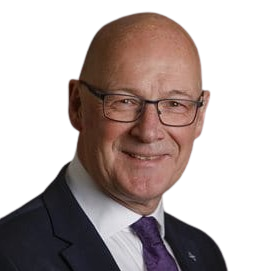
John Swinney is the first minister of Scotland and leader of the Scottish National Party (SNP). He assumed office as first minister in May 2024.
Swinney has had a long career in Scottish politics, previously serving as deputy first minister.
Swinney represents the constituency of Perthshire North in the Scottish Parliament. He has held this seat, and its predecessor Tayside North, since 1999.
Political Career
Swinney serves as the first minister of Scotland and leader of the SNP (since May 2024).
Swinney led his party into the May 2026 Scottish Parliament election. The SNP was returned as the largest party with 58 seats.
Swinney assumed office as first minister following the collapse of Humza Yousaf’s administration. Yousaf succeeded Nicola Sturgeon as first minister after winning the 2023 SNP leadership contest, defeating rivals Kate Forbes and Ash Regan.
In April 2024, Yousaf’s disastrous decision to end the SNP’s power-sharing agreement with the Scottish Greens led to a vote of no confidence. The Scottish Greens, the SNP’s former pro-independence partners in government, were lined up to vote against Yousaf, alongside the Scottish Conservatives, Scottish Labour and the Scottish Liberal Democrats. Yousaf responded by resigning.
Swinney was elected as the new leader of the SNP unopposed and became Scotland’s first minister in May 2024 – just weeks before a UK general election was called for 4 July. Swinney appointed Forbes as deputy first minister.
On 10 May, Swinney admitted that the SNP government’s proposed gender recognition reforms could not be “implemented.” Sturgeon’s departure had followed the controversy over the Gender Recognition Reform Bill, which sought to amend the Gender Recognition Act 2004, making it simpler for people to change their gender without having to obtain a medical diagnosis.
Swinney entered the 2024 general election campaign seeking to steady the ship. The SNP’s manifesto continued to foreground independence, with the first page declaring: “VOTE SNP FOR SCOTLAND TO BECOME AN INDEPENDENT COUNTRY.”
The official strategy, carried over from his predecessors, stated that winning a majority of the 57 Scottish seats at Westminster would empower the Scottish government to begin immediate negotiations with the UK government on independence.
The results of the 2024 general election marked a seismic shift in the Scottish political landscape and a severe setback for the independence movement. The SNP’s long-held electoral dominance crumbled as the party’s representation at Westminster was decimated, falling from 48 to just 9 seats. In a dramatic reversal of fortunes, the Labour Party surged back to prominence in its former heartland, winning 37 seats and becoming the largest Scottish party at Westminster for the first time since 2010. The SNP’s share of the vote fell by 15 points to 30%, while Labour’s rose by over 16 points to 35.3%.
In the wake of this crushing defeat, Swinney conceded that the SNP had “failed to convince people of the urgency of independence” and that the party’s strategy would have to be fundamentally rethought. The “de facto referendum” plan was rendered irrelevant, and the immediate prospect of another independence vote vanished.
In October 2025, SNP members endorsed a conference motion that said the 2026 Holyrood election should be fought on a “clear platform of national independence” and that winning a majority would be “the only uncontested way to deliver a new vote on Scotland’s future”.
In the 2026 Scottish Parliament election, the SNP won 58 seats – a net loss of six. Scottish Labour lost five seats, winning a total of 17. On 19 May, Swinney was re-appointed first minister.
Swinney previously served as deputy first minister of Scotland under Sturgeon from November 2014 to May 2023.
Swinney served as cabinet secretary for finance, constitution and economy from 2014 to 2016, and then as cabinet secretary for education and skills from 2016 to 2021. He later served as cabinet secretary for Covid recovery from 2021 to March 2023.
Swinney previously led the Scottish National Party from 2000 to 2004, during a period when the party was in opposition. He resigned from this leadership role in 2004 following disappointing results for the SNP in the European Parliament elections.
Before becoming an MSP, Swinney was MP for North Tayside in the UK parliament from 1997 to 2001.
Political Views
Swinney is a long-standing advocate for Scottish independence, a central tenet of the Scottish National Party.
In his leadership bid in 2024, Swinney emphasised the need for unity within the SNP. He indicated a pragmatic approach to governing, which was epitomised by his appointment of Kate Forbes as deputy first minister.
In the 2024 SNP manifesto, Swinney called for NHS funding to be boosted by £10 billion a year, renewed independence talks, the two-child limit on benefits to be scrapped and a ceasefire in Gaza.
Before Politics
Swinney was born on 13 April 1964 in Edinburgh, Scotland. He attended Forrester High School in Edinburgh.
He studied politics at the University of Edinburgh.
After university, Swinney worked as a management consultant.
Personal Life
Swinney is married to Elizabeth Quigley, a former BBC journalist. The couple has one son, Matthew, born in 2010.
Swinney was previously married to Lorna King, with whom he has two children, Judith and Stuart. This first marriage ended in divorce.
Trivia
Swinney joined the SNP in 1979 at the age of 15.
He is a supporter of Heart of Midlothian FC or Hearts.
John Swinney has not written for Politics.co.uk.