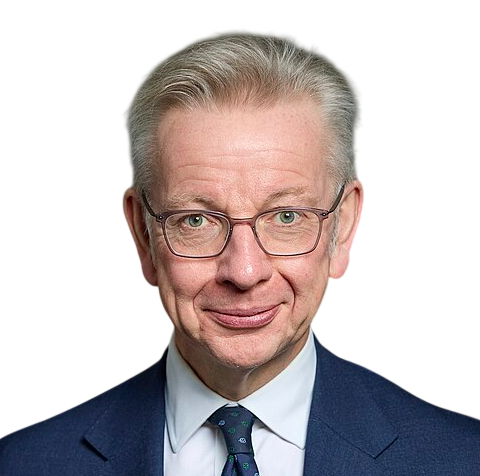
Michael Gove served as the Conservative MP for Surrey Heath from 2005 until the 2024 general election.
Gove is now editor of The Spectator magazine.
A prominent figure in Conservative governments from 2010 to 2024, Gove held a succession of senior cabinet posts. He sat in the cabinet continuously across this period, excluding two periods on the backbenches between 2016 to 2017, and July to October 2022.
Gove’s last role was as secretary of state for levelling up, housing and communities, to which he was re-appointed by Rishi Sunak in October 2022, serving until July 2024. He was sacked from the same role by Boris Johnson in July 2022 after advising the then prime minister to resign.
Gove’s relationship with Johnson was a prominent theme throughout his frontline political career.
In May 2024, Gove announced that he would be standing down from parliament at the forthcoming general election. In a letter to his constituency association, he wrote that, “there comes a moment when you know that it is time to leave. That a new generation should lead.”
Following Gove’s retirement, his former constituency of Surrey Heath was won by the Liberal Democrats. The Liberal Democrat candidate, Al Pinkerton, secured 21,387 votes (44.8%), while the Conservative candidate, Ed McGuinness, polled 15,747 votes (33.0%).
Michael Gove and ‘levelling up’
Gove served as secretary of state for levelling up, housing and communities in two stints from September 2021 to July 2022 and October 2022 to July 2024. He also served a minister for intergovernmental relations from October 2022 to July 2024.
On 2 February 2022, the government published its levelling up white paper – a 332-page document dedicated to Boris Johnson’s flagship policy. The white paper was spearheaded by Gove and established 12 national “missions” to be achieved by 2030 – targeting gaps in pay, productivity, health and transport infrastructure.
In a commons statement, Gove described the government’s objective as enabling “overlooked and undervalued communities to take back control of their destiny.”
He added: “While talent is spread equally across the United Kingdom, opportunity is not. Our country is an unparalleled success story, but not everyone shares in it.”
The levelling up agenda, widely viewed as a distinctive expression of Johnson’s vision for post-Brexit Britain, was embraced more cautiously by his Conservative successors as prime minister. In April 2024, Gove admitted that progress was incomplete, comparing the policy to a “half-built cathedral”.
Gove told the Financial Times: “You know, if I’m in the middle of building a cathedral, you might say, ‘well some of it looks great but the rest of it is just a mess’… but that’s because we are still constructing it. You’ve got to dream great if you want to achieve anything.”
Speaking on the Lord Speaker’s Corner podcast in December 2025, Gove reflected on the levelling up agenda’s apparent failure, attributing it to institutional scepticism across Whitehall.
Gove said: “The original impetus behind coming up, of course, came from Boris, and the white paper was… I thought a very effective way of giving effect to what he’d been talking about in very high level terms.
“But folk in the treasury were skeptical about what we were doing. They thought that this was just old-fashioned regional policy in new clothes. And other government departments didn’t like the idea in particular of devolving areas.”
Gove noted that the Department for Education opposed devolving elements of the skills budget to local areas, while the Department for Work and Pensions objected to devolving responsibility for employment support.
He added: “And as I say, Treasury ministers overall in particular thought that we were attempting to push water uphill. And that if you really wanted to promote growth, then making a particular emphasis on left-behind areas was a very long-haul exercise that would not generate the rapid growth the country needed.”
Michael Gove, the Conservative leadership and Boris Johnson
Gove twice stood for the leadership of the Conservative Party in 2016 and 2019. He placed third in both contests.
The 2016 contest was triggered by the resignation of Cameron following the UK’s vote to leave the European Union. Gove had been expected to manage Boris Johnson’s campaign. However, Gove stunned Westminster by declaring his own candidacy and rubbishing Johnson’s credentials as a possible prime minister. The justice secretary argued that “Boris cannot provide the leadership or build the team for the task ahead.”
In a statement, Gove declared: “I have repeatedly said that I do not want to be prime minister. That has always been my view. But events since last Thursday have weighed heavily with me.”
He suggested that Johnson, his fellow Vote Leave figurehead, could not lead Britain to a “better future”.
Johnson responded to Gove’s act of treachery by effectively withdrawing from the contest. The event intended as his campaign launch was instead repurposed to signal his decision to stand aside.
The former mayor of London told supporters: “I must tell you, my friends, you who have waited faithfully for the punchline of this speech, that having consulted colleagues and in view of the circumstances in parliament, I have concluded that person cannot be me.”
In the end, five candidates put themselves forward: Gove, Theresa May, Andrea Leadsom, Liam Fox and Stephen Crabb.
In the first ballot of Conservative MPs on 5 July, May established a commanding lead with 165 votes. Leadsom, a junior energy minister and Brexit-supporter, came second with 66 votes. Gove placed third with the support of 48 MPs. The second ballot of Conservative MPs was held on 7 July with only three candidates in the running. May extended her lead, securing 199 votes. Leadsom again came second with 84 votes, while Gove (46) was eliminated.
Gove’s 2019 campaign to be Conservative leader was also largely pitched as a more credible and professional alternative to Johnson. In an implied criticism of Johnson, who carried out few media interviews during the leadership contest, Gove said: “These are serious times; we need a serious leader. The stakes couldn’t be higher, the consequences couldn’t be greater.”
Gove, then the environment secretary, reached the final three during the parliamentary ballot stage. He was ultimately eliminated in the fifth ballot on 20 June, receiving 75 votes – just two fewer than Jeremy Hunt. Johnson defeated Hunt in the Conservative members ballot.
In June 2022, Gove publicly declared his loyalty to Johnson, ahead of a Conservative “no-confidence” in his leadership. The vote was triggered by discontent within the parliamentary party following the “partygate” scandal and the publication of the Sue Gray report. While the prime minister ultimately won the vote, the scale of the rebellion against him, with 148 of his own MPs voting to remove him, severely weakened his authority and presaged his resignation the following month.
At the time, Gove stated: “I’ll be voting for Boris this evening. The PM got the big decisions right on Brexit and Covid. We need to focus now on defending Ukraine, driving levelling-up and generating growth. We need to move past this moment and unite behind Boris to meet these challenges.”
But Gove did not ride to the support of Johnson during the July 2022 government crisis, triggered by the “Pincher affair”. Chris Pincher, who was responsible for maintaining party discipline and MP welfare, was accused of groping two male guests on the evening of 29 June 2022 at the Carlton Club.
On 6 July 2022, Gove was sacked as levelling up secretary for “disloyalty”.
Gove also served as chancellor of the Duchy of Lancaster from July 2019 to September 2021 under Johnson.
Michael Gove and Brexit
Gove supported Leave in the 2016 Brexit referendum, and therefore agreed with a majority of his constituents, 51.9% of whom voted to Leave. Crucially, he was one of the “gang of six” cabinet ministers who, after a rare Saturday cabinet meeting on 20 February 2016, broke ranks to join the Vote Leave campaign.
At the time, Gove, a close political ally of Cameron, released a 1,500-word essay outlining what he called “the most difficult decision of my political life.”
He wrote: “It pains me to have to disagree with the prime minister on any issue. My instinct is to support him through good times and bad.
“But I cannot duck the choice which the prime minister has given every one of us. In a few months time we will all have the opportunity to decide whether Britain should stay in the European Union or leave. I believe our country would be freer, fairer and better off outside the EU. And if, at this moment of decision, I didn’t say what I believe I would not be true to my convictions or my country.”
During the campaign, Gove famously remarked in an interview with Sky News that “people in this country have had enough of experts”.
In his memoirs, published December 2019, Cameron recalls that Gove promised to assume a low-profile role in the referendum. The battles that followed – which featured Gove at the forefront – placed significant strain on the integrity of the Conservative government.
On 23 June 2016, the United Kingdom voted to leave the European Union by 51.9% to 48.1%.
The referendum result ultimately triggered Cameron’s resignation, the dramatic rupture between Gove and Johnson, Gove’s own unsuccessful leadership bid, and his subsequent relegation to the relative wilderness following Theresa May’s elevation to the premiership.
Gove was dismissed as justice secretary after May was appointed as prime minister.
However, he was reappointed to the cabinet following the 2017 general election, which resulted in a hung parliament with the Conservatives as the largest party. Gove was made secretary of state for environment food and rural affairs. He served in this post loyally from June 2017 to July 2019.
When the cabinet met at Chequers, the country house of the UK prime minister, to agree May’s Brexit strategy in July 2018, Gove was reportedly among the first to back the scheme.
In March 2019, during an impassioned speech in the House of Commons, Gove praised May for her “full-hearted desire to do what is right for our country”.
He added: “Throughout this process she has shown fortitude, tenacity, thoughtfulness, diligence and, above all, an unselfish and unstinting patriotism.
“I think it only appropriate that in all parts of the House, whatever political differences we have, we recognise that the prime minister always, always puts country first, and that we are fortunate to have her in that position.”
Gove voted for May’s Brexit withdrawal agreement on all three occasions (“meaningful votes”).
Michael Gove and David Cameron
Gove, upon his election to parliament following the 2005 general election, was immediately appointed to the Conservative frontbench. He became a close ally of David Cameron during his tenure as leader of the opposition, and was promoted to the shadow cabinet as early as 2007, serving as shadow secretary of state for children, schools and families.
In the wake of the 2010 general election and the formation of the Conservative-Liberal Democrat coalition, Gove was appointed as education secretary. In this role, Gove was widely regarded as one of the coalition’s most proficient and energetic ministers. He oversaw a programme of school reforms that was lauded by ministers as transformative.
Gove’s tenure as education secretary was nonetheless marked by conflict with teaching unions. The education secretary was accused of taking a deliberately confrontational stance in his struggles with “The Blob” – the name he and his allies gave to the educational establishment.
In July 2014, Gove was moved from his position as education secretary to take on the role on chief whip. This move was the centrepiece of the reshuffle and pointed to strained relations between Gove and the prime minister.
Gove’s appointment as chief whip, a backroom party-management position, meant his removal from the political frontline. He was replaced as education secretary by Nicky Morgan, the former financial secretary to the treasury. Morgan’s promotion was part of an effort by Cameron to increase female representation at the cabinet table, and adopt a more congenial stance on education policy.
Gove’s removal was deeply politically sensitive.
In his memoirs, Cameron noted a conversation with Gove in which he said he would “love to be chief whip”. He also recalled telling Gove of his plans at the start of July – and receiving his approval. Gove changed his mind, however.
Upon receiving Gove’s second thoughts, the then prime minister responded: “I don’t accept your email. You have agreed to do this job. I’ve told you everything we’re planning. I accept your withdrawal of the email, and I expect to speak to you later on today about how we are going to finalise the reshuffle.”
He added: “You must realise that I divide the world into team players and w*****s. You’ve always been a team player. Please don’t become a w*****.”
Cameron sensed Gove’s former adviser, Dominic Cummings, was influencing his thinking.
Allies of the new chief whip were also said to have been angered by reports that Lynton Crosby, the Conservative campaign director, warned No 10 that Gove was “toxic” in polls.
At the time of the reshuffle, Gove’s private misgivings manifested in public when his wife, Daily Mail columnist Sarah Vine, shared an op-ed on social media which described the ministerial changes as a “shabby day’s work” and her husband’s demotion as “worse than a crime”. Cummings, meanwhile, accused the prime minister of surrendering to the education establishment. “We got away with subverting every [Whitehall and] No 10 process, & it took [Cameron] 4 yrs to surrender”, he blogged.
Publicly, both Gove and Cameron dismissed suggestions that the former’s removal as education secretary was a demotion. But it was plain that the former had, at least, mixed emotions over the move. He told the BBC that it was a “wrench” to leave his education post but whether you called it “demotion, emotion, locomotion” it was “exciting to be given a role at the heart of government”. Gove is said to have been bruised by the fact his new role only attended cabinet, rather than being a full member. It also involved a £36,000 pay cut.
Under the Fixed Term Parliaments Act 2011, the next general election was scheduled for 7 May 2015. The frontbench changes were clearly crafted with the forthcoming campaign in mind.
Gove was appointed as secretary of state for justice in May 2015, after the 2015 general election resulted in a Conservative majority government.
Cameron went on to deliver his pledge to hold an in-out referendum on Britain’s membership of the European Union.
What is he doing now?
Gove was created a life peer in the 2024 dissolution honours, taking the title Lord Gove.
He was appointed editor of The Spectator magazine in October 2024.
Political views
Leadership elections
Tory leadership 2022 (II): Gove supported Rishi Sunak’s candidacy in the Conservative Party’s October 2022 leadership election. The contest was triggered by the resignation of Liz Truss after just 45 days in office, following the financial and political tailspin triggered by her “mini-budget”.
Sunak, the former chancellor, had finished second to Truss in the previous contest. Unlike the summer contest, this election featured an expedited process requiring each candidate to secure at least 100 nominations from MPs to proceed. Sunak, having emerged as the clear frontrunner, was declared leader of the Conservative Party unopposed on 24 October.
Tory leadership 2022 (I): Gove supported Kemi Badenoch’s candidacy in the Conservative Party’s July-September 2022 leadership election. The contest was triggered by the resignation of Boris Johnson, following the mass exodus of more than 60 frontbenchers.
Badenoch, who had resigned as a local government minister, was seen as a combative culture warrior. Having gained significant momentum among the party’s right wing, she was eliminated in the fourth parliamentary ballot on 19 July after receiving 59 votes.
Gove went on to support Sunak’s candidacy. Sunak, the former chancellor, warned against “comforting fairytales” regarding unfunded tax cuts. Although he won every round of the parliamentary ballots, securing 137 votes in the final stage, Sunak was defeated by Liz Truss in the membership vote, finishing with 60,399 votes (42.6%).
Tory leadership 2016: After his elimination from the contest, Gove supported Theresa May for the party’s leadership in July 2016. The contest was triggered by the resignation of David Cameron following the UK’s vote to leave the European Union.
May, the then-home secretary, secured a commanding lead in the parliamentary stages, receiving 165 votes in the first ballot and 199 in the second. Following the withdrawal of her final rival, Andrea Leadsom, on 11 July, May was declared leader unopposed and was appointed prime minister two days later.
Brexit and Europe
Article 50: In February 2017, Gove voted in favour of the European Union (Notification of Withdrawal) Bill. The legislation empowered the prime minister to notify the Council of the European Union of the UK’s intention to withdraw, formally triggering the process set out in Article 50 of the Treaty on European Union. MPs supported the bill by 498 votes to 114 at second reading.
Social values and conscience issues
Same-sex marriage (2013): In February 2013, Gove was one of the 131 Conservative MPs to vote in favour of the Marriage (Same Sex Couples) Bill at its second reading. The landmark piece of legislation, which received its second reading by 400 votes to 175, legalised marriage for same-sex couples in England and Wales.
Foreign policy and security
Trident renewal (2016): Gove voted in favour of a government motion calling for the renewal of the Trident nuclear deterrent system in July 2016. The motion, which was passed by 472 votes to 117, committed the UK to constructing a new fleet of submarines to carry the nation’s nuclear weapons.
Syria airstrikes (2015): Gove voted in favour of a government motion to extend UK airstrikes against Isis from Iraq into Syria in December 2015. The motion, which was passed by 397 votes to 223 after a 10-hour debate in the House of Commons, authorised the RAF to conduct strikes against Isis targets in Syria.
Syria airstrikes (2013): Gove voted in favour of the government’s motion on the principle of military intervention in Syria in August 2013. The government motion was defeated by 285 votes to 272, a move which effectively ruled out UK participation in any US-led military strikes.
Before Politics
Born Graeme Andrew Logan in Aberdeen in 1967, Gove was adopted at four months old, after which his name was changed to Michael Gove.
Gove attended Robert Gordon’s College, a private school in Aberdeen, before attending Lady Margaret Hall, Oxford, where he read english and served as president of the Oxford Union.
Before entering parliament, Gove worked as a journalist. He worked for The Press and Journal in Aberdeen, Scottish Television, and the BBC before joining The Times newspaper. At The Times, he held senior roles including leader writer and assistant editor.
Personal Life
Gove married the journalist Sarah Vine in 2001. The couple have a son and a daughter. They announced in July 2021 that they were separating and finalised their divorce in 2022.
In his 2005 maiden speech, Gove stated: “As the son of a small business man who ran a flourishing fish merchants in Aberdeen, at a time when that city’s fishing industry was in ruder health than today, I know personally how regulation and legislation conceived from the best of motives can stifle enterprise and limit opportunity.”
He added: “Any opportunities that I have in life I owe to my parents and to the sacrifices that they made. They adopted me when I was just four months old, and I was fortunate therefore to be raised in a secure and loving home.
“That has left me with a profound sense of the importance of helping families to withstand all the pressures placed on them by modern life, and I hope in my time in this House to do what I can to improve the lives of children born to disadvantage and to support all parents in the difficult but immensely rewarding task of raising families.”
Trivia
In August 2021, while on a visit to his childhood home of Aberdeen, Gove was filmed dancing in a local nightclub. The incident was referenced by then-prime minister Boris Johnson in his Conservative Party conference speech.
Johnson nicknamed Gove “Jon Bon Govi”.
He is reportedly a supporter of Chelsea Football Club.
Michael Gove has not written for Politics.co.uk.