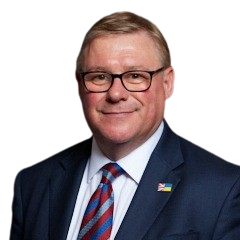
Mark Francois is the Conservative MP for Rayleigh and Wickford, having first been elected for the predecessor seat of Rayleigh at the 2001 general election.
In the 2024 general election, Francois won 17,756 votes, representing 37.0% of the vote. The Reform UK candidate, Grant Randall, received 12,135 votes (25.3%), while the Labour candidate, James Hedges, secured 11,823 votes (24.6%). Francois was duly elected with a majority of 5,621 votes.
The Rayleigh and Wickford constituency is located in South Essex and includes the towns of Rayleigh, Wickford, Hawkwell, and Hockley. The constituency boundaries were modified for the 2024 election. It is considered a safe Conservative seat with high levels of home ownership and strong support for Brexit in the 2016 referendum.
Political Career
Francois was appointed as shadow minister of state for defence in November 2024.
During the Conservative Party’s tenure in government, Francois was minister of state for communities and resilience from May 2015 to July 2016 – serving concurrently as minister of state for Portsmouth, minister of state for the armed forces from October 2013 to May 2015, and minister of state for defence personnel, welfare and veterans from September 2012 to October 2013.
Francois was also a senior government whip (vice-chamberlain of the household) from 2010 to 2012. This role meant Francois was partly responsible for enforcing party discipline and managing the government’s legislative agenda in the House of Commons. As a whip, Francois’s primary duty was to ensure that the party’s MPs attended parliamentary votes and supported the government’s position.
In opposition, he held roles including shadow minister for Europe from July 2007 to May 2010, shadow paymaster general from May 2005 to July 2007, shadow economic secretary to the Treasury from May 2004 to May 2005, and an opposition whip from May 2002 to May 2004.
Francois became chair of the European Research Group (ERG) of eurosceptic Conservative MPs in 2020. He was deputy chair of the influential caucus from 2018 to 2020.
https://x.com/BBCPolitics/status/1088814152037138435
Francois has repeatedly introduced private members’ bills aimed at regulating roadworks, including in the 2019-2021, 2022-2023 and 2024-2026 parliamentary sessions.
Francois was a member of the House of Commons public accounts committee from May 2021 to May 2024, the defence committee from September 2017 to May 2024, the administration committee from July 2010 to October 2012, and the environmental audit committee from July 2001 to July 2005.
Francois delivered his maiden speech on 4 July 2001. In it, he said: “I am in favour of enlargement of the European Union in principle, but not at any price.
“I have an affection for the Republic of Ireland; I proposed to my wife Karen while overlooking Galway bay. The next time I visit, I would like to congratulate the people of that country on their sagacious decision to vote against the Nice treaty [in 2001], and by such a clear margin.”
He added: “Whatever the views of any [MP] on the European issue, when a country as traditionally pro-European as the Irish Republic votes against a European treaty, that should, at the very least, give us all pause for thought.
“I confess that I was not quite old enough to vote in the British referendum in 1975, but I believe there was no real practical discussion of a federal Europe or of abandoning our currency…
“The British people were essentially told that they were assenting to a free trade area – a common market – and that is what they endorsed in 1975. The further we move from that position, the greater the risk that we shall exhaust their patience on all things European.
“We are an historically tolerant people, and we are willing to negotiate and co-operate, but we will not be subsumed by a foreign superstate that ignores our traditions and undermines our laws.”
Before entering parliament, Francois served on Basildon District Council from 1991 to 1995, acting as vice-chairman of the housing committee from 1992.
Francois previously stood unsuccessfully as the Conservative candidate for Brent East in the 1997 general election, finishing second to Labour incumbent Ken Livingstone on 7,866 votes (22.3%).
Francois issued a plea at the 1995 Conservative conference for no cuts in defence spending.
With then-defence secretary Michael Portillo (whom Francois would later challenge unsuccessfully in the Tory selection race ahead of the 1999 Kensington and Chelsea by-election) and PM John Major sat behind him, Francois told delegates: “There is always a danger, when governments are under financial pressure, they are tempted to find savings from the defence budget. It is always a temptation they should resist.”
In the 1992 general election, he worked alongside Sir David Amess in his successful bid to defend the marginal seat of Basildon. Sir David, who was murdered at a constituency surgery in 2021, and Francois were long-standing close friends.
During the time of Francois’ 1995 conference speech, Amess served as Portillo’s parliamentary private secretary (PPS).
Remembering Sir David in an October 2021 commons debate, Francois described him as “my best and oldest friend in politics.”
In a moving contribution, he told the House: “Everything that I ever learned about how to be a constituency MP, I learned from David Amess. He sponsored me for the candidates list, and he mentored me when I arrived. Without him, I would never have become [an MP], so some might well argue that he has much to answer for…
“I am absolutely determined – I ask for the House’s support in this – that he will not have died in vain. He is now resting in the arms of the God he worshipped devotedly his whole life, so farewell David, my colleague, my great friend – in fact, quite simply the best bloke I ever knew.”
https://x.com/BBCPolitics/status/1450118226940203011
Political views
Leadership elections and loyalty
Tory leadership 2024: Francois supported Robert Jenrick’s candidacy in the 2024 Conservative Party leadership election. The contest was triggered by the resignation of Rishi Sunak following the party’s defeat in the 2024 general election.
Jenrick, a former immigration minister, positioned himself on the right wing of the party, advocating for the UK to leave the European Convention on Human Rights (ECHR). He emerged as an early frontrunner, topping the first two parliamentary ballots. After reaching the final two, he was defeated in the membership vote by Kemi Badenoch, receiving 41,388 votes (43.5%) compared to Badenoch’s 53,806 (56.5%).
In an article for the Daily Express, published August 2024, Francois praised Jenrick’s decision to resign from Sunak’s government in late 2023 in opposition to the Rwanda bill. “I hardly need to stress how rare in modern politics that action now is”, he wrote.
He also argued that Jenrick was right to call for the UK to withdraw from the ECHR. “We do not need to publish our detailed 2028/9 manifesto next week but we do, before too long, need to start staking out clear and principled positions, on key issues, so that we can begin to win back lost Conservative voters, not least from Reform”, Francois argued.
He added: “Based on experience, Robert has now taken one such position – that we will need to withdraw from the ECHR if we are to regain our territorial integrity and I think he is probably right.”
Tory leadership 2022 (I): Francois supported Liz Truss’ candidacy in the Conservative Party’s July-September 2022 leadership election. The contest was triggered by the resignation of Boris Johnson, following the mass exodus of more than 60 frontbenchers.
Truss, the then-foreign secretary, campaigned on a platform of sweeping tax cuts. After finishing second in the final parliamentary ballot with 113 votes, she won the subsequent vote of the party membership with 81,326 votes (57.4%) and was appointed prime minister on 6 September.
Tory leadership 2019: Francois supported Boris Johnson for the party’s leadership in 2019. The election was triggered by the resignation of Theresa May following her inability to secure a Brexit deal acceptable to the Conservative Party.
Johnson, the former foreign secretary and mayor of London, campaigned on the central pledge to “deliver Brexit” by 31 October 2019, “deal or no deal”. He thereby positioned himself as the candidate best-placed to break the parliamentary deadlock. Johnson secured 114 votes in the first parliamentary ballot, and reached 160 votes in the final MP round. In the subsequent ballot of the party membership, Johnson won a decisive victory with 92,153 votes (66.4%).
Factional identity and party tradition
Net Zero Scrutiny Group: In the 2019-2024 parliament, Francois was associated with the Net Zero Scrutiny Group (NZSG), a faction within the Conservative Party that questioned the cost and feasibility of the UK’s climate targets. The group, which came to prominence in 2022, sought to link the then-Conservative government’s commitment to net zero with the cost-of-living crisis. In a 2022 open letter published in the Daily Telegraph, the group urged the government to scrap green levies and drill for more fossil fuels in the North Sea to lower energy bills. The COP26 climate conference in 2021 was said to have been a catalyst for the group’s formation.
Conservative Way Forward: Francois has been associated with the Conservative Way Forward (CWF) grouping of Thatcherite MPs. CWF was founded in 1991 by supporters of Margaret Thatcher, aiming to “defend and build upon [her] achievements… and to adapt the principles of her era in government to modern concerns and challenges”. In July 2022, the group was relaunched by Tory MP Steve Baker.
Animal welfare: Francois is a patron of the Conservative Animal Welfare Foundation (CAWF). The CAWF, co-founded animal welfare campaigner Lorraine Platt and Carrie Johnson, the wife of the former prime minister, calls for an end to live animal exports for fattening and slaughter, tougher sentencing for animal cruelty, and a ban on the import of fur and foie gras. It has close links with the Conservatives Against Fox Hunting campaign, also known as Blue Fox.
Brexit and Europe
Brexit referendum: Francois supported the Leave campaign in the 2016 referendum on Britain’s membership of the European Union (EU), and therefore agreed with a majority of constituents, 67.7% of whom also voted to Leave.
Article 50: In February 2017, Francois voted in favour of the European Union (Notification of Withdrawal) Bill. The legislation empowered the prime minister to notify the Council of the European Union of the UK’s intention to withdraw, formally triggering the process set out in Article 50 of the Treaty on European Union. MPs supported the bill by 498 votes to 114 at second reading.
European Research Group: Francois succeeded Steve Baker as chair of the European Research Group in 2020. During the Conservative Party’s last stint in government, the ERG emerged as a highly influential Tory faction composed of staunchly eurosceptic MPs. Founded in 1993, the group played a pivotal role in shaping the UK’s exit from the European Union, consistently advocating for a “hard” Brexit. Its members were generally and often stridently critical of the withdrawal agreement negotiated by Theresa May. Francois acted, in effect, as the ERG’s chief whip during this period – corralling parliamentary sentiment against May’ deal in an attempt to defeat it.
In March 2019, when asked at the time why he would not accept May’s Brexit deal and “bank the win”, Francois responded: “I was in the army, I wasn’t trained to lose.”
https://x.com/frasernelson/status/1105945440564989952
Marina Hyde of the Guardian described Francois as the “undisputed breakout star of Britain’s Brexit s***show.”
Brexit spartan: Francois was one of the 28 so-called “Brexit spartans”, a group of hardline Eurosceptic Conservative MPs who voted against May’s Brexit withdrawal agreement on all three occasions it was put to parliament in 2019. The so-called “spartans” argued that May’s deal did not represent a genuine departure from the European Union. Their steadfast opposition was a critical factor in May’s resignation as prime minister.
Francois’ self-published memoir, Spartan Victory: The inside story of the Battle for Brexit, recounts his view of this turbulent period in British politics – in which he played a starring role. The book states that prior to the third “meaningful vote” on May’s deal, Francois was “absolutely settled in my mind about what to do”. Francois also revealed the “Spartan” title originated from a conversation he had with ConservativeHome’s Paul Goodman.
Speaking to the friendly Bruges Group in December 2021, Francois commented: “I think everyone in politics knows the story of the Spartans, at least anyone who followed the Brexit debate closely anyway!
“We were the 28 Brexiteer MPs who voted against the prime minister’s withdrawal agreement all three times when she put it to the House of Commons in the so-called ‘meaningful votes’, the third and final attempt being on March 29th 2019, the day we were supposed to leave the European Union.”
He added: “The reason I made that analogy is because I would argue that the 28 Spartans literally saved our country from becoming a vassal state.
“Another reason for the comparison is because of the vilification we received for voting against the deal, the same vilification which Lord [Michael] Spicer spoke of when he led the charge against [the 1993 Maastricht Treaty], I want to convey to the reader of my book what that feels like and the tremendous amount of pressure we were under to crack.”
During the latter stages of the 2019 to 2024 parliament, the ERG proved something of a thorn in the side of Rishi Sunak as prime minister, rebelling on two notable occasions: over the Windsor framework, the UK-EU deal on post-Brexit arrangements in Northern Ireland, and the government’s plan to enable the Rwanda deportation scheme.
Responding to the Windsor framework, unveiled in February 2023, the ERG under Francois’ chairship commissioned a “star chamber” of legal experts to pore over the agreement. Speaking at a March 2023 press conference, Francois said that among the chamber’s findings were that, under the terms of the Windsor framework, EU law was “supreme” in Northern Ireland and that the rights of its people secured in the 1800 Act of Union had still not been restored.
Francois said the Stormont brake – the mechanism to allow a minority of politicians in Belfast to formally flag concerns about the imposition of new EU laws in Northern Ireland – was “practically useless”.
In the end, 22 Conservative MPs – Francois included – voted against the “Stormont brake” aspect of the Windsor framework, which was subject to a commons division on 22 March 2023.
Customs union vote (2025): In December 2025, Francois voted against the UK-EU Customs Union (Duty to Negotiate) Bill. The bill, introduced under the ten-minute rule procedure by Liberal Democrat Europe spokesperson Al Pinkerton, sought to mandate the government to enter into negotiations with the European Union to establish a bespoke customs union.
Rwanda rebellion (amendments): In January 2024, Francois was one of around 60 Conservative MPs who supported amendments to the government’s Safety of Rwanda (Asylum and Immigration) Bill. The amendments, proposed by Conservative MPs Sir Bill Cash and Robert Jenrick, sought to strengthen the proposed legislation by limiting the ability of individual asylum seekers to prevent their deportation to Rwanda, under the terms of the government’s flagship removals scheme.
Rwanda rebellion (third reading): In January 2024, Francois was one of 11 Conservative MPs to vote against the Safety of Rwanda (Asylum and Immigration) Bill at its third reading. The bill was passed by the House of Commons by 320 votes to 276. The Tory MPs who voted against it, including former home secretary Suella Braverman and former immigration minister Robert Jenrick, argued that it did not go far enough in closing off legal challenges from asylum seekers facing deportation.
These votes came after the ERG joined forces with a constellation of other Conservative caucuses situated on the party’s right flank. Together, the ERG alongside the New Conservatives, the Conservative Growth Group (CGG), the Commons Sense Group (CSG) and the Northern Research Group (NRG) made up the so-called “five families” of Tory rebel vehicles.
The “five families” had called on the prime minister to strengthen the proposed Rwanda legislation by way of a series of amendments. Francois argued that the Rwanda bill, in its original form, did not afford ministers the necessary powers to achieve Sunak’s pledge to “stop the boats”.
In an article for the Telegraph, published 13 January 2024, Francois alongside Danny Kruger of the New Conservatives and Sir John Hayes of the CSG, compared themselves to the Tory “Spartans” who sank May’s Brexit deal .
They wrote: “As the leaders of the three largest groups of Conservative MPs on the conservative wing of the parliamentary party, we have united in recent weeks to express our fear that the Safety of Rwanda bill fails to do that.
“We have two principal concerns. Firstly, the bill as currently drafted does not give ministers the express authority to ignore – as a default – the anonymous ‘pyjama injunctions’ of the European Court of Human Rights [ECHR].
“Second, the continued right of migrants to delay their departure for many months, by making individual claims to UK courts by citing any number of personal circumstances, risks frustrating the entire purpose of the legislation.”
They added: “But the point is that the bill is simply not good enough in its current form to deliver the outcome we all seek. Failing to deliver for the British people carries a much greater cost than temporary discomfort in parliament. Standing firm is no more or less than our duty, for it means keeping our promise to those we serve – our constituents.”
Assisted dying
Francois voted against the Terminally Ill Adults (End of Life) Bill, better known as the assisted dying bill, at the second reading. On the third reading of the Terminally Ill Adults (End of Life) Bill (Assisted Dying Bill) in June 2025, Francois did not record a vote.
Social values and conscience issues
Abortion decriminalisation (2025): Francois voted against a backbench amendment to the Crime and Policing Bill that sought to decriminalise abortion in England and Wales in June 2025. The amendment, which was passed by a majority of 242 votes, removed women from the threat of prosecution for ending a pregnancy at any stage. As an issue of conscience, MPs were allowed to vote according to their personal beliefs.
Same-sex marriage (2013): In February 2013, Francois was one of the 139 Conservative MPs to vote against the Marriage (Same Sex Couples) Bill at its second reading. The landmark piece of legislation, which received its second reading by 400 votes to 175, legalised marriage for same-sex couples in England and Wales.
Foreign policy and security
Trident renewal (2016): Francois voted in favour of a government motion calling for the renewal of the Trident nuclear deterrent system in July 2016. The motion, which was passed by 472 votes to 117, committed the UK to constructing a new fleet of submarines to carry the nation’s nuclear weapons.
Syria airstrikes (2015): Francois voted in favour of a government motion to extend UK airstrikes against Isis from Iraq into Syria in December 2015. The motion, which was passed by 397 votes to 223 after a ten-hour debate in the House of Commons, authorised the RAF to conduct strikes against Isis targets in Syria.
Syria airstrikes (2013): Francois voted in favour of the government’s motion on the principle of military intervention in Syria in August 2013. The government motion was defeated by 285 votes to 272, a move which effectively ruled out UK participation in any US-led military strikes.
Iraq War authorisation vote (2003): In March 2003, Francois voted in favour of the government motion authorising military action against Iraq. The vote, one of the most contentious in recent parliamentary history, gave the prime minister, Tony Blair, the authority to join the US-led invasion.
Sanctioned (Russia): In April 2022, Francois was among the group of MPs placed on a sanctions list by the Russian government. The measure barred them from entering Russia and was presented by Moscow as a retaliatory response to the UK’s stance on the invasion of Ukraine.
Before Politics
Born Mark Gino Francois in Islington, London on 14 August 1965, his father was an engineer and his mother an Italian au pair. He moved to Basildon, Essex in 1971, growing up on a council estate.
He attended Nicholas Comprehensive School. He studied history at the University of Bristol (BA, 1986) and war studies at King’s College London (MA, 1987).
He served as an infantry officer in the Territorial Army (Royal Anglian Regiment) from 1983 to 1989. After university, he worked as a management trainee for Lloyds Bank and then as a political consultant for Market Access International.
He founded his own lobbying firm, Francois Associates, in 1996, closing it upon his election in 2001.
Personal Life
Mark Francois married Karen Thomas in June 2000. They divorced in 2006. Francois has said their relationship suffered from the pressures of his job as an MP.
“I didn’t afford Karen anything like the time and attention that I should have done. [She] tried to tell me on a number of occasions she was feeling neglected, but the truth is, I was so self-absorbed in what I was doing, I didn’t really hear what I was being told, until it was too late”, he wrote in his memoirs.
Francois is now married to Olivia Sanders, an NHS radiographer who is the former Conservative mayor of Brentwood.
Trivia
Mark Francois served as an officer in the Territorial Army in the 1980s.
Francois famously clashed with author Will Self in a March 2019 edition of BBC One’s Politics Live programme.
https://x.com/BBCEssex/status/1104059373175914496
During his time as a student, Francois challenged former commons speaker John Bercow for the chairmanship of the Society of Conservative Students.
At university, Francois was “good friends” with former Liberal Democrat MP Lembit Opik. Speaking to the Bruges Group, Francois said he once “turned down a double date with one of the Cheeky Girls [Monica Irimia]”. Opik had been in a relationship with Gabriela Irimia of the Cheeky Girls.
Francois sought the Conservative nomination to be the party’s candidate in the 1999 Kensington and Chelsea by-election – losing out to former Conservative cabinet minister Michael Portillo.
Mark Francois has not written for Politics.co.uk.