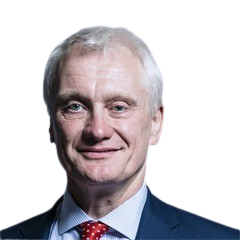
Graham Stuart is the Conservative MP for Beverley and Holderness, having represented the constituency since 2005.
In the 2024 general election, Stuart received 15,501 votes, representing 34.5% of the vote share. The Labour candidate, Margaret Pinder, received 15,377 votes (34.2%), while the Reform UK candidate, Andrew Smith, secured 8,198 votes (18.3%).Stuart was duly re-elected with an extremely narrow majority of just 124 votes.
The Beverley and Holderness constituency is located in the East Riding of Yorkshire. It includes the market town of Beverley, the smaller town of Hedon near the Humber Estuary and a significant stretch of the rural Holderness peninsula running down the North Sea coast to Spurn Point.
The seat was created in 1997 and has been held by the Conservative Party continuously since then, initially by James Cran (1997-2005) and subsequently by Stuart. While the Conservatives held large majorities between 2010 and 2019, the seat became highly marginal in the 2024 election.
Political Career
Stuart is a member of the panel of chairs (since January 2025). The panel of chairs is made up of MPs chosen by the House of Commons speaker, typically at the beginning of every parliament, to chair public bill committees and other commons general committees. In this capacity, Stuart also chairs debates in Westminster Hall and may also act as temporary chair during a committee of the whole House.
In March 2025, Stuart said that the UK should consider the possibility that Donald Trump, the US president, is a Kremlin asset. The comment was a response to Trump’s decision to pause all military aid to Ukraine.
Stuart posted to social media: “We have to consider the possibility that president Trump is a Russian asset.
“If so, Trump’s acquisition is the crowning achievement of [Vladimir] Putin’s FSB career – and Europe is on its own.”
Prior to the 2024 general election, which saw the Conservatives ejected from government, Stuart held several ministerial positions. He served as minister of state for energy security and net zero from September 2022 to April 2024.
Stuart resigned from this post in April 2024. In his resignation letter, addressed to Rishi Sunak as prime minister, Stuart said it was time to “step down”.
He added: “Having served as a minister for most of the last eight years I have decided that now is the time to stand down. I intend to continue serving my constituents in Beverley and Holderness, campaigning on local issues and look forward to fighting and winning the seat later this year.”
During his time as an energy security and net zero minister, Stuart was implicated in the botched management of a Labour opposition day that ultimately triggered Liz Truss’ resignation as prime minister. On 19 October 2022, the government, which had recently lifted the moratorium on fracking, faced an “opposition day” debate on this topic tabled by the Labour Party. The official opposition triggered a debate on the issue in order to drive a wedge between the government and anti-fracking Conservative MPs, who, after all, had been elected on a 2019 manifesto that pledged to keep the ban.
The Labour motion effectively forced Conservative MPs to either back fracking or rebel against their government. In response, the government attempted to maximise pressure on backbench MPs to prevent any rebellion. Senior government figures briefed that the vote was being treated as a vote of confidence in the prime minister.
This strategy led to chaos on the floor of the commons. Shortly before the vote, addressing the House from the government despatch box, Stuart announced that “quite clearly, this is not a confidence vote”. The intervention appeared to contradict the instruction delivered by the whips, causing widespread confusion.
Jacob Rees-Mogg, the business secretary at the time, blamed the confusion on “a junior official at 10 Downing Street [who] sent a message through to the front bench that it was not a vote of confidence and nobody else was aware of that”.
He added: “The whips were not aware of that, I was not aware of that and most members thought that it was a vote of confidence. It was simply one of those unfortunate miscommunications that occasionally happens.”
Stuart served briefly as minister of state at the Foreign, Commonwealth and Development Office in the caretaker/interim government constructed by Boris Johnson after he announced his resignation as Conservative leader.
In June 2022, Stuart publicly declared their loyalty to the prime minister, Boris Johnson, ahead of a Conservative “no-confidence” in his leadership. The vote was triggered by discontent within the parliamentary party following the “partygate” scandal and the publication of the Sue Gray report. While the prime minister ultimately won the vote, the scale of the rebellion against him, with 148 of his own MPs voting to remove him, severely weakened his authority and presaged his resignation the following month.
In a post to Twitter (now X) at the time, Stuart stated: “The prime minister has my full support. He led the country well through unprecedented challenges and has given global moral leadership in arming, supporting and advocating for Ukraine.”
Previously, Stuart was parliamentary under-secretary of state for international trade (responsible for exports and later investment) from January 2018 to September 2021 under Theresa May and Boris Johnson. He also served as a government whip (assistant whip, then lord commissioner) from July 2016 to January 2018.
Before entering government, Stuart chaired the House of Commons education select committee from June 2010 to March 2015. By virtue of this role, he served on the liaison committee across the same period.
Stuart was also a member of the children, schools and families committee (2007-2010), education and skills committee (2007), and the environmental audit committee (2006-2010).
Stuart is listed as a member of the all-party parliamentary groups (APPGs) for British buses, Hydrogen, Indonesia and Mexico.
Stuart delivered his maiden speech on 7 June 2005. In it, he said: “Our area has an older than average population, yet they have inadequate public transport to link them to public services. It may take two or even three bus rides to reach the hospitals.
“We are lucky, however, in having community hospitals in Withernsea, Hornsea and Beverley.”
He added: “I am yet to meet the person – certainly in Beverley and Holderness, of any political persuasion and of none – whose vision of life is of paying taxes throughout their working life and contributing to society, and whose aspiration at the end of it is to have to fill out a 24-page council tax benefit form and a 12-page pension credit form in order to get enough money on which to live.”
Before entering parliament, Stuart served as a Conservative councillor on Cambridge City Council, representing the Cherry Hinton ward from 1998 to 2004. He unsuccessfully contested the Cambridge constituency in the 2001 general election.
Political Views
Leadership elections and loyalty
Tory leadership 2022 (I): Stuart supported Grant Shapps’s candidacy in the Conservative Party’s July-September 2022 leadership election. The contest was triggered by the resignation of Boris Johnson, following the mass exodus of more than 60 frontbenchers.
Shapps, the transport secretary, emphasised his loyalty to Johnson, saying he had not plotted “behind his back”. Shapps withdrew from the contest shortly before the nominations deadline, after failing to secure enough support from fellow MPs to reach the required 20-nomination threshold.
Stuart went on to support Liz Truss’ candidacy. Truss, the then-foreign secretary, campaigned on a platform of sweeping tax cuts. After finishing second in the final parliamentary ballot with 113 votes, she won the subsequent vote of the party membership with 81,326 votes (57.4%) and was appointed prime minister on 6 September.
Tory leadership 2022 (II): Stuart supported Rishi Sunak’s candidacy in the Conservative Party’s October 2022 leadership election. The contest was triggered by the resignation of Truss after just 45 days in office, following the financial and political tailspin triggered by her “mini-budget”.
Sunak, the former chancellor, had finished second to Truss in the previous contest. Unlike the summer contest, this election featured an expedited process requiring each candidate to secure at least 100 nominations from MPs to proceed. Sunak, having emerged as the clear frontrunner, was declared leader of the Conservative Party unopposed on 24 October.
Tory leadership 2019: Stuart supported Boris Johnson for the party’s leadership in 2019. The election was triggered by the resignation of Theresa May following her inability to secure a Brexit deal acceptable to the Conservative Party.
Johnson, the former foreign secretary and mayor of London, campaigned on the central pledge to “deliver Brexit” by 31 October 2019, “deal or no deal”. He thereby positioned himself as the candidate best-placed to break the parliamentary deadlock. Johnson secured 114 votes in the first parliamentary ballot, and reached 160 votes in the final MP round. In the subsequent ballot of the party membership, Johnson won a decisive victory with 92,153 votes (66.4%).
Tory leadership 2016: Stuart supported Theresa May for the party’s leadership in July 2016. The contest was triggered by the resignation of David Cameron following the UK’s vote to leave the European Union.
May, the then-home secretary, secured a commanding lead in the parliamentary stages, receiving 165 votes in the first ballot and 199 in the second. Following the withdrawal of her final rival, Andrea Leadsom, on 11 July, May was declared leader unopposed and was appointed prime minister two days later.
Factional identity and party tradition
Conservative Environment Network: Stuart is listed as a member of the Conservative Environment Network (CEN) advisory council. CEN is an independent forum for conservatives that supports conservation and decarbonisation. It calls for the environment to be given a higher profile at the heart of policy making, describing “biodiversity loss, climate change, and wasteful resource use are threats to our national security”, and promotes “market-based policies” to environmental challenges. Members of its parliamentary caucus, such as …, are thought to generally align with the group’s “green” message and environmentalism.
Bright Blue: Stuart has been listed as a parliamentary supporter of Bright Blue, an independent centre-right think tank and membership organisation that champions liberal conservatism in the UK. Since its founding in 2014, the organisation has expanded its reach through a new cross-party strategy.
Brexit and Europe
Brexit referendum: Stuart supported Remain in the 2016 Brexit referendum, and therefore disagreed with a majority of constituents, 58.7% of whom voted to Leave.
Article 50: In February 2017, Stuart voted in favour of the European Union (Notification of Withdrawal) Bill. The legislation empowered the prime minister to notify the Council of the European Union of the UK’s intention to withdraw, formally triggering the process set out in Article 50 of the Treaty on European Union. MPs supported the bill by 498 votes to 114 at second reading.
Customs union vote (2025): In December 2025, Stuart voted against the UK-EU Customs Union (Duty to Negotiate) Bill. The bill, introduced under the ten-minute rule procedure by Liberal Democrat Europe spokesperson Al Pinkerton, sought to mandate the government to enter into negotiations with the European Union to establish a bespoke customs union.
Assisted dying
Stuart voted against the Terminally Ill Adults (End of Life) Bill, better known as the assisted dying bill, at both second reading (November 2024) and third reading (June 2025).
Social values and conscience issues
Abortion decriminalisation (2025): Stuart voted against a backbench amendment to the Crime and Policing Bill that sought to decriminalise abortion in England and Wales in June 2025. The amendment, which was passed by a majority of 242 votes, removed women from the threat of prosecution for ending a pregnancy at any stage. As an issue of conscience, MPs were allowed to vote according to their personal beliefs.
Foreign policy and security
Trident renewal (2016): Stuart voted in favour of a government motion calling for the renewal of the Trident nuclear deterrent system in July 2016. The motion, which was passed by 472 votes to 117, committed the UK to constructing a new fleet of submarines to carry the nation’s nuclear weapons.
Syria airstrikes (2015): Stuart voted in favour of a government motion to extend UK airstrikes against Isis from Iraq into Syria in December 2015. The motion, which was passed by 397 votes to 223 after a ten-hour debate in the House of Commons, authorised the RAF to conduct strikes against Isis targets in Syria.
Syria airstrikes (2013): Stuart voted in favour of the government’s motion on the principle of military intervention in Syria in August 2013. The government motion was defeated by 285 votes to 272, a move which effectively ruled out UK participation in any US-led military strikes.
Sanctioned (Russia): In April 2022, Stuart was among the group of MPs placed on a sanctions list by the Russian government. The measure barred them from entering Russia and was presented by Moscow as a retaliatory response to the UK’s stance on the invasion of Ukraine.
Before Politics
Born Graham Charles Stuart in Carlisle on 12 March 1962, he was educated at Glenalmond College, an independent school in Perthshire.
He attended Selwyn College, Cambridge, from 1982 to 1985, where he studied philosophy and law. He did not complete his degree, instead focusing on his business project producing “What’s on in Cambridge” guides.
Personal Life
Stuart has two daughters. He separated from his wife in January 2022
Trivia
Stuart’s hobbies include football, cricket, rugby and punk rock.


Comment: It’s time to let English MPs speak for England
5 December 2014