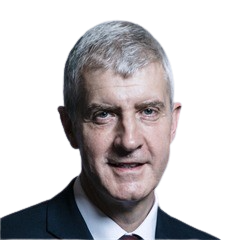
Derek Twigg is the Labour MP for Widnes and Halewood, having first been elected to parliament for the predecessor constituency of Halton at the 1997 general election.
In the 2024 general election, Twigg received 23,484 votes, representing 61.6% of the vote share. The Reform UK candidate, Jake Fraser, received 7,059 votes (18.5%), while the Conservative candidate, Sean Houlston, secured 3,507 votes (9.2%). Twigg was duly re-elected with a majority of 16,425 votes.
The Widnes and Halewood constituency straddles the River Mersey, covering the town of Widnes in Cheshire and the Halewood area of Knowsley in Merseyside.
It is a new constituency created for the 2024 general election, formed primarily from the abolished Halton constituency along with the Halewood area from the abolished Garston and Halewood seat. It had been a Labour seat from 1983.
Political Career
Twigg is a member of the House of Commons defence select committee (since May 2020) – the committee responsible for monitoring the expenditure, administration and policy of the Ministry of Defence (MOD) and its associated public bodies. The committee’s remit includes oversight of the British Armed Forces.
Twigg is also a member of the panel of chairs (since June 2020). The panel of chairs is made up of MPs chosen by the House of Commons speaker, typically at the beginning of every parliament, to chair public bill committees and other commons general committees. In this capacity, Twigg may chair debates in Westminster Hall and may also act as temporary chair during a committee of the whole House.
Twigg was appointed as head of the United Kingdom delegation to the Nato parliamentary assembly (Nato PA) by the prime minister in November 2024. The delegation serves as a consultative link between the UK parliament and Nato. The assembly brings together legislators from all 32 member states to debate and provide oversight on security and defence policy. The party distribution of the delegation is intended to reflect the composition of the House of Commons.
At the beginning of the parliament elected in 2024, Twigg stood unsuccessfully for election as chair of the defence committee. In the contest, the results of which were announced in September 2024, Twigg secured 243 votes, placing second. They were ultimately defeated by Tanmanjeet Singh Dhesi, who won the support of 320colleagues.
Twigg served as a minister in the governments of Tony Blair and Gordon Brown. His served as parliamentary under-secretary of state for veterans in the Ministry of Defence from September 2006 to October 2008, parliamentary under-secretary of state at the Department for Transport (May 2005 – September 2006), and parliamentary under-secretary of state for schools at the Department for Education and Skills (December 2004 – May 2005).
Twigg was also a government whip (lord commissioner of the Treasury) from June 2003 to December 2004 and an assistant whip from May 2002 to June 2003.
Before becoming a minister, he served as parliamentary private secretary (PPS) to Helen Liddell as minister of state for energy and Stephen Byers as secretary of state for transport, local government and the regions.
In opposition, Twigg was a shadow health minister from October 2010 to October 2011.
Twigg chaired the statutory instruments (joint committee) from July 2015 to November 2018. By virtue of this role, he sat on the liaison committee across the same period. He was also a member of the House of Commons defence committee (2013-2015), the panel of chairs (2020-2024), the defence sub-committee (2020-2024), the children, schools and families committee (2009-2010), and the public accounts committee committee (1998-1999).
Twigg delivered his maiden speech on 10 June 1997.
In it, he said: “Education and training are crucial to my constituency. The prime minister was right to make education our number one priority, and I know that the new Halton unitary authority, due to take over next April, will make education its top priority so as to help to regenerate the towns of Widnes and Runcorn by producing a skilled and flexible work force and improving the cultural and social lives of its citizens.”
He added: “Our most famous landmark is the Runcorn-Widnes bridge, similar in design to the Sydney harbour bridge and dwarfing the Tyne bridge. It is a stunning sight when lit up at night. Unfortunately, the bridge has now reached capacity, and we face regular congestion and queuing to get over it.
“I feel sure that this government will adopt a much more positive approach to working with Halton borough council and the Merseyside and Cheshire local authorities to come up with a solution for a second crossing, which is crucial to the economic and social development of the area.”
Before entering parliament, Twigg served on Cheshire County Council and later on Halton Borough.
Political Views
Leadership elections and loyalty
Labour deputy leadership 2025: Twigg was one of 175 Labour MPs who nominated Bridget Phillipson for the party’s deputy leadership in September 2025. The election followed the resignation of Angela Rayner, who stepped down as deputy prime minister and deputy party leader after an investigation into her tax affairs. It marked the first time since 2007 that Labour had held a deputy leadership contest while in government.
Phillipson, the serving education secretary, was widely viewed as the candidate favoured by Downing Street and the party leadership. She secured 175 nominations from the Parliamentary Labour Party (PLP), comfortably exceeding the 80 required to reach the final ballot. She was ultimately defeated by Lucy Powell.
Labour leadership 2020: Twigg was one of 31 Labour MPs who nominated Lisa Nandy for the party’s leadership in early 2020. The election was triggered by the resignation of Jeremy Corbyn following the party’s defeat in the 2019 general election, which resulted in Labour’s fewest seats in the House of Commons since 1935.
Nandy, the MP for Wigan, argued that the party needed a “bridge” to reconnect with traditional working-class voters in northern England. She finished third in the contest with 16.2% of the vote.
Labour leadership 2015: Twigg was one of 68 Labour MPs who nominated Andy Burnham for the party’s leadership in June 2015. The election followed the resignation of Ed Miliband after the party’s defeat in the 2015 general election. It was the first contest held under the “one member, one vote” system, which replaced the previous electoral college.
Burnham, the shadow health secretary, was initially considered the frontrunner. He secured 68 nominations from the Parliamentary Labour Party (PLP), comfortably exceeding the 35 required to reach the final ballot. He ultimately finished second in the contest with 19% of the vote, losing to Jeremy Corbyn in the first round.
Corbyn loyalty list: In March 2016, Twigg was labelled as “core group negative” by the Corbyn leadership in a leaked list which categorised Labour MPs by their perceived loyalty. This label suggested the Corbyn leadership viewed Twigg as a critic but not openly hostile.
Labour leadership 2010: Twigg was one of 33 Labour MPs who nominated Burnham for the party’s leadership in May 2010. The election followed the resignation of Gordon Brown, who stepped down as prime minister and Labour leader after the 2010 general election.
Burnham, the former health secretary, secured 33 nominations from the Parliamentary Labour Party (PLP), the minimum required to reach the final ballot. He ultimately finished fourth in the contest with 10.4% of the vote.
Factional identity and party tradition
Labour Friends of Nato: Twigg is a patron of Labour Friends of Nato (LFN), a parliamentary network and pressure group established in January 2026 to reinforce the Labour Party’s commitment to the Atlantic alliance. According to a LabourList report, the group seeks to deepen understanding of Nato’s strategic role among MPs and party activists. It also seeks to provide a platform to rebut political arguments from both the left and right that seek to diminish Britain’s involvement in the treaty.
The formation of the network was framed by its founders as a return to the post-war traditions of the Clement Attlee government, which helped establish the alliance.
The group set up with plans to organise fact-finding missions to Nato’s military and political headquarters in Brussels, and host an annual lecture in honour of Ernest Bevin, the former foreign secretary and Nato treaty signatory.
Brexit and Europe
Brexit referendum: Twigg supported Remain in the 2016 Brexit referendum, and therefore disagreed with a majority of constituents, 57.7% of whom voted to Leave.
Article 50: In February 2017, Twigg voted in favour of the European Union (Notification of Withdrawal) Bill. The legislation empowered the prime minister to notify the Council of the European Union of the UK’s intention to withdraw, formally triggering the process set out in Article 50 of the Treaty on European Union. MPs supported the bill by 498 votes to 114 at second reading.
Welfare
Welfare vote (July 2025): Twigg voted against the government’s flagship welfare bill at second reading. The vote came after ministers agreed to significant concessions to avoid defeat via a mass rebellion of Labour MPs on 1 July 2025.
Assisted dying
Twigg voted against the Terminally Ill Adults (End of Life) Bill, better known as the assisted dying bill, at both second reading (November 2024) and third reading (June 2025).
Social values and conscience issues
Abortion decriminalisation (2025): Twigg voted against a backbench amendment to the Crime and Policing Bill that sought to decriminalise abortion in England and Wales in June 2025. The amendment, which was passed by a majority of 242 votes, removed women from the threat of prosecution for ending a pregnancy at any stage. As an issue of conscience, MPs were allowed to vote according to their personal beliefs.
Same-sex marriage (2013): In February 2013, Twigg was one of the 22 Labour MPs to vote against the Marriage (Same Sex Couples) Bill at its second reading. The landmark piece of legislation, which received its second reading by 400 votes to 175, legalised marriage for same-sex couples in England and Wales.
Social media ban: In January 2026, Twigg was one of over 60 Labour MPs to sign a letter to the prime minister calling for the introduction of an Australia-style ban on social media access for children under the age of 16. Organised by Plymouth Moor View MP Fred Thomas, the initiative brought together a cross-factional coalition of backbenchers – spanning the Socialist Campaign Group, Tribune Group and Blue Labour – to demand action.
The letter called on Keir Starmer to “show leadership” by introducing a minimum age for social media access “to protect young people from the consequences of unregulated, addictive social media platforms”.
It stated: “We are all strong supporters of technology, and of this Labour government’s ambition to use tech to improve lives. But successive governments have done far too little to protect young people from the consequences of unregulated, addictive social media platforms.”
X letter: In November 2025, Twigg was one of 34 cross-party MPs and peers who signed a letter to Ofcom demanding an investigation into the social media platform X (formerly Twitter). The letter, led by Joani Reid, chair of the all-party parliamentary group (APPG) on antisemitism, called on the regulator to determine whether the platform was in breach of its legal duties under the Online Safety Act following a reported surge in antisemitic content and calls for violence against Jews on X.
Foreign policy and security
Syria airstrikes (2015): Twigg voted against a government motion to extend UK airstrikes against Isis from Iraq into Syria in December 2015. The motion, which was passed by 397 votes to 223 after a ten-hour debate in the House of Commons, authorised the RAF to conduct strikes against Isis targets in Syria.
Syria airstrikes (2013): Twigg voted against the government’s motion on the principle of military intervention in Syria in August 2013. The government motion was defeated by 285 votes to 272, a move which effectively ruled out UK participation in any US-led military strikes.
Iraq War authorisation vote (2003): In March 2003, Twigg voted in favour of the government motion authorising military action against Iraq. The vote, one of the most contentious in recent parliamentary history, gave the prime minister, Tony Blair, the authority to join the US-led invasion.
Palestine
Palestinian recognition vote (2014): In October 2014, Twigg was one of 192 Labour MPs who voted in favour of recognising Palestine as a state. The motion, passed by 274 votes to 12, called on the government to “recognise the state of Palestine alongside the state of Israel as a contribution to securing a negotiated two-state solution”.
Before Politics
Born John Derek Twigg in Widnes, Lancashire, on 9 July 1959, he was educated at Bankfield High School and later attended Halton College of Further Education.
Twigg joined the civil service at the age of 16 and worked for 19 years at the Department of Employment office in Runcorn.
Personal Life
Twigg is married to Mary and they have two children, a son and a daughter.
Twigg was present as a spectator at the Hillsborough disaster in Sheffield on 15 April 1989.
Trivia
Twigg’s interests include hill walking, military history, Rugby League and football.
He is a supporter of Liverpool FC.
He joined the Labour Party in 1979.
Derek Twigg has not written for Politics.co.uk.