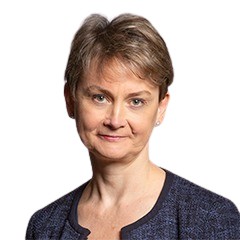
Yvette Cooper is the Labour MP for Pontefract, Castleford and Knottingley, having first been elected to parliament at the 1997 general election for the predecessor seat of Pontefract and Castleford.
In the 2024 general election, Cooper received 17,089 votes in the Pontefract, Castleford and Knottingley constituency, representing 47.5% of the vote share. The Reform UK candidate, John Thomas, was the runner-up with 10,459 votes (29.1%), while the Conservative candidate, Laura Weldon, secured 5,406 votes (15.0%). Cooper was duly elected with a majority of 6,630.
Cooper has held significant positions in parliament since 2005, and has been a member of the Labour Party since her teenage years. She is also married to Ed Balls, the former cabinet minister and Labour shadow chancellor.
Yvette Cooper: former and current offices
Cooper currently serves as secretary of state for health and social care. She was appointed to this role in July 2026, following the Labour leadership contest and Andy Burnham’s elevation as prime minister.
Cooper has spent much of her political career as a frontbencher. She was appointed to the post of secretary of state for foreign, commonwealth and development affairs in the September 2025 ministerial reshuffle, having served as home secretary from July 2024 to September 2025.
During the New Labour years, Cooper served as minister of housing and planning from May 2005 to January 2008, chief secretary to the Treasury from January 2008 to June 2009 and secretary of state for work and pensions from June 2009 to May 2010.
In the 2010-2015 parliament after Labour entered opposition, Cooper served as shadow secretary of state for work and pensions from May 2010 to October 2010, shadow foreign secretary from October 2010 to January 2011 and shadow home secretary from January 2011 to September 2015. Cooper also served as shadow minister for women and equalities from October 2010 to October 2013.
Cooper later returned to the position of shadow home secretary in November 2021 after Keir Starmer became party leader.
Cooper has also served as a member of the House of Commons education and employment committee from July 1997 to November 1999, the liaison committee from October 2016 to December 2021 and the national security strategy from November 2016 to November 2019.
Yvette Cooper: rise to prominence and political career
In May 2015, Cooper announced that she would be running for leader of the Labour party. In an article for the Daily Mirror, she argued that Labour should “move beyond the old labels of left and right” and be “credible, compassionate, creative and connected to the day-to-day realities of life”.
She continued: “Going back to the remedies of the past, of Gordon Brown or Tony Blair, won’t keep up with the way the world has changed. We need a Labour party that moves beyond the old labels of left and right, and focuses four-square on the future. Credible, compassionate, creative, and connected to the day-to-day realities of life.”
Cooper received support from influential Labour figures including the former leader Gordon Brown, as well as Jonathan Ashworth and Jess Philips. She was also endorsed by the Guardian and the New Statesman. Cooper lost the race, winning just 71,928 votes (17.0%), and announced after the result that she would not serve in the shadow cabinet and would focus on campaigning to remain in the Brexit for the referendum happening the following year.
Cooper also held junior ministerial roles in the Labour government under Tony Blair, including parliamentary under-secretary of state at the Department of Health from October 1999 to May 2002; parliamentary secretary to the lord chancellor’s department from May 2002 to June 2003; and parliamentary under-secretary for regeneration and regional development from June 2003 and May 2005.
From October 2016 to December 2021, Cooper served as the chair of the influential home affairs select committee. In this role, she led inquiries into matters including counter-terrorism, policing, immigration, and the Windrush scandal. By virtue of this role, she served on the liaison committee across the same period.
Cooper was a prominent figure on the Labour backbenches during the tumultuous Brexit years.
On 29 January 2019, when the House of Commons voted on a series of amendments to a government motion, Cooper tabled an amendment that would have made time for MPs to debate the EU Withdrawal Bill, and called for Article 50 period to be extended if a deal is not agreed before 26 February. At the time, Cooper warned that “the drift and the chasing of unicorns” could mean that the country ended up “with no deal by accident”. Her amendment was rejected by 321 votes to 298.
In March 2019, Cooper moved an amendment (initially tabled by Conservative MP Caroline Spelman and Labour MP Jack Dromey) to a government motion seeking to rule out a “no-deal” exit under any circumstances. The amendment passed by 312 votes to 308 – a majority of just four.
The amended motion was worded as follows: “That this House rejects the United Kingdom leaving the European Union without a withdrawal agreement and a framework for the future relationship.”
In April 2019, Cooper tabled a cross-party private member’s bill (PMB) alongside Conservative MP Oliver Letwin aimed at preventing the UK from leaving the European Union without a deal. The bill was approved at second reading by 315 votes to 310 – a majority of five. The bill secured its commons third reading by 313 votes to 312 at 11:09 pm. Conservative MP Mark Francois said the bill amounted to a “constitutional outrage”, adding: “Forgive them, Father, for they know not what they do.”
At the time, Cooper said the bill would “prevent a chaotic no deal in four days’ time, hitting jobs, manufacturing, medicine supplies, policing and security.”
The senior Labour MP said parliament had “responded to the gravity and urgency of the situation by passing the legislation in time”.
She added: “That is why colleagues from all sides have worked so quickly together, including with government ministers to ensure a workable, common-sense safeguard could be put in place.
“We are in this difficult situation because the prime minister left things until so late in the day and we should be honest that none of this is ideal. The bill helps avoid the worst outcome on Friday, but the prime minister still needs to build consensus around a workable way forward.”
The European Union (Withdrawal) Act 2019, or the “Cooper-Letwin act”, received royal assent on 8 April.
Cooper was also seen as a critic of Jeremy Corbyn during her time on the backbenches. In March 2019, she supported the formation of the Future Britain Group, a parliamentary caucus intended to provide a voice for the party’s social democratic and centre-left traditions. The initiative was widely seen as a direct response to Labour defections to the Independent Group (later Change UK) – that is, an attempt to create a political home for disillusioned “moderate” MPs and prevent further schisms.
Cooper delivered her maiden speech on 2 July 1997 during a debate on the budget.
In it, she stated: “Many of the pits [in my constituency] are now closed, jobs in traditional industries have gone and, most important, we lack new investment and help to reskill the work force to generate new jobs to replace the old ones that have gone.”
She added: “At the same time as controlling consumer demand and stopping it expanding too fast, the Budget is boosting the supply side to try to raise Britain’s long-term sustainable rate of growth.”
Political Views
Leadership elections and loyalty
Labour leadership 2020: Cooper was one of 82 Labour MPs who nominated Keir Starmer for the party’s leadership in early 2020. The election was triggered by the resignation of Jeremy Corbyn following the party’s defeat in the 2019 general election, which resulted in Labour’s fewest seats in the House of Commons since 1935.
Starmer’s 82 nominations were the highest of any candidate. The shadow Brexit secretary won a decisive victory in the first round with 56.2% of the vote, defeating Rebecca Long-Bailey and Lisa Nandy.
During the campaign, Cooper defended her choice to support Starmer, saying it was a “hard decision” because she had “always argued it’s time we had a Labour woman leader”.
Cooper said: “There’s lots of strong women standing… you know it’s been a hard decision for me as well about who to nominate in this race because I have always argued it’s time we had a Labour woman leader and we also need a Labour woman prime minister.
“We are not going to get any of that unless we also have a way to turn around the problems Labour are facing at the moment, and so I nominated Keir Starmer and Angela Rayner because I think they are the best people to get us out of the hole that we’re in.”
Corbyn loyalty list: In March 2016, Cooper was labelled as “hostile group” by the Corbyn leadership in a leaked list which categorised Labour MPs by their perceived loyalty. This label suggested the Corbyn leadership viewed Cooper as actively and openly antagonistic.
Labour leadership 2016: Cooper was one of 162 Labour MPs who nominated Owen Smith for the party’s leadership in July 2016. The election was triggered by a challenge to Jeremy Corbyn following the EU referendum, which led to a wave of shadow cabinet resignations and a vote of no confidence supported by 172 MPs. Smith, the former shadow work and pensions secretary, was ultimately defeated by Corbyn, who won with an increased mandate of 61.8% of the vote.
Labour leadership 2010: Cooper was one of 33 Labour MPs who nominated Ed Balls for the party’s leadership in May 2010. The election followed the resignation of Gordon Brown, who stepped down as prime minister and Labour leader after the 2010 general election.
Balls, the former children, schools and families secretary, was regarded as the ultimate “Brownite” candidate, having served as Brown’s chief economic adviser for a decade before entering parliament. He secured 33 nominations from the Parliamentary Labour Party (PLP), the minimum required to reach the final ballot. He ultimately finished third with 16% of the vote.
Factional identity and party tradition
Tribune group (2017): Cooper was listed among the supporters of the Tribune parliamentary group – a caucus generally described as representing the party’s “soft left”.
The Tribune group was initially formed in 1964 to support the newspaper of the same name. It served as a prominent forum for those parliamentarians situated on the left of the Labour Party – but it split over Tony Benn’s campaign for the deputy leadership in 1981. Benn’s supporters founded the Campaign group – which evolved into the Socialist Campaign Group (SCG). Today, the Bennite SCG is strongly associated with the Labour left tradition.
During the 1980s, the Tribune group emerged as a more natural home for those on Labour’s “soft left”.
In 2017, Efford officially re-launched the group with a new mission statement calling for “opportunity and aspiration” to be placed at the heart of the party’s programme. Efford said he had reformed the group to ensure that the centre-left of the Parliamentary Labour Party (PLP) “have a space in which to put forward ideas and debate which has not been there under successive leaders”.
He added: “The view of Labour MPs at the moment tends to be that too much are just Blairites who want to stab Jeremy Corbyn in the back. We want to show that is not where we are, and that we want to develop our own ideas that represent the centre-left of the party.”
Brexit and Europe
Brexit referendum: Cooper supported Remain in the 2016 Brexit referendum, and therefore disagreed with a majority of her constituents, 69.3% of whom voted to Leave.
Article 50: In February 2017, Cooper voted in favour of the European Union (Notification of Withdrawal) Bill. The legislation empowered the prime minister to notify the Council of the European Union of the UK’s intention to withdraw, formally triggering the process set out in Article 50 of the Treaty on European Union. MPs supported the bill by 498 votes to 114 at second reading.
Welfare
Welfare vote (July 2025): Cooper voted in favour of the government’s flagship welfare bill at second reading. The vote came after ministers agreed to significant concessions to avoid defeat via a mass rebellion of Labour MPs on 1 July 2025.
Assisted dying
Cooper voted in favour of the Terminally Ill Adults (End of Life) Bill, better known as the assisted dying bill, at both second reading (November 2024) and third reading (June 2025). Defending her decision on ITV’s Good Morning Britain programme, Cooper said: “I continue to support the principle of needing change but also to ensure that we’ve got the proper safeguards and systems in place.”
Social values and conscience issues
Same-sex marriage (2013): In February 2013, Cooper voted in favour of the Marriage (Same Sex Couples) Bill at its second reading. The landmark piece of legislation, which received its second reading by 400 votes to 175, legalised marriage for same-sex couples in England and Wales.
Foreign policy and security
Trident renewal (2016): Cooper voted in favour of a government motion calling for the renewal of the Trident nuclear deterrent system in July 2016. The motion, which was passed by 472 votes to 117, committed the UK to constructing a new fleet of submarines to carry the nation’s nuclear weapons. Labour was split over the issue with 140 of its 230 MPs going against leader Jeremy Corbyn and backing the motion.
Syria airstrikes (2015): Cooper voted in favour of a government motion to extend UK airstrikes against Isis from Iraq into Syria in December 2015. The motion, which was passed by 397 votes to 223 after a 10-hour debate in the House of Commons, authorised the RAF to conduct strikes against Isis targets in Syria.
Syria airstrikes (2013): Cooper voted against the government’s motion on the principle of military intervention in Syria in August 2013. The government motion was defeated by 285 votes to 272, a move which effectively ruled out UK participation in any US-led military strikes.
Iraq War authorisation vote (2003): In March 2003, Cooper voted in favour of the government motion authorising military action against Iraq. The vote, one of the most contentious in recent parliamentary history, gave the prime minister, Tony Blair, the authority to join the US-led invasion.
Palestine
Palestinian recognition vote (2014): In October 2014, Cooper was one of 192 Labour MPs who voted in favour of recognising Palestine as a state. The motion, passed by 274 votes to 12, called on the government to “recognise the state of Palestine alongside the state of Israel as a contribution to securing a negotiated two-state solution”.
Before Politics
Born in Inverness, Scotland, in 1969, Cooper was educated at Balliol College, University of Oxford, where she earned a first-class degree in philosophy, politics and economics (PPE).
Cooper subsequently won a Kennedy Scholarship to study at Harvard University from 1991 to 1992. Cooper later completed a master’s degree in economics at the London School of Economics.
Before entering parliament, Cooper worked as an economic policy researcher for the shadow chancellor John Smith in 1990. She later worked as a policy adviser to Harriet Harman as shadow chief secretary to the Treasury.
Following this, she moved into journalism, becoming the chief economics correspondent for the Independent newspaper in 1995, where her editor was Andrew Marr.
Personal Life
Cooper is married to Ed Balls, the former frontline politician and broadcaster. They married in 1998 and have three children.
Cooper and Balls were the first married couple to serve together in the UK cabinet.
Her father, Tony Cooper, is a former trade union leader who served as general secretary of the Engineers’ and Managers’ Association (EMA) and later as joint general secretary of its successor union, Prospect.
In her twenties, Cooper suffered from Chronic Fatigue Syndrome (CFS), also known as ME, which required her to take a year off work to recover.
Trivia
During her time studying in the United States in 1992, Cooper volunteered on Bill Clinton’s successful presidential campaign team in Arkansas. She later recalled Clinton wearing an “I’m backing Hillary’s husband” badge, drawing parallels to her own political relationship with Ed Balls.
In an interview, Balls once described Cooper as “extremely untidy” around the house.
Yvette Cooper has not written for Politics.co.uk.