
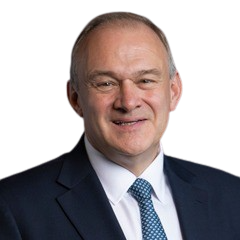
Toby Perkins is the Labour MP for Chesterfield, having first been elected to parliament at the 2010 general election.
In the 2024 general election, Perkins received 19,316 votes, representing 46.5% of the vote share. The Conservative candidate, Ben Flook, received 8,496 votes (20.4%), while the Reform UK candidate, Dan Price, secured 7,897 votes (19.0%). Perkins was duly re-elected with a majority of 10,820 votes.
The Chesterfield constituency is located in northern Derbyshire and is centred around the town of Chesterfield. It has been represented by Labour for most of the period since 1935, with a notable interruption when the Liberal Democrats held the seat between 2001 and 2010. The constituency was represented by the prominent left-wing Labour politician Tony Benn from 1984 until his retirement in 2001.
Political Career
Perkins is a member of the House of Commons environmental audit (since September 2024) – the commons select committee that acts as parliament’s primary cross-departmental watchdog on environmental issues. The EAC has a wide-ranging remit to examine how the policies and programmes of all government departments and public bodies impact environmental protection and sustainable development.
By virtue of this role, Perkins sits on the liaison committee – the so-called “super committee” composed of the cross-party chairs of all the other commons select committees. It has a broad oversight role, but is best known for its questioning of the prime minister in sessions that take place two or three times a year.
Prior to the 2024 general election, which saw Labour returned to power after 14 years in opposition, Perkins held a series of shadow ministerial roles. Most recently, under Keir Starmer, he was shadow minister for rural affairs (September 2023 – July 2024) and shadow minister for skills and further education (April 2020 – September 2023).
Under Jeremy Corbyn, Perkins briefly served as shadow minister for the armed forces from September 2015 to June 2016. He was among those to resign from the shadow frontbench in protest at Jeremy Corbyn’s leadership and his approach to the EU referendum.
In his resignation statement, Perkins claimed that Labour would face a “catastrophe” if Corbyn led it into a general election.
He wrote: “It is with deep regret that I walk away from this role, but no-one who has spent the last six weeks in daily conversations with voters in the North of England, as I have in Chesterfield, could be under any illusions about how urgently the Labour Party needs a change at the top.
“I note that you continue to refer back to the mandate you received last September. I have to tell you that I have been contacted by many of the people so enthused by your victory last year, to urge me to persuade you to stand down.
“I am still uncertain whether you believe that you did all you could to secure votes during the recent EU Referendum campaign and this ambiguity certainly fed through to voters. Either way, it does not augur well for any general election campaign.”
Perkins concluded that Corbyn was “not destined” to become prime minister and called on him to stand down “at the earliest opportunity”.
Perkins was one of six Labour MPs (alongside Jon Cruddas, Grahame Morris, Emma Lewell, Sarah Champion and Rosie Cooper) to support Boris Johnson’s Brexit deal in December 2019, defying the party whip. In a statement at the time, Perkins said he “needed to demonstrate that I had listened to the verdict that I heard in thousands of doorstep conversations and support the second Reading of the bill which demonstrates approval for the principle of leaving the EU by the end of 2020.”
He added: “When even the ‘Stooooopppppp Brexit’ campaigner Steve Bray packs up and goes home, it’s time to accept that Brexit is going to happen. The ‘fight’ now is about ensuring that Brexit is not used as an opportunity to reduce environmental and workplace protections (which I fear it will be) and to ensure that Britain can continue to trade.”
In March 2016, Perkins introduced an unsuccessful private members’ bill (PMB) seeking to establish an official English national anthem for sporting events, separate from the UK anthem “God Save the Queen”. Perkins reportedly arranged for a choir to sing Jerusalem outside the Houses of Parliament.
An e-petition on the subject gathered nearly 2,000 signatures arguing that it is “time for England to have its own national anthem, to enable us to establish our English identity and support our role in the United Kingdom”.
At the time, Perkins said: “The level of interest and support for this has been overwhelming, and I am delighted that there is now a chance for people to show their backing for the bill by signing our e-petition.
“We will be aiming to show the level of support that there is across the country for this, so that the government embark upon a proper consultation to select an English national anthem for use in sporting events when England are represented.”
Under Ed Miliband, Perkins was shadow minister for small business (October 2011 – September 2015) and shadow minister for education (October 2010 – October 2011).
Perkins was a member of the House of Commons home affairs committee (2019-2019), the international trade committee (2016-2017), and the housing, communities and local government committee (2010-2010).
Perkins is listed as a member of the all-party parliamentary groups (APPGs) for tennis and apprenticeships.
Perkins delivered his maiden speech on 8 June 2010 during a debate on economic affairs and work and pensions.
In it, he said: “Chesterfield has a great deal going for it; under Labour, it improved so much. I came into politics to fight for the next generation of working opportunities for Chesterfield and Staveley – to fight inequality and to protect the public services that our people rely on.’
He added: “It is a great privilege to be only the fifth person to represent the Chesterfield constituency in parliament in the past 80 years.”
Before entering parliament, Perkins served as a Labour councillor for the Rother Ward on Chesterfield Borough Council from 2003 to 2011.
Political Views
Leadership elections and loyalty
Oppose leadership election: In May 2026, Perkins was among the over 100 Labour MPs who signed a joint statement insisting it was “no time for a leadership contest.” The letter was an intervention in the political crisis engulfing Keir Starmer’s premiership, after Labour suffered heavy losses in the 2026 local elections and devolved elections to the Scottish Parliament and Senedd Cymru. It was organised as a counterweight to a mounting rebellion that had seen high-profile figures, including some ministers, call for Starmer’s resignation.
The statement read: “Last week we had a devastatingly tough set of election results. It shows we have a hard job ahead to win back trust from the electorate.
“That job needs to start today – with all of us working together to deliver the change the country needs.
“We must focus on that. This is no time for a leadership contest.”
Labour leadership 2020: Perkins was one of 82 Labour MPs who nominated Keir Starmer for the party’s leadership in early 2020. The election was triggered by the resignation of Jeremy Corbyn following the party’s defeat in the 2019 general election, which resulted in Labour’s fewest seats in the House of Commons since 1935.
Starmer’s 82 nominations were the highest of any candidate. The shadow Brexit secretary won a decisive victory in the first round with 56.2% of the vote, defeating Rebecca Long-Bailey and Lisa Nandy.
Labour leadership 2016: Perkins was one of 162 Labour MPs who nominated Owen Smith for the party’s leadership in July 2016. The election was triggered by a challenge to Jeremy Corbyn following the EU referendum, which led to a wave of shadow cabinet resignations and a vote of no confidence supported by 172 MPs. Smith, the former shadow work and pensions secretary, was ultimately defeated by Corbyn, who won with an increased mandate of 61.8% of the vote.
Labour leadership 2015: Perkins was one of 41 Labour MPs who nominated Liz Kendall for the party’s leadership in June 2015. The election followed the resignation of Ed Miliband after the party’s defeat in the 2015 general election. It was the first contest held under the “one member, one vote” system, which replaced the previous electoral college.
Kendall, the shadow minister for care and older people, was viewed as the “Blairite” candidate in the race. She secured 41 nominations from the Parliamentary Labour Party (PLP), exceeding the 35 required to reach the final ballot. She ultimately finished fourth in the contest with 4.5% of the vote.
Corbyn loyalty list: In March 2016, Perkins was labelled as “hostile group” by the Corbyn leadership in a leaked list which categorised Labour MPs by their perceived loyalty. This label suggested the Corbyn leadership viewed Perkins as actively and openly antagonistic.
Labour leadership 2010: Perkins was one of 81 Labour MPs who nominated David Miliband for the party’s leadership in May 2010. The election followed the resignation of Gordon Brown, who stepped down as prime minister and Labour leader after the 2010 general election.
Miliband, the former foreign secretary, was seen as closely aligned with the New Labour project – a Blairite figure. He secured 81 nominations from the Parliamentary Labour Party (PLP), comfortably exceeding the 33 required to reach the final ballot, but was narrowly defeated by his brother, Ed Miliband, in the final round by 50.7% to 49.3%.
Factional identity and party tradition
Labour Growth Group: Perkins has been listed as a member of the Labour Growth Group (LGG) – a vocal faction of backbenchers committed to ensuring economic growth remains the central mission of the government. In an open letter addressed to Keir Starmer, issued upon the group’s founding in July 2024, LGG MPs said it was imperative that “the government grasps the nettle and goes for growth”.
Brexit and Europe
Brexit referendum: Perkins supported Remain in the 2016 Brexit referendum, and therefore disagreed with a majority of his constituents, 59.3% of whom voted to Leave.
Article 50: In February 2017, Perkins voted in favour of the European Union (Notification of Withdrawal) Bill. The legislation empowered the prime minister to notify the Council of the European Union of the UK’s intention to withdraw, formally triggering the process set out in Article 50 of the Treaty on European Union. MPs supported the bill by 498 votes to 114 at second reading.
Welfare
Welfare ‘reasoned amendment’ (June 2025): Perkins was one of the over 120 Labour MPs to sign the reasoned amendment to the government’s flagship welfare bill which aimed to reject the proposed legislation.
The amendment, in the name of senior Labour MP Dame Meg Hillier, objected to the fact that the bill had not been subject to a “formal consultation with disabled people” and that “250,000 people will be pushed into poverty” as a result of it, according to a government impact assessment.
The motion also called on the government to wait for the publication of the review into the Personal Independence Payment (Pip), helmed by minister Sir Stephen Timms, and the independent review, conducted by Sir Charlie Mayfield, into how the employment of disabled people could be boosted.
Welfare vote (July 2025): Perkins voted in favour of the government’s flagship welfare bill at second reading. The vote came after ministers agreed to significant concessions to avoid defeat via a mass rebellion of Labour MPs on 1 July 2025.
Assisted dying
Perkins voted in favour of the Terminally Ill Adults (End of Life) Bill, better known as the assisted dying bill, at both second reading (November 2024) and third reading (June 2025).
Social values and conscience issues
Abortion decriminalisation (2025): Perkins voted against a backbench amendment to the Crime and Policing Bill that sought to decriminalise abortion in England and Wales in June 2025. The amendment, which was passed by a majority of 242 votes, removed women from the threat of prosecution for ending a pregnancy at any stage. As an issue of conscience, MPs were allowed to vote according to their personal beliefs.
Same-sex marriage (2013): In February 2013, Perkins voted in favour of the Marriage (Same Sex Couples) Bill at its second reading. The landmark piece of legislation, which received its second reading by 400 votes to 175, legalised marriage for same-sex couples in England and Wales.
Foreign policy and security
Trident renewal (2016): Perkins voted in favour of a government motion calling for the renewal of the Trident nuclear deterrent system in July 2016. The motion, which was passed by 472 votes to 117, committed the UK to constructing a new fleet of submarines to carry the nation’s nuclear weapons. Labour was split over the issue with 140 of its 230 MPs going against leader Jeremy Corbyn and backing the motion.
Syria airstrikes (2015): Perkins voted against a government motion to extend UK airstrikes against Isis from Iraq into Syria in December 2015. The motion, which was passed by 397 votes to 223 after a ten-hour debate in the House of Commons, authorised the RAF to conduct strikes against Isis targets in Syria.
Syria airstrikes (2013): Perkins voted against the government’s motion on the principle of military intervention in Syria in August 2013. The government motion was defeated by 285 votes to 272, a move which effectively ruled out UK participation in any US-led military strikes.
Palestine
Palestinian recognition letter (July 2025): In July 2025, Perkins was among the over 254 MPs to sign a cross-party letter calling for the government to immediately recognise the state of Palestine. The letter called on the prime minister and foreign secretary to recognise Palestine at the UN Conference then taking place in New York.
Palestinian recognition vote (2014): In October 2014, Perkins was one of 192 Labour MPs who voted in favour of recognising Palestine as a state. The motion, passed by 274 votes to 12, called on the government to “recognise the state of Palestine alongside the state of Israel as a contribution to securing a negotiated two-state solution”.
Before Politics
Born Matthew Toby Perkins on 12 August 1970 in Reading, Berkshire, he attended Trinity Catholic School in Leamington Spa and later Silverdale School in Sheffield.
He is the son of film critic V. F. Perkins and Tessa Pudney (daughter of poet John Pudney).
Before entering politics, he worked in IT sales and consultancy. He subsequently set up and ran his own small business, supplying rugby clothing.
Personal Life
Perkins has two children from a previous marriage. He lives in Chesterfield.
Speaking to GB News in December 2022, Perkins spoke about the loss of his twins Joshua and Jennifer.
He said: “You go and have the scan when you discover you’ve not only got one on the way, but you’ve got two. We then ended up going back for a scan to check if everything was okay.
“We got told that they can only find one heartbeat and you realise that this means that a baby has died. I guess at that moment you think, well, we’ve still got one. But actually, the reality came very quickly.
“My ex-wife gave birth to the dead child – my son Joshua. And, within a few moments, she gave birth to my daughter, Jennifer, who was alive, but it was only 23 weeks into the pregnancy.
“I think nowadays there might’ve been more of a chance of survival, but we had about six hours with her, and then she died also.”
Trivia
Perkins previously played rugby union for the Sheffield Tigers.
Perkins has a rugby coaching qualification.
He is the grandson of the poet John Pudney and the great-grandson of the writer, humorist and independent MP A. P. Herbert.

Comment: What does Hizb ut-Tahrir climb-down tell us about our prime minister?
25 August 2011