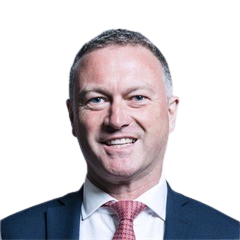
Steve Reed is the Labour and Co-operative MP for Streatham and Croydon North, having first been elected for the predecessor seat of Croydon North in a by-election on 29 November 2012.
In the 2024 general election, Reed won 23,232 votes, representing 52.1% of the vote. The Green Party candidate, Scott Ainslie, received 7,629 votes (17.1%), while the Conservative candidate, Anthony Boutall, secured 5,328 votes (12.0%). Reed was duly elected with a majority of 15,603 votes.
The Streatham and Croydon North constituency was newly created for the 2024 election, formed from parts of the abolished Croydon North and Streatham seats. It covers areas including Streatham, Norbury, Thornton Heath, and Upper Norwood in South London. It is considered a safe Labour seat.
Reed succeeded Malcom Wicks as the MP for Croydon North. Wicks’s death triggered the 2012 by-election which Reed won with 15,898 votes (64.7%) – a majority of 11,755 over the Conservative candidate.
Political Career
Reed served as secretary of state for housing, communities and local government from September 2025 to July 2026. He served as secretary of state for environment, food and rural affairs from July 2024 to September 2025.
Reed, a prominent ally of Keir Starmer, left government as part of the July 2026 cabinet reshuffle conducted by Andy Burnham upon his appointment as prime minister.
In a statement at the time, Reed said he was “disappointed to be leaving government now” but wished Burnham’s “new team every success”. His statement also featured a parting shot at “disloyal” MPs.
He wrote: “Keir Starmer showed loyalty to me by appointing me to his cabinet. I make no apology for returning that loyalty. It’s what is expected of functioning teams, and I hope those who did not show loyalty to Keir will now show it to you.”
He added: “I’m proud I acted with integrity at every step over the turbulent past few months.”
The remarks were read as a rebuke to colleagues who agitated against Starmer in the months before his resignation on 22 June, which followed Burnham’s return to the House of Commons in the Makerfield by-election.
Reed also issued a warning in his statement, addressed to Burnham, regarding the new prime minister’s broader policy agenda.
He wrote: “You can’t make funding fairer for the rest of England by making it unfair on Londoners. I’m proud to be a London MP and I’ll always fight to ensure London is treated fairly as you explore new models of devolution, taxation and funding.”
Reed urged Burnham not to “slow down implementation” of automatic voter registration if the new government reopens consultation on the policy and pressed him to take forward plans for a state housebuilder.
Prior to the 2024 general election, which saw Labour returned to power after 14 years in opposition, Reed served extensively in the shadow cabinet, including as shadow secretary of state for environment, food and rural affairs (September 2023 – July 2024), shadow secretary of state for justice (November 2021 – September 2023), and shadow secretary of state for communities and local government (April 2020 – November 2021).
As shadow justice secretary, Reed was involved in a controversial “attack ad” accusing the then prime minister Rishi Sunak of failing to put paedophiles in prison.
At the time, Reed, seen as a leading ally of Keir Starmer as Labour leader, defended the campaign.
He told the i paper: “What we did was pull out the facts that showed the Tories have broken the criminal justice system from end to end and hand them to Labour’s campaigners, I didn’t sit here and make the ad myself.”
He added: “I stand by them 100%. Rishi Sunak is the leader of the Conservatives and bears responsibility. We got people talking about the Tories’ appalling record on all this for a week and we are speaking in the wake of a stunning set of victories in the local elections.”
Previously, Reed served as shadow children and families minister in Labour’s education team (2019-2020), shadow civil society minister (2016-2019), shadow communities and local government minister (May 2015 – June 2016 and October 2016 – July 2017), and shadow home affairs minister (2013-2015).
In June 2016, Reed was among those to resign from the shadow frontbench in protest at Jeremy Corbyn’s leadership and his approach to the Brexit referendum.
In his letter of resignation, addressed to Corbyn, Reed wrote that he no longer believed that Labour could “win a general election with you as leader of the party.”
He added: “A majority of Labour supporters in large parts of the north and midlands voted to leave the EU because their connection with our party has broken. We are losing touch with them, a process that has been under way for some time but which has speeded up under your leadership…
“There is now a strong possibility of a general election this Autumn, and I am convinced that Labour faces electoral annihilation from which we may not recover for a generation if you lead us into it.
“However, with the Tories divided like never before, there is a real chance that a different leader could win that election for Labour and save millions of our supporters from the horror that would follow the election of an even more right-wing Tory government with a vastly increased majority.”
Reed successfully introduced the Mental Health Units (Use of Force) Act 2018 or “Seni’s Law” as a private members’ bill (PMB). After the legislation received royal assent, Reed became the first Labour MP to pass a major new act of parliament from opposition in 22 years.
The legislation banned the use of violent forms of restraint against mental health patients and to tackle deaths in custody. Seni Lewis, a 21-year-old graduate from South Norwood, died in a mental health hospital after police officers handcuffed him, put his legs in shackles and took it in turns to sit on him until he had a heart attack and went into a coma.
At the time, Reed commented: “I was so proud when Seni’s Law became an act of parliament. People with mental ill health deserve to be treated with care and compassion, not with cruelty. This law stands as a lasting testament to Seni Lewis’s life and will make sure no one else suffers and dies the way he did.”
Reed was a member of the House of Commons public administration committee from December 2012 to November 2013.
Reed is a patron of LGBT+ Labour – a socialist society formally affiliated with the Labour Party.
Reed delivered his maiden speech on 11 December 2012 during a commons debate on the economy.
In it, he stated: “Croydon North faces real challenges. It is a relatively poor area, and people living there feel let down because the slow decline of the area over recent years has not been addressed.
“Unemployment is too high, the streets are not clean enough, and people worry that police are being taken off the streets when crimes such as robbery are on the rise.”
Reed added: “I hope during my term of office to represent the people of Croydon North to the best of my ability. If, when I finally leave this place, I have earned even a fraction of the respect and warmth that people felt for my predecessor, Malcolm Wicks, I will have done well.”
Before entering parliament, Reed served as a Labour councillor on Lambeth London Borough Council from 1998 to 2012, representing Town Hall ward and later Brixton Hill ward. He was leader of Lambeth Council from 2006 until his election as an MP in 2012.
Reed was awarded an OBE in 2013 for services to local government.
In his 2012 maiden speech, Reed said: “I am proud of the work I did [in Lambeth council], alongside many talented colleagues, to turn around a once failing council. Lambeth children’s services were in the bottom 3% nationally when I was elected leader, but were rated by Ofsted as the best in the country when I left.
“I hope that that experience of transforming public services will be of value to the House and the people of Croydon North.”
Reed contested the Labour selection process for the Streatham constituency in 2008 but was defeated by Chuka Umunna
Political views
Leadership elections and loyalty
Labour deputy leadership 2025: Reed was one of 175 Labour MPs who nominated Bridget Phillipson for the party’s deputy leadership in September 2025. The election followed the resignation of Angela Rayner, who stepped down as deputy prime minister and deputy party leader after an investigation into her tax affairs. It marked the first time since 2007 that Labour had held a deputy leadership contest while in government.
Phillipson, the serving education secretary, was widely viewed as the candidate favoured by Downing Street and the party leadership. She secured 175 nominations from the Parliamentary Labour Party (PLP), comfortably exceeding the 80 required to reach the final ballot. She was ultimately defeated by Lucy Powell.
Labour leadership 2020: Reed was one of 82 Labour MPs who nominated Keir Starmer for the party’s leadership in early 2020. The election was triggered by the resignation of Jeremy Corbyn following the party’s defeat in the 2019 general election, which resulted in Labour’s fewest seats in the House of Commons since 1935.
Starmer’s 82 nominations were the highest of any candidate. The shadow Brexit secretary won a decisive victory in the first round with 56.2% of the vote, defeating Rebecca Long-Bailey and Lisa Nandy.
Labour leadership 2015: Reed was one of 41 Labour MPs who nominated Liz Kendall for the party’s leadership in June 2015. The election followed the resignation of Ed Miliband after the party’s defeat in the 2015 general election. It was the first contest held under the “one member, one vote” system, which replaced the previous electoral college.
Kendall, the shadow minister for care and older people, was viewed as the “Blairite” candidate in the race. She secured 41 nominations from the Parliamentary Labour Party (PLP), exceeding the 35 required to reach the final ballot. She ultimately finished fourth in the contest with 4.5% of the vote.
Corbyn loyalty list: In March 2016, Reed was labelled as “core group negative” by the Corbyn leadership in a leaked list which categorised Labour MPs by their perceived loyalty. This label suggested the Corbyn leadership viewed Reed as a critic but not openly hostile.
Labour leadership 2016: Reed was one of 162 Labour MPs who nominated Owen Smith for the party’s leadership in July 2016. The election was triggered by a challenge to Jeremy Corbyn following the EU referendum, which led to a wave of shadow cabinet resignations and a vote of no confidence supported by 172 MPs. Smith, the former shadow work and pensions secretary, was ultimately defeated by Corbyn, who won with an increased mandate of 61.8% of the vote.
Factional identity and party tradition
Tribune group (2017): Reed was listed among the supporters of the Tribune parliamentary group – a caucus generally described as representing the party’s “soft left”.
The Tribune group was initially formed in 1964 to support the newspaper of the same name. It served as a prominent forum for those parliamentarians situated on the left of the Labour Party – but it split over Tony Benn’s campaign for the deputy leadership in 1981. Benn’s supporters founded the Campaign group – which evolved into the Socialist Campaign Group (SCG). Today, the Bennite SCG is strongly associated with the Labour left tradition.
During the 1980s, the Tribune group emerged as a more natural home for those on Labour’s “soft left”.
In 2017, Efford officially re-launched the group with a new mission statement calling for “opportunity and aspiration” to be placed at the heart of the party’s programme. Efford said he had reformed the group to ensure that the centre-left of the Parliamentary Labour Party (PLP) “have a space in which to put forward ideas and debate which has not been there under successive leaders”.
He added: “The view of Labour MPs at the moment tends to be that too much are just Blairites who want to stab Jeremy Corbyn in the back. We want to show that is not where we are, and that we want to develop our own ideas that represent the centre-left of the party.”
Brexit and Europe
Brexit referendum: Reed supported Remain in the 2016 Brexit referendum, and therefore agreed with a majority of constituents, 58.8% of whom voted to Remain.
Article 50: In February 2017, Reed voted in favour of the European Union (Notification of Withdrawal) Bill. The legislation empowered the prime minister to notify the Council of the European Union of the UK’s intention to withdraw, formally triggering the process set out in Article 50 of the Treaty on European Union. MPs supported the bill by 498 votes to 114 at second reading.
Remain pledge: During the 2019 general election campaign, Reed was one of 193 Labour candidates to sign the anti-Brexit “Remain pledge”, drawn up by the campaign group Remain Labour.
It stated: “Labour is committed to a confirmatory referendum, to give you the final say on Brexit. If elected as your Labour MP, I pledge to campaign to Remain in the EU.”
Welfare
Welfare vote (July 2025): Reed voted in favour of the government’s flagship welfare bill at second reading. The vote came after ministers agreed to significant concessions to avoid defeat via a mass rebellion of Labour MPs on 1 July 2025.
Assisted dying
Reed voted in favour of the Terminally Ill Adults (End of Life) Bill, better known as the assisted dying bill, at both second reading (November 2024) and third reading (June 2025).
Social values and conscience issues
Abortion decriminalisation (2025): Reed voted in favour of a backbench amendment to the Crime and Policing Bill that sought to decriminalise abortion in England and Wales in June 2025. The amendment, which was passed by a majority of 242 votes, removed women from the threat of prosecution for ending a pregnancy at any stage. As an issue of conscience, MPs were allowed to vote according to their personal beliefs.
Same-sex marriage (2013): In February 2013, Reed voted in favour of the Marriage (Same Sex Couples) Bill at its second reading. The landmark piece of legislation, which received its second reading by 400 votes to 175, legalised marriage for same-sex couples in England and Wales.
Foreign policy and security
Trident renewal (2016): Reed voted in favour of a government motion calling for the renewal of the Trident nuclear deterrent system in July 2016. The motion, which was passed by 472 votes to 117, committed the UK to constructing a new fleet of submarines to carry the nation’s nuclear weapons. Labour was split over the issue with 140 of its 230 MPs going against leader Jeremy Corbyn and backing the motion.
Syria airstrikes (2013): Reed voted against the government’s motion on the principle of military intervention in Syria in August 2013. The government motion was defeated by 285 votes to 272, a move which effectively ruled out UK participation in any US-led military strikes.
Before Politics
Born Steven Mark Ward Reed in St Albans, Hertfordshire on 12 November 1963. He attended Verulam School in St Albans.
In the 1980s, Reed demonstrated outside parliament against Section 28 – the law passed by Margaret Thatcher’s government banning the promotion of homosexuality by local authorities and teaching in schools of what the law referred to as “pretended” family relationships.
Reed studied English at the University of Sheffield. After graduating, he worked in the educational publishing industry from 1990, holding roles at Routledge, Thomson International, the Law Society, and Sweet & Maxwell.
He organised Labour’s campaign in Brixton for the 1997 general election.
Personal Life
Reed is gay and married his partner of 14 years in July 2022.
In 2024, PinkNews listed Reed among a number of out LGBTQ+ parliamentarians.
Trivia
Reed successfully passed Seni’s law through parliament as a PMB, becoming the first Labour MP in 22 years to pass a major new act of parliament from opposition.
In November 2016, Reed joined a cross-party group of politicians and musicians to record a charity cover of “You Can’t Always Get What You Want” in memory of murdered Labour MP Jo Cox. The recording marked the launch of the Jo Cox Foundation, with Rimmer participating alongside members of the Royal Opera House Thurrock Community Chorus.
Organisers hoped that the project would be “uplifting and remind people of [Cox’s] values, about social cohesion and about working as a community.”
Steve Reed has not written for Politics.co.uk.