
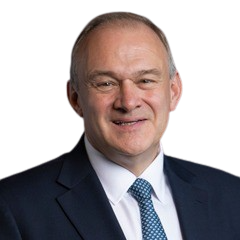
Dame Siobhain McDonagh is the Labour MP for Mitcham and Morden, having first been elected to parliament at the 1997 general election.
In the 2024 general election, McDonagh won 25,085 votes, representing 55.4% of the vote. The Conservative candidate, Ellie Cox, received 6,324 votes (14.0%), while the Green Party candidate, Pippa Maslin, secured 4,635 votes (10.2%). McDonagh was duly elected with a majority of 18,761 votes.
The Mitcham and Morden constituency is located in South London, within the London Borough of Merton.
McDonagh was appointed a Dame Commander of the Order of the British Empire (DBE) in the 2024 New Year Honours.
Political Career
McDonagh is a member of the House of Commons Treasury select committee (since May 2020) – the committee tasked with scrutinising His Majesty’s Treasury and government policy on taxation and public spending. The committee’s remit also extends to scrutinising major financial institutions that shape the UK economy, including the Bank of England, the Financial Conduct Authority (FCA) and the tax authority, HM Revenue and Customs (HMRC).
McDonagh is also a member of the panel of chairs (since September 2017). The panel of chairs is made up of MPs chosen by the House of Commons speaker, typically at the beginning of every parliament, to chair public bill committees and other commons general committees. In this capacity, McDonagh may chair debates in Westminster Hall and may also act as temporary chair during a committee of the whole House.
currently serves on the treasury committee (since October 2024, previously 2020-2024) and the panel of chairs (since July 2024, previously 2017-2019 and 2020-2024).
McDonagh served as an assistant government whip under prime minister Gordon Brown from June 2007 until September 2008. She was dismissed from this role after becoming the first government member to publicly call for a leadership contest.
McDonagh told BBC News: “It’s about time we let party members and people involved in the Labour Party and the wider community in on that debate.
“I think we need to clear the air. I think whoever wants to stand for leader of the Labour Party should do so and we should have a good debate about the direction of the party and the government.”
The comments came as 12 backbench Labour MPs, including six former ministers, urged the leadership to develop “a convincing new narrative”.
A government spokesman reportedly said that McDonagh had always been “anti-Gordon”. She was the only member of the government not to nominate Brown for the Labour leadership after Tony Blair’s resignation.
Conservative spokesperson Chris Grayling responded: “The Labour Party is quite clearly degenerating into a state of civil war. For a prime minister to have one of his own whips calling for a leadership contest is unprecedented.”
Prior to this, she was parliamentary private secretary (PPS) to John Reid (2005-2007) as defence secretary and home secretary.
McDonagh was a member of the House of Commons women and equalities committee (2015-2016), the education committee (2012-2015), the health and social care committee (2000-2005), and the social security committee (1997-1997)
McDonagh is listed as a member of the all-party parliamentary groups (APPGs) for the Ahmadiyya Muslim Community, brain tumours, children who need palliative care, households in temporary accommodation and Tamils.
McDonagh delivered her maiden speech during a common debate on the Local Government Finance (Supplementary Credit Approvals) Bill on 17 June 1997.
In it, she said: “Mine is a constituency of two halves – those who regard themselves as Londoners and those who think that they live in Surrey. It is a suburban seat to which people come to raise their families and where they generally enjoy living.”
She added: “On behalf of those people, in particular the one in five households who live in council accommodation, the 200 families in significant housing need each year who have no chance of being housed, and the many people who work in the building industry either in small firms or as self-employed, be they plasterers, bricklayers or carpenters, I commend the bill to the House.
“I also commend it on behalf of those young people in my constituency who desperately want a trade and who want the opportunity to make their future better.”
Before entering parliament, McDonagh served as a Labour councillor on Merton London Borough Council representing the Colliers Wood ward from 1982 to 1998. Elected aged 22, she was London’s youngest councillor at the time. She chaired the council’s housing committee from 1990 to 1995.
Political views
Leadership elections and loyalty
Labour leadership 2020: McDonagh was one of 21 Labour MPs who nominated Jess Phillips for the party’s leadership in early 2020. The election was triggered by the resignation of Jeremy Corbyn following the party’s defeat in the 2019 general election, which resulted in Labour’s fewest seats in the House of Commons since 1935.
Phillips, the MP for Birmingham Yardley, had been a prominent critic of Corbyn’s leadership of the Labour Party. She withdrew from the contest on 21 January 2020, suggesting that she could not “unite all parts of our movement”.
Labour leadership 2015: McDonagh was one of 41 Labour MPs who nominated Liz Kendall for the party’s leadership in June 2015. The election followed the resignation of Ed Miliband after the party’s defeat in the 2015 general election. It was the first contest held under the “one member, one vote” system, which replaced the previous electoral college.
Kendall, the shadow minister for care and older people, was viewed as the “Blairite” candidate in the race. She secured 41 nominations from the Parliamentary Labour Party (PLP), exceeding the 35 required to reach the final ballot. She ultimately finished fourth in the contest with 4.5% of the vote.
Corbyn loyalty list: In March 2016, McDonagh was labelled as “hostile group” by the Corbyn leadership in a leaked list which categorised Labour MPs by their perceived loyalty. This label suggested the Corbyn leadership viewed McDonagh as actively and openly antagonistic.
Labour leadership 2016: McDonagh supported Angela Eagle for the party’s leadership in July 2016. The election was triggered by a challenge to Jeremy Corbyn following the EU referendum, which led to a wave of shadow cabinet resignations and a vote of no confidence supported by 172 MPs.
Eagle, the former shadow first secretary of state, was the first to formally launch a challenge against Corbyn. However, she withdrew from the race on 19 July after attracting fewer nominations than Owen Smith. Corbyn was ultimately re-elected with an increased mandate of 61.8% of the vote.
McDonagh subsequently shifted her support to Smith’s candidacy. Smith, the former shadow work and pensions secretary, was ultimately defeated by Corbyn, who won with an increased mandate of 61.8% of the vote.
Labour leadership 2010: McDonagh was one of 81 Labour MPs who nominated David Miliband for the party’s leadership in May 2010. The election followed the resignation of Gordon Brown, who stepped down as prime minister and Labour leader after the 2010 general election.
Miliband, the former foreign secretary, was seen as closely aligned with the New Labour project – a Blairite figure. He secured 81 nominations from the Parliamentary Labour Party (PLP), comfortably exceeding the 33 required to reach the final ballot, but was narrowly defeated by his brother, Ed Miliband, in the final round by 50.7% to 49.3%.
Brexit and Europe
Brexit referendum: McDonagh supported Remain in the 2016 Brexit referendum, and therefore agreed with a majority of her constituents, 55.3% of whom also voted to Remain.
Article 50: In February 2017, McDonagh voted in favour of the European Union (Notification of Withdrawal) Bill. The legislation empowered the prime minister to notify the Council of the European Union of the UK’s intention to withdraw, formally triggering the process set out in Article 50 of the Treaty on European Union. MPs supported the bill by 498 votes to 114 at second reading.
People’s vote support (2019): McDonagh signed a January 2019 statement by Labour MPs calling for a “people’s vote” or second referendum. The statement, signed by 71 Labour MPs, read: “Defeat of the Tory [Brexit] deal in a public vote would give us all a chance to campaign for the anti-austerity policies and a Labour government that deals with the true causes of the Brexit vote, and a reformed Europe that works for all people.”
Remain pledge: During the 2019 general election campaign, McDonagh was one of 193 Labour candidates to sign the anti-Brexit “Remain pledge”, drawn up by the campaign group Remain Labour.
It stated: “Labour is committed to a confirmatory referendum, to give you the final say on Brexit. If elected as your Labour MP, I pledge to campaign to Remain in the EU.”
Brexit trade deal: In December 2020, McDonagh was among the 37 Labour MPs to rebel against the leadership’s position on the EU (Future Relationship) Bill – which enabled the government to implement and ratify its post-Brexit trade deal with the EU. Keir Starmer, the newly elected Labour leader, argued that while the trade deal negotiated by Boris Johnson’s government was “thin” and flawed, the only alternative at that late stage was a “no-deal” exit. To enforce the leadership’s position, a three-line whip was imposed. McDonagh abstained over the bill. One Labour MP, Bell Ribeiro-Addy, voted against the bill.
Welfare
Welfare vote (July 2025): McDonagh voted in favour of the government’s flagship welfare bill at second reading. The vote came after ministers agreed to significant concessions to avoid defeat via a mass rebellion of Labour MPs on 1 July 2025.
Assisted dying
McDonagh voted against the Terminally Ill Adults (End of Life) Bill, better known as the assisted dying bill, at both second reading (November 2024) and third reading (June 2025).
Social values and conscience issues
Abortion decriminalisation (2025): McDonagh voted in favour of a backbench amendment to the Crime and Policing Bill that sought to decriminalise abortion in England and Wales in June 2025. The amendment, which was passed by a majority of 242 votes, removed women from the threat of prosecution for ending a pregnancy at any stage. As an issue of conscience, MPs were allowed to vote according to their personal beliefs.
Same-sex marriage (2013): In February 2013, McDonagh voted in favour of the Marriage (Same Sex Couples) Bill at its second reading. The landmark piece of legislation, which received its second reading by 400 votes to 175, legalised marriage for same-sex couples in England and Wales.
Foreign policy and security
IPAC: McDonagh is a member of the Inter-Parliamentary Alliance on China (IPAC) – an international, cross-party network of legislators from democratic countries focused on relations with the People’s Republic of China. The alliance, established on 4 June 2020, the anniversary of the 1989 Tiananmen Square protests and massacre, was formed to unite “lawmakers worldwide, promoting democracy and addressing threats to the rules-based and human rights systems posed by the rise of China.”
Trident renewal (2016): McDonagh voted in favour of a government motion calling for the renewal of the Trident nuclear deterrent system in July 2016. The motion, which was passed by 472 votes to 117, committed the UK to constructing a new fleet of submarines to carry the nation’s nuclear weapons. Labour was split over the issue with 140 of its 230 MPs going against leader Jeremy Corbyn and backing the motion.
Syria airstrikes (2015): McDonagh voted in favour of a government motion to extend UK airstrikes against Isis from Iraq into Syria in December 2015. The motion, which was passed by 397 votes to 223 after a 10-hour debate in the House of Commons, authorised the RAF to conduct strikes against Isis targets in Syria.
Iraq War authorisation vote (2003): In March 2003, McDonagh voted in favour of the government motion authorising military action against Iraq. The vote, one of the most contentious in recent parliamentary history, gave the prime minister, Tony Blair, the authority to join the US-led invasion.
Palestine
Palestinian recognition vote (2014): In October 2014, McDonagh was one of 192 Labour MPs who voted in favour of recognising Palestine as a state. The motion, passed by 274 votes to 12, called on the government to “recognise the state of Palestine alongside the state of Israel as a contribution to securing a negotiated two-state solution”.
Before Politics
Born Siobhain Ann McDonagh in Colliers Wood, London on 20 February 1960, her parents were Irish immigrants.
McDonagh attended Holy Cross school, New Malden, and studied politics (BA) at the university of Essex.
After graduating, she worked as a clerical officer at the department of health and social security (DHSS), a receptionist at Wandsworth council’s homeless persons unit, a housing adviser, and later as development manager at Battersea churches housing trust (1988-1997).
Personal Life
McDonagh lived with her sister, Margaret (Baroness McDonagh), the former general secretary of the Labour Party, in Colliers Wood until Margaret’s death from brain cancer in June 2023.
She is Roman Catholic.
Trivia
McDonagh became London’s youngest councillor when elected to Merton Council in 1982.

Siobhain McDonagh: ‘Why the regulatory framework for short selling must be reformed’
21 December 2023