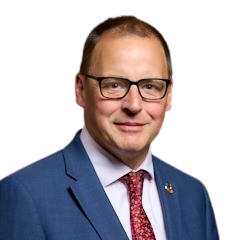
Scott Arthur is the Labour Party MP for Edinburgh South West, having first been elected to parliament at the 2024 general election.
In the 2024 general election, Arthur won 18,663 votes, representing 40.9% of the vote. The Scottish National Party (SNP) candidate, Joanna Cherry, received 12,446 votes (27.3%), while the Conservative candidate, Sue Webber, secured 5,558 votes (12.2%). Arthur was duly elected with a majority of 6,217.
Arthur’s immediate predecessor as the MP for Edinburgh South West was Joanna Cherry of the SNP, who represented the seat from 2015 to 2024. Arthur described Cherry as a “formidable parliamentarian” in his 2024 maiden speech.
The late Alistair Darling, a former chancellor and long-serving cabinet minister in the New Labour years, represented the constituency from 2005 to 2015.
Political Career
Arthur is a member of the House of Commons transport select committee (since October 2024) – the committee responsible for the scrutiny of the Department for Transport and its associated public bodies. Its remit covers all aspects of transport policy in England, as well as UK-wide issues such as aviation and maritime policy.
In the 2024-2026 parliamentary session, Arthur introduced the Rare Cancers Bill to tackle the fact that sees less research and investment into treatments for rare cancers compared to more common types. The bill sought to incentivise pharmaceutical companies to develop new drugs for these conditions by offering enhanced rewards, such as extended market exclusivity.
Arthur introduced the bill after placing sixth out of the 20 MPs selected in the private member’s bill (PMB) ballot.
Speaking during the bill’s commons second reading debate, Arthur argued for “justice” for patients who he said were being overlooked by the healthcare system. He began his address by telling the story of a four-year-old constituent, Tilly, who had died from neuroblastoma, stating that the development of new treatments for such cancers has been moving at a “glacial pace for too long”. He also spoke of his own family’s experience, recounting how his father-in-law, Ivor, died from glioblastoma, a disease for which treatments “have not changed in decades””
He concluded: “Tilly and Ivor deserved a better chance of beating the cancer inside them, and those who are yet to be diagnosed deserve a better chance of a full life. Let us pass this bill today and work across the UK to take the fight to rare cancers and save lives.”
In a November 2024 article for The House magazine, Arthur argued that because rare cancers affect small patient populations, there is a “market failure” as pharmaceutical companies lack a commercial incentive to invest in research.
Arthur’s bill received royal assent as the Rare Cancers Act on 5 March 2026.
In February 2026, Arthur expressed reservation about the government’s proposed overhaul of indefinite leave to remain (ILR) guidelines in a Westminster Hall debate. The session, which was triggered by two public petitions signed by over 330,000 people, focused on Home Office proposals to replace the established five-year pathway to permanent residency (also known as indefinite leave to remain or settlement) with a 10-year baseline under an “earned settlement” model.
In the debate, Arthur suggested that the proposals would damage the UK’s ability to attract and retain talent in the health and academic sectors.
Arthur stated: “I am speaking today because I am concerned that these proposals will damage our ability as a country to attract and retain talent. I think that we can all agree that the UK must continue to attract and retain world-class talent in every sector of our economy…
“Through my work on my Rare Cancers Bill, I have also seen how vital the contributions of immigrant doctors, nurses and researchers are to cancer care in the UK.”
Rejoin debate: In March 2025, Arthur participated in a Westminster Hall debate on a public petition calling for the United Kingdom to rejoin the European Union as a full member. The debate was triggered by an e-petition signed by over 128,000 people.
In the debate, Arthur described Brexit as a cultural and economic “tragedy”.
He said: “Brexit has been an absolute tragedy for the UK, both economically and culturally. The Conservatives have taken a share of the blame today, along with Reform and its predecessor parties, but I have to be honest and say that when I think about how close the Brexit result was, I think about my party’s leadership at that time.
“More could have been done, so some blame should certainly be shared there.”
Arthur said he supported the “petition on rejoining the EU as soon as possible”.
He added: “I also think that people were not wrong to vote for Brexit, but they were misled, so we have to be honest with them about that… We have to be honest, frank and transparent with people, and we have to lead this debate. Hopefully, after the next election, we can build up to that referendum to rejoin.”
Asked by LabourList what he considered to be his political highlight of 2024, Arthur said he “almost cried” when he heard that the newly-elected Labour government had scrapped the Rwanda deportations scheme.
He said: “Winning was great, but seeing the SNP and Tories struggle to come to terms with the scale of their brutal defeat has been interesting.
“I almost cried when I heard that we’d scrapped the Rwanda scheme as it summed up so much of what the last government got wrong. I was also quite emotional when we voted for better rights for pregnant women in the workplace.”
Arthur delivered his maiden speech on 19 July 2024 in a debate on Planning, the Green Belt and Rural Affairs.
In it, he said: “Elections are a reminder that we are all equal in this country, but it pained me that many constituents felt that they were less equal than others during the election campaign…
“The first past the post system means that I was elected on just 40.9% of the vote – I still cannot believe it, to be honest – and I know that some of those voters still want to be reassured that they did the right thing.”
He added: “We know, of course, that the people who need our help most did not vote for us. Among them are the 3,000 children in my constituency who are living in poverty. That number has grown across the whole UK since Labour last sat on the government benches, and that should shame us all…
“Measures such as GB Energy, building more homes, a new deal for working people and our plans for sustainable economic growth will not just get our country back on track and help us to meet our climate targets, but give parents hope again of a better future for their children. The child poverty taskforce is an opportunity to maximise the benefits of those policies by integrating their delivery.”
Arthur served as a Labour Party councillor on Edinburgh city council, first elected in May 2017. He resigned his council seat in September 2024 upon his election to Westminster.
Political views
Leadership elections and loyalty
Labour deputy leadership 2025: Arthur was one of 175 Labour MPs who nominated Bridget Phillipson for the party’s deputy leadership in September 2025. The election followed the resignation of Angela Rayner, who stepped down as deputy prime minister and deputy party leader after an investigation into her tax affairs. It marked the first time since 2007 that Labour had held a deputy leadership contest while in government.
Phillipson, the serving education secretary, was widely viewed as the candidate favoured by Downing Street and the party leadership. She secured 175 nominations from the Parliamentary Labour Party (PLP), comfortably exceeding the 80 required to reach the final ballot. She was ultimately defeated by Lucy Powell.
Electoral reform
Fair elections APPG: Arthur is listed as a member of the all-party parliamentary group (APPG) for fair elections – a cross-party group of MPs and peers that campaigns for electoral reform. The group’s stated aims include replacing the first past the post (FPTP) voting system with a form of proportional representation, eliminating “dark money” and “undemocratic influence” from politics, and countering disinformation.
Electoral reform amendment: In May 2026, Arthur was one of over 70 Labour MPs who signed an amendment to the Representation of the People Bill, calling on the government to establish a “national commission on electoral reform”. Tabled by Alex Sobel as chair of the fair elections APPG, the amendment aimed to force a rethink of the first past the post voting system.
At the time, Sobel described FPTP as “one of the biggest examples of a broken status quo in UK politics.” He invited colleagues to join this “common sense call to take a fresh look at how parliament is elected in modern Britain.”
Proportional representation bill: In December 2024, Arthur voted in favour of the Elections (Proportional Representation) Bill – introduced by Liberal Democrat frontbencher Sarah Olney under the 10-minute rule procedure. The bill sought to “introduce a system of proportional representation for parliamentary elections and for local government elections in England”.
A total of 138 MPs supported the bill – with 136 opposed. Notably, 59 Labour MPs backed Olney’s bill.
Introducing the bill, Olney told the House: “First past the post is a broken and unfair system. This summer, the Labour party won a landslide election victory, securing 63% of seats in the House of Commons in return for just 34% of the vote.
“The system leaves millions of voices unheard and creates a divisive, adversarial political climate where collaboration is discouraged and accountability is often sidestepped.”
Welfare
Welfare ‘reasoned amendment’ (June 2025): Arthur was one of the over 120 Labour MPs to sign the reasoned amendment to the government’s flagship welfare bill which aimed to reject the proposed legislation.
The amendment, in the name of senior Labour MP Dame Meg Hillier, objected to the fact that the bill had not been subject to a “formal consultation with disabled people” and that “250,000 people will be pushed into poverty” as a result of it, according to a government impact assessment.
The motion also called on the government to wait for the publication of the review into the Personal Independence Payment (Pip), helmed by minister Sir Stephen Timms, and the independent review, conducted by Sir Charlie Mayfield, into how the employment of disabled people could be boosted.
Welfare vote (July 2025): Arthur voted in favour of the government’s flagship welfare bill at second reading. The vote came after ministers agreed to significant concessions to avoid defeat via a mass rebellion of Labour MPs on 1 July 2025.
Assisted dying
Arthur voted against the Terminally Ill Adults (End of Life) Bill, better known as the assisted dying bill, at both second reading (November 2024) and third reading (June 2025).
In a statement setting out his position, issued May 2025, Arthur said he had “deep reservations” about the bill.
He wrote: “The bill allows doctors to raise assisted dying with patients who haven’t asked about it. For someone terminally ill and vulnerable, this could feel like pressure…
“Doctors could discuss assisted dying with 16- and 17-year-olds, even though the process can’t begin until they turn 18. Seriously ill young people are especially vulnerable to influence. We must ensure they are protected from any suggestion that ending their life is the ‘right’ choice.”
Social values and conscience issues
Abortion decriminalisation (2025): Arthur voted in favour of a backbench amendment to the Crime and Policing Bill that sought to decriminalise abortion in England and Wales in June 2025. The amendment, which was passed by a majority of 242 votes, removed women from the threat of prosecution for ending a pregnancy at any stage. As an issue of conscience, MPs were allowed to vote according to their personal beliefs.
Social media ban: In January 2026, Arthur was one of over 60 Labour MPs to sign a letter to the prime minister calling for the introduction of an Australia-style ban on social media access for children under the age of 16. Organised by Plymouth Moor View MP Fred Thomas, the initiative brought together a cross-factional coalition of backbenchers – spanning the Socialist Campaign Group, Tribune Group and Blue Labour – to demand action.
The letter called on Keir Starmer to “show leadership” by introducing a minimum age for social media access “to protect young people from the consequences of unregulated, addictive social media platforms”.
It stated: “We are all strong supporters of technology, and of this Labour government’s ambition to use tech to improve lives. But successive governments have done far too little to protect young people from the consequences of unregulated, addictive social media platforms.”
Palestine
Palestinian recognition letter (July 2025): In July 2025, Arthur was among the over 254 MPs to sign a cross-party letter calling for the government to immediately recognise the state of Palestine. The letter called on the prime minister and foreign secretary to recognise Palestine at the UN Conference then taking place in New York.
Before Politics
Born on 8 June 1969, Arthur grew up on a council estate in Kirkcaldy during the 1980s miner’s strike.
An academic by profession, he obtained his undergraduate degree from Abertay University and went on to get a PhD. He began working at Heriot-Watt University in Edinburgh in 2000, where he is a professor within the Institute for Infrastructure and Environment.
He has co-edited books related to the International Conference on Advances in Civil Engineering.
Personal Life
Arthur is married and has two children.
Trivia
Arthur has described former chancellor and prime minister Gordon Brown as his “political hero”.
Taylor Swift, meanwhile, is his “guiltiest pleasure”.

Scott Arthur MP: ‘Edinburgh can build the next generation of defence tech’
26 August 2026