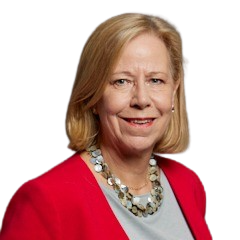
Ruth Cadbury is the Labour MP for Brentford and Isleworth, having first been elected to parliament at the 2015 general election.
In the 2024 general election, Cadbury received 20,007 votes (44.2%) in Brentford and Isleworth. The Conservative candidate received 10,183 votes (22.5%), and the Green Party candidate secured 4,029 votes (8.9%). Cadbury was duly elected with a majority of 9,824.
The Brentford and Isleworth constituency is located in West London, within the London Borough of Hounslow. It includes the communities of Brentford, Isleworth, Osterley, Hounslow and Whitton, stretching along the north bank of the River Thames. Historically a swing marginal seat, Brentford and Isleworth was represented by Conservative MPs including Nirj Deva (1992-1997) and Mary Macleod (2010-2015) and by Labour’s Ann Keen (1997-2010).
Since Cadbury gained the seat for Labour in 2015, the party’s majority increased significantly in 2017, before reducing somewhat in 2019 and 2024.
Political Career
Cadbury currently serves as chair of the transport select committee (September 2024). The committee is responsible for the scrutiny of the Department for Transport and its associated public bodies. Its remit covers all aspects of transport policy in England, as well as UK-wide issues such as aviation and maritime policy.
By virtue of this role, Cadbury sits on the liaison committee – the so-called “super committee” composed of the cross-party chairs of all the other commons select committees. It has a broad oversight role, but is best known for its questioning of the prime minister in sessions that take place two or three times a year.
Prior to the 2024 general election, which saw Labour returned to power after 14 years in opposition, Cadbury served on the Labour frontbench. She was shadow minister for prisons, parole and probation (2023-2024), shadow minister for international trade (2021-2023) and shadow minister for planning (2021).
Cadbury was shadow minister for housing from October 2016 until June 2017, when she was dismissed by then-Labour Party leader Jeremy Corbyn for defying the party whip to vote in favour of remaining in the European Single Market.
In a statement issued after Corbyn’s move, Cadbury said: “During the recent election campaign I made an explicit commitment to the voters in Brentford and Isleworth that I would do all in my power to secure a Brexit settlement that secured jobs, rights and environmental protections.
“I received strong support for my position from my constituents, particularly young people voting for the first time and many others who voted Labour for the first time. It was a key reason my vote increased by over 10,000.
“Therefore I had no doubt that I had to support the amendment moved by Labour colleagues with cross-party support today. The amendment ruled out withdrawing from the EU without a deal, sought a parliamentary vote on the final negotiations and proposed to remaining in the customs union and single market.”
She added: “This is a point of principle for me and I felt bound to honour the commitment I had made to voters. I was aware that, as I was breaking the whip, I could not retain my frontbench role.”
In July 2016, Cadbury introduced a 10-minute rule bill to parliament which aimed to allow individuals to opt out of their taxes being spent on defence. She said that the taxes for peace bill, officially the Income Tax (Non-Military Expenditure) Bill, “would make the hard-won right of conscientious objection relevant to today’s society by granting people the right not to pay for someone to kill on their behalf.”
Cadbury told the commons: “The central purpose of the bill is to give taxpayers who have a conscientious objection to war the right to direct to a non-military security fund the portion of their taxes that would otherwise be spent on military purposes.
“One hundred years ago, at the height of world war one, Britain became the first country in the world to make the legal right of conscientious objection available to all British subjects…
“Let us acknowledge the rights of individuals committed to this by extending the recognition of conscience with regard to war. You get the world you pay for – let us allow the right to pay taxes for peace, not war.”
Cadbury has been a long-standing opponent of Heathrow Airport expansion, leading campaigns during her time as a councillor and voting against the proposal in parliament in 2018. The Brentford and Isleworth MP argues that expansion would see her constituents affected by more noise, pollution, and congestion.
In January 2025, when chancellor Rachel Reeves proposed plans to expand Heathrow, Cadbury voiced her fears that it would result in a “displacement of passengers from regional airports to the London system.”
Cadbury has served as a member of the transport select committee from 2018 to 2023 and since 2024, the justice committee (2017-2019), and the women and equalities committee (2015-2017).
She is listed as treasurer of the all-party parliamentary group (APPG) for Western Rail Link to Heathrow.
Cadbury delivered her maiden speech on 2 June 2015 during the Queen’s speech debate. In it, she said: “Artists and writers including William Hogarth, William Turner and Vincent van Gogh all lived locally for at least some of their lives.
“Our cultural diversity has been enriched in recent decades by people choosing to make Britain their home and then giving back to Britain.
“No one epitomises this more than Mo Farah, whose family settled locally after fleeing Somalia.”
Cadbury served as a Labour councillor on the London Borough of Hounslow Council for 29 years, from 1986 until standing down upon her election as an MP in 2015. She was deputy leader of Hounslow council from 2010 to 2012.
Political Views
Leadership elections and loyalty
Oppose leadership election: In May 2026, Cadbury was among the over 100 Labour MPs who signed a joint statement insisting it was “no time for a leadership contest.” The letter was an intervention in the political crisis engulfing Keir Starmer’s premiership, after Labour suffered heavy losses in the 2026 local elections and devolved elections to the Scottish Parliament and Senedd Cymru. It was organised as a counterweight to a mounting rebellion that had seen high-profile figures, including some ministers, call for Starmer’s resignation.
The statement read: “Last week we had a devastatingly tough set of election results. It shows we have a hard job ahead to win back trust from the electorate.
“That job needs to start today – with all of us working together to deliver the change the country needs.
“We must focus on that. This is no time for a leadership contest.”
Labour deputy leadership 2025: Cadbury was one of 117 Labour MPs who nominated Lucy Powell for the party’s deputy leadership in September 2025. The election followed the resignation of Angela Rayner, who stepped down as deputy prime minister and deputy party leader after an investigation into her tax affairs. It marked the first time since 2007 that Labour had held a deputy leadership contest while in government.
Powell, the former leader of the House of Commons, was seen as a candidate representing the party’s “soft left”; she was support by leading soft left figures including Ed Miliband and Andy Burnham. She secured 117 nominations from the Parliamentary Labour Party (PLP), above the 80 required, and went on to win the election – defeating Bridget Phillipson with 54.3% of the vote.
Labour leadership 2020: Cadbury was one of 21 Labour MPs who nominated Jess Phillips for the party’s leadership in early 2020. The election was triggered by the resignation of Jeremy Corbyn following the party’s defeat in the 2019 general election, which resulted in Labour’s fewest seats in the House of Commons since 1935.
Phillips, the MP for Birmingham Yardley, had been a prominent critic of Corbyn’s leadership of the Labour Party. She withdrew from the contest on 21 January 2020, suggesting that she could not “unite all parts of our movement”.
Labour leadership 2015: Cadbury nominated Yvette Cooper for the party’s leadership in June 2015. The election followed the resignation of Ed Miliband after the party’s defeat in the 2015 general election. It was the first contest held under the “one member, one vote” system, which replaced the previous electoral college.
Cooper, the shadow home secretary, secured 59 nominations from the Parliamentary Labour Party (PLP), comfortably exceeding the 35 required to reach the final ballot. She ultimately finished third in the contest with 17% of the vote.
Corbyn loyalty list: In March 2016, Cadbury was labelled as “neutral but not hostile” by the Corbyn leadership in a leaked list which categorised Labour MPs by their perceived loyalty.
Labour leadership 2016: Cadbury was one of 162 Labour MPs who nominated Owen Smith for the party’s leadership in July 2016. The election was triggered by a challenge to Jeremy Corbyn following the EU referendum, which led to a wave of shadow cabinet resignations and a vote of no confidence supported by 172 MPs. Smith, the former shadow work and pensions secretary, was ultimately defeated by Corbyn, who won with an increased mandate of 61.8% of the vote.
Factional identity and party tradition
Tribune group (2017): Cadbury was listed among the supporters of the Tribune parliamentary group — a caucus generally described as representing the party’s “soft left”.
The Tribune group was initially formed in 1964 to support the newspaper of the same name. It served as a prominent forum for those parliamentarians situated on the left of the Labour Party – but it split over Tony Benn’s campaign for the deputy leadership in 1981. Benn’s supporters founded the Campaign group – which evolved into the Socialist Campaign Group (SCG). Today, the Bennite SCG is strongly associated with the Labour left tradition.
During the 1980s, the Tribune group emerged as a more natural home for those on Labour’s “soft left”.
In 2017, Efford officially re-launched the group with a new mission statement calling for “opportunity and aspiration” to be placed at the heart of the party’s programme. Efford said he had reformed the group to ensure that the centre-left of the Parliamentary Labour Party (PLP) “have a space in which to put forward ideas and debate which has not been there under successive leaders”.
He added: “The view of Labour MPs at the moment tends to be that too much are just Blairites who want to stab Jeremy Corbyn in the back. We want to show that is not where we are, and that we want to develop our own ideas that represent the centre-left of the party.”
SERA: Cadbury has been listed as a member of the Socialist Environment and Resources Association (SERA) – a socialist society affiliated with the Labour Party. Founded in 1973, SERA is the party’s official environmental campaign group. The organisation campaigns on a wide range of issues, including renewable energy, biodiversity, air quality and the transition to a green economy. SERA describes its member MPs as “champions for the environment”.
Brexit and Europe
Brexit referendum: Cadbury campaigned for remain in the 2016 referendum on Britain’s membership of the European Union (EU), and therefore agreed with a majority of constituents, 56.7% of whom voted to remain.
Article 50: In February 2017, Cadbury voted against the European Union (Notification of Withdrawal) Bill. The legislation empowered the prime minister to notify the Council of the European Union of the UK’s intention to withdraw, formally triggering the process set out in Article 50 of the Treaty on European Union. MPs supported the bill by 498 votes to 114 at second reading. In voting against the bill, Cadbury defied the party whip – one of 47 Labour MPs to do so.
People’s vote support (2019): Cadbury signed a January 2019 statement by Labour MPs calling for a “people’s vote” or second referendum. The statement, signed by 71 Labour MPs, read: “Defeat of the Tory [Brexit] deal in a public vote would give us all a chance to campaign for the anti-austerity policies and a Labour government that deals with the true causes of the Brexit vote, and a reformed Europe that works for all people.”
Remain pledge: During the 2019 general election campaign, Cadbury was one of 193 Labour candidates to sign the anti-Brexit “Remain pledge”, drawn up by the campaign group Remain Labour.
It stated: “Labour is committed to a confirmatory referendum, to give you the final say on Brexit. If elected as your Labour MP, I pledge to campaign to Remain in the EU.”
Electoral reform
Fair elections APPG: Cadbury is listed as a member of the all-party parliamentary group (APPG) for fair elections – a cross-party group of MPs and peers that campaigns for electoral reform. The group’s stated aims include replacing the first past the post (FPTP) voting system with a form of proportional representation, eliminating “dark money” and “undemocratic influence” from politics, and countering disinformation.
Electoral reform amendment: In May 2026, Cadbury was one of over 70 Labour MPs who signed an amendment to the Representation of the People Bill, calling on the government to establish a “national commission on electoral reform”. Tabled by Alex Sobel as chair of the fair elections APPG, the amendment aimed to force a rethink of the first past the post voting system.
At the time, Cadbury said “The local elections make it quite clear that first past the post is no longer fit for purpose. When public representatives are winning seats on just 20 percent of the vote, something has gone wrong with our democracy. What we’re asking the Government for is a very reasonable first step towards rectifying this – set up a Commission to look at the electoral system and consider how we can modernise it.”
Welfare
Welfare ‘reasoned amendment’ (June 2025): Cadbury was one of the over 120 Labour MPs to sign the reasoned amendment to the government’s flagship welfare bill which aimed to reject the proposed legislation.
The amendment, in the name of senior Labour MP Dame Meg Hillier, objected to the fact that the bill had not been subject to a “formal consultation with disabled people” and that “250,000 people will be pushed into poverty” as a result of it, according to a government impact assessment.
The motion also called on the government to wait for the publication of the review into the Personal Independence Payment (Pip), helmed by minister Sir Stephen Timms, and the independent review, conducted by Sir Charlie Mayfield, into how the employment of disabled people could be boosted.
Welfare vote (July 2025): Cadbury voted in favour of the government’s flagship welfare bill at second reading. The vote came after ministers agreed to significant concessions to avoid defeat via a mass rebellion of Labour MPs on 1 July 2025.
Assisted dying
Cadbury voted in favour of the Terminally Ill Adults (End of Life) Bill, better known as the assisted dying bill, at second reading (November 2024) and third reading (June 2025). Cadbury was a co-sponsor of the bill.
In a statement setting out her position, Cadbury said: “No terminally ill [person] wants to be ill, but their illness has robbed them of the choice to live. Those people that end their own lives do so because they face deaths that are either excruciatingly painful or are deaths they do not feel will be dignified.
“Their choice in the matter is not whether they die but how they die, where they die, and who they have around them in their last moments. And fundamentally, this comes down to giving individuals the right to choose.”
She added: “The fact that their loved ones can currently be prosecuted for ‘assisting’ them is not fair. More importantly they cannot talk to the very people who are best placed to help them have a pain-free and dignified death – their Doctors. Simply discussing the matter with a patient exposes doctors to prosecution under the current law.”
Social values and conscience issues
Abortion decriminalisation (2025): Cadbury voted in favour of a backbench amendment to the Crime and Policing Bill that sought to decriminalise abortion in England and Wales in June 2025. The amendment, which was passed by a majority of 242 votes, removed women from the threat of prosecution for ending a pregnancy at any stage. As an issue of conscience, MPs were allowed to vote according to their personal beliefs.
Foreign policy and security
Trident renewal (2016): Cadbury voted against a government motion calling for the renewal of the Trident nuclear deterrent system in July 2016. The motion, which was passed by 472 votes to 117, committed the UK to constructing a new fleet of submarines to carry the nation’s nuclear weapons. Labour was split over the issue with 140 of its 230 MPs going against leader Jeremy Corbyn and backing the motion.
At the time, she argued that Trident will not “help Britain’s position in the world and in fact will probably make Britain more unsafe.”
Syria airstrikes (2015): Cadbury voted against a government motion to extend UK airstrikes against Isis from Iraq into Syria in December 2015. The motion, which was passed by 397 votes to 223 after a ten-hour debate in the House of Commons, authorised the RAF to conduct strikes against Isis targets in Syria.
Palestine
Palestinian recognition letter (July 2025): In July 2025, Cadbury was among the over 254 MPs to sign a cross-party letter calling for the government to immediately recognise the state of Palestine. The letter called on the prime minister and foreign secretary to recognise Palestine at the UN Conference then taking place in New York.
https://x.com/SarahChampionMP/status/1949769513123094568
Before Politics
Ruth Margaret Cadbury was born in Birmingham on 14 May 1959.
Cadbury attended The Mount School, a private Quaker school in York, and then Bournville College in Birmingham.
Cadbury graduated from the University of Salford in 1981 with a degree in social sciences.
Before entering parliament, she worked primarily as a planning advisor and consultant. Her roles included working for the Covent Garden Community Association, Planning Aid for London and as a policy planner for the London Borough of Richmond upon Thames – before becoming a freelance consultant from 2006 to 2014.
Personal Life
Cadbury identifies as a nontheist Quaker and is one of only a few Quakers in the House of Commons.
She has said that both her grandfathers were conscientious during war time.
She is also an honorary associate of the National Secular Society.
She is married to Nick Gash, who serves as a non-executive director in the NHS, and former chair of West Middlesex Hospital – which is within Cadbury’s constituency.
Trivia
Cadbury is related to the founders of the Cadbury chocolate business.
In her maiden speech, she referenced her family’s creation of Cadbury chocolate, as well as their strong Quaker faith: “We are of the dynasty that brought Cadbury chocolate to the world, but the Cadburys are also recognised for their social values, values instilled through our Quaker faith.
“The Cadburys of the first half of the 20th century knew that we could not expect working people to be productive, healthy and fulfilled unless the whole person and their family are supported with good pay, good training, decent housing and adequate welfare support.”
Cadbury’s fellow Quaker MP, Catherine West, was also dismissed from the shadow frontbench in June 2017 after rebelling over a Brexit amendment to the queen’s speech.
Ruth Cadbury has not written for Politics.co.uk.