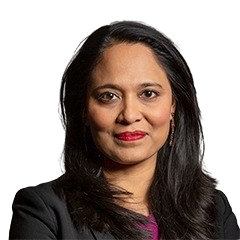
Rushanara Ali is the Labour Party MP for Bethnal Green and Stepney. She was first elected to parliament for the predecessor seat of Bethnal Green and Bow in May 2010.
In 2010, Ali was the first British Bangladeshi elected to parliament.
Following the Labour victory in the 2024 general election, Rushanara Ali was appointed parliamentary under-secretary of state for homelessness and democracy.
In the 2024 general election, Rushanara Ali received 15,896 votes, representing 34.1% of the vote share. An independent candidate, Ajmal Masroor, came second with 14,207 votes (30.5%), while the Green Party candidate, Phoebe Gill, secured 6,391 votes (13.7%). Ali was elected with a majority of 1,689 votes.
Ali had won a 37,524-vote majority at the 2019 general election.
During the 2024 campaign, Ali spoke out about death threats and abuse. A letter sent to Ali’s office, seen by BBC News, promised the Labour MP would be “smashed and killed”.
The Bethnal Green and Stepney constituency was newly created for the 2024 general election, covering parts of the London Borough of Tower Hamlets including Bethnal Green, Stepney, Whitechapel, Shadwell, and Mile End. It largely replaced the former Bethnal Green and Bow seat.
The constituency is located in London’s East End and is known for its high ethnic diversity, including a significant British Bangladeshi population. Historically a Labour area, the predecessor seat was represented by George Galloway of the Respect party between 2005 and 2010.
Ali was one of the first three female Muslim MPs elected to the UK parliament in 2010, alongside Yasmin Qureshi and Shabana Mahmood. In March 2009, Ali was listed by the Guardian as one of the most powerful Muslim women in Britain.
Political Career
Ali is a member of the House of Commons work and pensions select committee (since October 2025) – the committee responsible for scrutinising the policies and spending of the Department for Work and Pensions and associated bodies.
Ali served as parliamentary under-secretary of state for homelessness and democracy from July 2024 to August 2025. This followed her appointment as shadow minister for investment and small business in September 2023, a role she undertook when Labour was in opposition.
Ali resigned as parliamentary under-secretary of state for homelessness and democracy in August 2025 after it had been reported that she evicted tenants from her property in Bow. Ali was reported to have ended her tenants’ contract in order to sell up, before re-listing the house for rent at a higher price within six months. This sparked accusations of hypocrisy, as Ali was the minister responsible for introducing the Renters’ Rights Bill.
In a letter to the prime minister, Ali wrote: “It is with a heavy heart that I offer you my resignation as a minister.”
She insisted that “at all times I have followed all relevant legal requirements”, adding: “I believe I took my responsibilities and duties seriously, and the facts demonstrate this.”
Ali wrote: “However, it is clear that continuing in my role will be a distraction from the ambitious work of the government.
“I have therefore decided to resign from my ministerial position.”
https://x.com/rushanaraali/status/1953539386026733963
In late 2024, survivors of the Grenfell Tower fire called for her resignation due to Ali previously attending a conference sponsored by Saint-Gobain when serving as shadow minister for investment and small business. Ali subsequently relinquished her ministerial portfolio of building safety on 19 October 2024.
In a statement, Ali said: “Trusted relationships between ministers and the Grenfell community are essential for this department. Before I became a minister, I called for the French delegation of the Franco-British Colloque to cut ties with Saint-Gobain. But I understand that perception matters and I have therefore concluded that the building safety portfolio would be best transferred to another minister.
“Our goals of making buildings safe and preventing another tragedy continue to be very important issues for me, and the deputy prime minister and the rest of the ministerial team have my full support in delivering on this work.”
A spokesperson for Grenfell United said: “Any minister that went to events held or chaired by an organisation who had a hand in Grenfell should never have been put in charge of building safety. This is yet another example where government has failed to do their due diligence and the skeletons will continue to come out”.
Previously, Ali served as shadow minister for international development (2010-2013) and shadow minister for education (2013-2014).
However, she resigned from the Labour frontbench in September 2014. Her resignation from the shadow frontbench came as she wished to abstain on a parliamentary vote regarding strikes against IS in Iraq, which went against the party whip supporting the action.
In a letter to the leader of the party Ed Miliband at the time, she wrote: “I appreciate the sincerity of members of parliament from all sides of the House who today support military action against ISIL. I know that British Muslims stand united in the total condemnation of the murders that ISIL have committed. However, there is a genuine belief in Muslim and non-Muslim communities that military action will only create further bloodshed and further pain for the people of Iraq.”
https://x.com/LukeEJames2/status/610397026052874240
In 2015, she stood for the deputy leadership of the Labour Party, but withdrew 30 minutes before the deadline for nominations. Ali had won the support of 25 colleagues. Her exit allowed her supporters to transfer their backing to other candidates to enable them to get onto the ballot paper. She was praised by fellow candidate Ben Bradshaw for her “incredibly selfless” decision.
In April 2016, Ali was appointed as the prime minster’s trade envoy to Bangladesh, a cross-party programme aiming to build business and bilateral trade relationships and help drive economic growth in developing countries. Upon her appointment, she said: “I want to see Britain play a twin role helping Bangladesh thrive economically and supporting the country’s efforts to tackle the threat of climate change.”
Rushanara Ali delivered her maiden speech on 8 June 2010. In it, she said: “It is an amazing privilege to be standing here as the Labour MP for Bethnal Green and Bow, a place described as the heart and soul of this great country, of which I am incredibly proud to be a citizen.
“I feel just as proud to be one of the first three Muslim women MPs ever to be elected to this Parliament, and the first person of British-Bengali heritage to be elected to this House.”
Paying something of a tribute to her controversial predecessor, Ali added: “It is customary to pay tribute to one’s predecessor — in my case, the inimitable George Galloway. Where do I begin?
“Perhaps I should begin with his long service in this House, and his rather shorter stay in the other house. His great oratory was admired by many, even when they passionately disagreed with him.”
Political Views
Leadership elections and loyalty
Labour deputy leadership 2025: Ali was one of 175 Labour MPs who nominated Bridget Phillipson for the party’s deputy leadership in September 2025. The election followed the resignation of Angela Rayner, who stepped down as deputy prime minister and deputy party leader after an investigation into her tax affairs. It marked the first time since 2007 that Labour had held a deputy leadership contest while in government.
Phillipson, the serving education secretary, was widely viewed as the candidate favoured by Downing Street and the party leadership. She secured 175 nominations from the Parliamentary Labour Party (PLP), comfortably exceeding the 80 required to reach the final ballot. he was ultimately defeated by Lucy Powell.
Labour leadership 2020: Ali was one of 82 Labour MPs who nominated Keir Starmer for the party’s leadership in early 2020. The election was triggered by the resignation of Jeremy Corbyn following the party’s defeat in the 2019 general election, which resulted in Labour’s fewest seats in the House of Commons since 1935.
Starmer’s 82 nominations were the highest of any candidate. The shadow Brexit secretary won a decisive victory in the first round with 56.2% of the vote, defeating Rebecca Long-Bailey and Lisa Nandy.
Labour leadership 2015: Ali was part of a group of MPs who lent their nominations to ensure Corbyn, a veteran backbencher, reached the threshold of 35 required to appear on the ballot, intending to “broaden the debate.” Following Corbyn’s landslide victory with 59.5% of the vote, several of these MPs expressed regret.
Corbyn loyalty list: In March 2016, Ali was labelled as “neutral but not hostile” by the Corbyn leadership in a leaked list which categorised Labour MPs by their perceived loyalty.
Labour leadership 2016: Ali supported Angela Eagle for the party’s leadership in July 2016. The election was triggered by a challenge to Jeremy Corbyn following the EU referendum, which led to a wave of shadow cabinet resignations and a vote of no confidence supported by 172 MPs.
Eagle, the former shadow first secretary of state, was the first to formally launch a challenge against Corbyn. However, she withdrew from the race on 19 July after attracting fewer nominations than Owen Smith.
Ali went on to support Smith’s candidacy.
At the time, she called on Corbyn to “do the decent thing” and quit as Labour leader.
Ali said: “If he is the decent man I know him to be, he will do the decent thing and put our communities, our country and our party first… The Labour party needs strong leadership to see us through the period ahead, to hold the government to account and to fight a possible early general election.
“It is vital we repair the deep divisions in our country and help unite the many different communities, and especially those who feel particularly anxious about their future.”
Corbyn was ultimately re-elected an increased mandate of 61.8% of the vote.
Labour leadership 2010: Ali was one of 33 Labour MPs who nominated Diane Abbott for the party’s leadership in May 2010. The election followed the resignation of Gordon Brown, who stepped down as prime minister and Labour leader after the 2010 general election.
Abbott, a member of the Socialist Campaign Group (SCG), secured the minimum 33 nominations from the Parliamentary Labour Party (PLP). It came after several senior figures, including Harriet Harman and David Miliband, lent her their support to ensure a ideologically diverse ballot. She finished fifth in the contest with 7.4% of the vote.
Factional identity and party tradition
Tribune group (2017): Ali was listed among the supporters of the Tribune parliamentary group — a caucus generally described as representing the party’s “soft left”.
The Tribune group was initially formed in 1964 to support the newspaper of the same name. It served as a prominent forum for those parliamentarians situated on the left of the Labour Party – but it split over Tony Benn’s campaign for the deputy leadership in 1981. Benn’s supporters founded the Campaign group – which evolved into the Socialist Campaign Group (SCG). Today, the Bennite SCG is strongly associated with the Labour left tradition.
During the 1980s, the Tribune group emerged as a more natural home for those on Labour’s “soft left”.
In 2017, Efford officially re-launched the group with a new mission statement calling for “opportunity and aspiration” to be placed at the heart of the party’s programme. Efford said he had reformed the group to ensure that the centre-left of the Parliamentary Labour Party (PLP) “have a space in which to put forward ideas and debate which has not been there under successive leaders”.
He added: “The view of Labour MPs at the moment tends to be that too much are just Blairites who want to stab Jeremy Corbyn in the back. We want to show that is not where we are, and that we want to develop our own ideas that represent the centre-left of the party.”
Brexit and Europe
Brexit referendum: In the 2016 Brexit referendum, Ali campaigned for the UK to remain in the European Union, and therefore agreed with a majority of constituents, 69.1% of whom also voted to remain.
Article 50: In February 2017, Ali voted against the European Union (Notification of Withdrawal) Bill. The legislation empowered the prime minister to notify the Council of the European Union of the UK’s intention to withdraw, formally triggering the process set out in Article 50 of the Treaty on European Union. MPs supported the bill by 498 votes to 114 at second reading. In voting against the bill, Ali defied the party whip – one of 47 Labour MPs to do so.
People’s vote support (2019): Ali signed a January 2019 statement by Labour MPs calling for a “people’s vote” or second referendum. The statement, signed by 71 Labour MPs, read: “Defeat of the Tory [Brexit] deal in a public vote would give us all a chance to campaign for the anti-austerity policies and a Labour government that deals with the true causes of the Brexit vote, and a reformed Europe that works for all people.”
Ali’s stance prompted calls for her to be sacked as a trade envoy. Iain Duncan Smith, the Conservative MP and former leader of the opposition, told the BrexitCentral website: “It is quite absurd that at the moment the UK leaves the EU and starts to make new free-trade deals we should have as our trade representatives people who are viscerally opposed to Brexit.”
Remain pledge: During the 2019 general election campaign, Ali was one of 193 Labour candidates to sign the anti-Brexit “Remain pledge”, drawn up by the campaign group Remain Labour.
It stated: “Labour is committed to a confirmatory referendum, to give you the final say on Brexit. If elected as your Labour MP, I pledge to campaign to Remain in the EU.”
Welfare
Welfare vote (July 2025): Ali voted in favour of the government’s flagship welfare bill at second reading. The vote came after ministers agreed to significant concessions to avoid defeat via a mass rebellion of Labour MPs on 1 July 2025.
Assisted dying
Ali voted against the Terminally Ill Adults (End of Life) Bill, better known as the assisted dying bill, at both second reading (November 2024) and third reading (June 2025).
Social values and conscience issues
Same-sex marriage (2013): In February 2013, Ali voted in favour of the Marriage (Same Sex Couples) Bill at its second reading. The landmark piece of legislation, which received its second reading by 400 votes to 175, legalised marriage for same-sex couples in England and Wales.
Foreign policy and security
Trident renewal (2016): Ali voted in favour of a government motion calling for the renewal of the Trident nuclear deterrent system in July 2016. The motion, which was passed by 472 votes to 117, committed the UK to constructing a new fleet of submarines to carry the nation’s nuclear weapons. Labour was split over the issue with 140 of its 230 MPs going against leader Jeremy Corbyn and backing the motion.
Syria airstrikes (2015): Ali voted against a government motion to extend UK airstrikes against Isis from Iraq into Syria in December 2015. The motion, which was passed by 397 votes to 223 after a ten-hour debate in the House of Commons, authorised the RAF to conduct strikes against Isis targets in Syria.
Syria airstrikes (2013): Ali voted against the government’s motion on the principle of military intervention in Syria in August 2013. The government motion was defeated by 285 votes to 272, a move which effectively ruled out UK participation in any US-led military strikes.
Palestine
LFPME: Ali is a member of Labour Friends of Palestine and the Middle East (LFPME). The organisation’s stated aim is to promote peace and justice in the region through the application of international law and respect for human rights.
Ceasefire vote (November 2023): In November 2023, Ali faced intense criticism from constituents after she followed the Labour Party whip to abstain on a Scottish National Party (SNP) motion calling for an immediate ceasefire in Gaza. Labour had tabled a rival motion, making a more moderate appeal for a “humanitarian pause” in the conflict.
Palestinian recognition vote (2014): In October 2014, Ali was one of 192 Labour MPs who voted in favour of recognising Palestine as a state. The motion, passed by 274 votes to 12, called on the government to “recognise the state of Palestine alongside the state of Israel as a contribution to securing a negotiated two-state solution”.
Before Politics
Ali was educated at Mulberry School for Girls and Tower Hamlets College. She went on to study philosophy, politics and economics (PPE) at St John’s College, University of Oxford.
Prior to entering parliament, Rushanara Ali worked as a parliamentary researcher for Oona King, the former Labour MP for Bethnal Green and Bow.
Her subsequent career included roles at the Institute for Public Policy Research (IPPR), the Foreign and Commonwealth Office focusing on human rights policy, and the Home Office.
Immediately before her election in 2010, she was Associate Director of the Young Foundation, a centre for social innovation based in Bethnal Green.
Personal Life
Born in Bangladesh in 1975, Ali moved with her family to Tower Hamlets in East London at the age of seven.
Trivia
Ali jointly became Britain’s first female Muslim MP when elected in 2010 alongside Yasmin Qureshi and Shabana Mahmood.
Rushanara Ali has not written for Politics.co.uk.