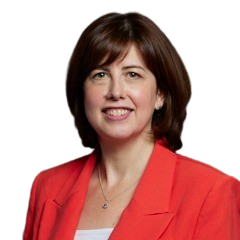
Rachel Reeves is the Labour MP for Leeds West and Pudsey, having first been elected to parliament for the predecessor seat of Leeds West at the 2010 general election.
In the 2024 general election, Reeves won 18,976 votes in the Leeds West and Pudsey constituency, representing 49.3% of the vote share. The Conservative candidate, Lee Farmer, came second with 6,584 votes (17.1%), while the Reform UK candidate, Andrea Whitehead, secured 6,281 votes (16.3%). Rachel Reeves was duly elected with a majority of 12,392.
Rachel Reeves: chancellor (2024-2026)
Reeves served as chancellor of the exchequer from July 2024 to July 2026. She left government as part of the July 2026 cabinet reshuffle conducted by Andy Burnham upon his appointment as prime minister.
Reeves, who was the first woman to hold the post of chancellor, reportedly declined the offer of another post in Burnham’s cabinet.
In late July 2024, mere weeks into her tenure as chancellor, Reeves accused the previous Conservative government of leaving a £22 billion fiscal “black hole” in the country’s finances. She said compensation payments for victims of the Post Office Horizon IT and infected blood scandals, as well as a series of other projects, had not been fully accounted for.
The chancellor responded with urgent spending cuts, controversially limiting the winter fuel payment. In her budget statement, Reeves accused the Conservatives of having “hid the reality of their public spending plans”.
Reeves delivered her first budget as chancellor in October 2024. The fiscal event, presented just four months after the party’s landslide victory in the 2024 general election, was the first Labour budget since 2010 and the first in history to be delivered by a woman. Reeves outlined a series of tax increases and spending commitments aimed at “restoring economic stability” and “rebuilding Britain.”
The central feature of the budget was its package of tax increases, amounting to £40 billion. This figure made the 2024 autumn budget the largest tax-raising budget since 1993. The budget’s primary revenue-raising measure was a significant increase in business taxation, raising employers’ national insurance contributions by 1.2 points to 15% from April 2025 and lowering the threshold at which employers begin paying these contributions (on salaries above £9,100 to £5,000).
Other measures included increasing the lower rate of capital gains tax (CGT) from 10% to 18%, and the higher rate from 20% to 24%; new inheritance tax rules for agricultural and business property above £1 million (referred to be critics as the “family farms tax”), a rise in the stamp duty surcharge for second homes by 2 points to 5%, and the confirmation of applying VAT to private school fees from January 2025, forecast to raise over £9 billion.
The rises created room for increased spending on public services and investment. Reeves announced the health budget would receive a £22.6 billion increase in day-to-day spending and a £3.1 billion increase in capital investment over the next two years. The core schools budget was increased by £2.3 billion. These measures were framed as a repudiation of previous austerity budgets. “I said there would be no return to austerity; that is the choice I have made today”, Reeves told MPs.
Overall, the budget left £9.9 billion worth of fiscal headroom – the buffer between the government’s fiscal rules and spending/tax plans, or money available for additional spending.
The narrow headroom established in the autumn was swiftly eliminated due to a worsening economic outlook.
At the spring statement in March 2025, the Office for Budget Responsibility (OBR) revised the UK’s 2025 growth forecast down from 2% to 1%. This reversal of fortunes left the chancellor with a £4.1 billion fiscal gap and forced her to announce £14 billion worth of spending cuts – predominantly targeting the welfare and foreign aid budgets – to adhere to her own rules.
The plan to cut the welfare and disability benefits bill by nearly £5 billion, including a crackdown on eligibility for personal independence payment (Pip), triggered a significant backlash among Labour MPs.
The welfare debacle amounted to a major political crisis for the Labour government.
Rachel Reeves: previous offices (2010-2024)
Prior to the 2024 general election, which saw Labour returned to power after 14 years in opposition, Reeves held a series of senior frontbench roles. She was appointed as shadow chancellor as part of a wide-ranging shadow cabinet reshuffle in May 2021. Reeves replaced Anneliese Dodds. During her tenure as shadow chancellor, she focused on presenting Labour as fiscally responsible. Reeves’ economic approach was described as “securonomics”.
Previously, Reeves served on the frontbench as shadow chancellor of the Duchy of Lancaster from April 2020 to May 2021, the shadow secretary of state for work and pensions from October 2013 to September 2015, shadow chief secretary to the Treasury from October 2011 to October 2013, and shadow minister for work and pensions from October 2010 to October 2011.
In October 2013, Reeves caused controversy as shadow secretary of state for work and pensions when she claimed that Labour would be “tougher” than the Conservatives on the benefits bill. “Nobody should be under any illusions that they are going to be able to live a life on benefits under a Labour government”, she said at the time.
“If you can work you should be working, and under our compulsory jobs guarantee if you refuse that job you forgo your benefits, and that is really important.”
Reeves added: “We would be tougher [than the Conservatives]. If they don’t take it [the offer of a job] they will forfeit their benefit. But there will also be the opportunities there under a Labour government.”
At this time, Reeves was seen as a rising star in the Labour Party and a possible future leader.
Rachel Reeves: rise to prominence
Reeves stood down from the shadow frontbench upon Jeremy Corbyn’s election as Labour leader in September 2015.
She posted to social media at the time: “When I return from maternity leave in January I will serve my constituents in Leeds West, [the] party and [the] new leadership from backbenches.”
Reeves was a relatively prominent Labour backbencher during the tumultuous Brexit years from 2016 to 2020. In January 2019, as the House of Commons voted on a series of amendments to a neutral government motion, Reeves proposed an amendment that would have required the government to request an extension to the Article 50 Brexit negotiating period if the commons had not approved a deal by 26 February. It was rejected by 322 to 290.
Reeves chaired the House of Commons business and trade committee from July 2017 to April 2020. By virtue of this role, Reeves sat on the liaison committee across the same period.
Reeves was also a member of the national security strategy (joint committee) (2017-2019), the Treasury committee (2015-2017) and the business, innovation and skills committee (2010).
Reeves delivered her maiden speech on 8 June 2010 during a debate on economic affairs and work and pensions.
In it, she said: “Most of all, I will fight for jobs, growth and prosperity”.
She added: “We know that the causes of this crisis are global, but the pathways out must be local and regional, so I will fight for Leeds West with determination, and I will do so in a responsible way. It would not be responsible or sensible to oppose every spending cut or tax increase.”
Political Views
Leadership elections and loyalty
Labour leadership 2020: Reeves was one of 21 Labour MPs who nominated Jess Phillips for the party’s leadership in early 2020. The election was triggered by the resignation of Jeremy Corbyn following the party’s defeat in the 2019 general election, which resulted in Labour’s fewest seats in the House of Commons since 1935.
Phillips, the MP for Birmingham Yardley, had been a prominent critic of Corbyn’s leadership of the Labour Party. She withdrew from the contest on 21 January 2020, suggesting that she could not “unite all parts of our movement”.
Labour leadership 2015: Reeves was one of 68 Labour MPs who nominated Andy Burnham for the party’s leadership in June 2015. The election followed the resignation of Ed Miliband after the party’s defeat in the 2015 general election. It was the first contest held under the “one member, one vote” system, which replaced the previous electoral college.
Burnham, the shadow health secretary, was initially considered the frontrunner. He secured 68 nominations from the Parliamentary Labour Party (PLP), comfortably exceeding the 35 required to reach the final ballot. He ultimately finished second in the contest with 19% of the vote, losing to Jeremy Corbyn in the first round.
Corbyn loyalty list: In March 2016, Reeves was labelled as “hostile group” by the Corbyn leadership in a leaked list which categorised Labour MPs by their perceived loyalty. This label suggested the Corbyn leadership viewed Reeves as actively and openly antagonistic.
Labour leadership 2016: Reeves supported Angela Eagle for the party’s leadership in July 2016. The election was triggered by a challenge to Jeremy Corbyn following the EU referendum, which led to a wave of shadow cabinet resignations and a vote of no confidence supported by 172 MPs.
Eagle, the former shadow first secretary of state, was the first to formally launch a challenge against Corbyn. However, she withdrew from the race on 19 July after attracting fewer nominations than Owen Smith.
Reeves went on to support Smith’s candidacy. Smith, the former shadow work and pensions secretary, was ultimately defeated by Corbyn, who won with an increased mandate of 61.8% of the vote.
Labour leadership 2010: Reeves was one of 63 Labour MPs who nominated Ed Miliband for the party’s leadership in May 2010. The election followed the resignation of Gordon Brown, who stepped down as prime minister and Labour leader after the 2010 general election.
Miliband, the former energy and climate change secretary, was seen as the candidate of the “soft left” and secured significant backing from affiliated trade unions. He secured 63 nominations from the Parliamentary Labour Party (PLP), exceeding the 33 required to reach the final ballot. Miliband went on to narrowly defeat his brother, David, in the final round by 50.7% to 49.3%.
Factional identity and party tradition
SERA: Reeves has been listed as a member of the Socialist Environment and Resources Association (SERA) – a socialist society affiliated with the Labour Party. Founded in 1973, SERA is the party’s official environmental campaign group. The organisation campaigns on a wide range of issues, including renewable energy, biodiversity, air quality and the transition to a green economy. SERA describes its member MPs as “champions for the environment”.
Brexit and Europe
Brexit referendum: Reeves supported Remain in the 2016 Brexit referendum, and therefore disagreed with a majority of her constituents, 53.3% of whom voted to Leave.
Article 50: In February 2017, Reeves voted in favour of the European Union (Notification of Withdrawal) Bill. The legislation empowered the prime minister to notify the Council of the European Union of the UK’s intention to withdraw, formally triggering the process set out in Article 50 of the Treaty on European Union. MPs supported the bill by 498 votes to 114 at second reading.
People’s vote support (2019): Reeves signed a January 2019 statement by Labour MPs calling for a “people’s vote” or second referendum. The statement, signed by 71 Labour MPs, read: “Defeat of the Tory [Brexit] deal in a public vote would give us all a chance to campaign for the anti-austerity policies and a Labour government that deals with the true causes of the Brexit vote, and a reformed Europe that works for all people.”
Remain pledge: During the 2019 general election campaign, Reeves was one of 193 Labour candidates to sign the anti-Brexit “Remain pledge”, drawn up by the campaign group Remain Labour.
It stated: “Labour is committed to a confirmatory referendum, to give you the final say on Brexit. If elected as your Labour MP, I pledge to campaign to Remain in the EU.”
Welfare
Welfare vote (July 2025): Reeves voted in favour of the government’s flagship welfare bill at second reading. The vote came after ministers agreed to significant concessions to avoid defeat via a mass rebellion of Labour MPs on 1 July 2025.
Assisted dying
Reeves voted in favour of the Terminally Ill Adults (End of Life) Bill, better known as the assisted dying bill, at both second reading (November 2024) and third reading (June 2025).
Social values and conscience issues
Same-sex marriage (2013): In February 2013, Reeves voted in favour of the Marriage (Same Sex Couples) Bill at its second reading. The landmark piece of legislation, which received its second reading by 400 votes to 175, legalised marriage for same-sex couples in England and Wales.
Foreign policy and security
Trident renewal (2016): Reeves voted in favour of a government motion calling for the renewal of the Trident nuclear deterrent system in July 2016. The motion, which was passed by 472 votes to 117, committed the UK to constructing a new fleet of submarines to carry the nation’s nuclear weapons. Labour was split over the issue with 140 of its 230 MPs going against leader Jeremy Corbyn and backing the motion.
Syria airstrikes (2015): Reeves voted against a government motion to extend UK airstrikes against Isis from Iraq into Syria in December 2015. The motion, which was passed by 397 votes to 223 after a ten-hour debate in the House of Commons, authorised the RAF to conduct strikes against Isis targets in Syria.
Syria airstrikes (2013): Reeves voted against the government’s motion on the principle of military intervention in Syria in August 2013. The government motion was defeated by 285 votes to 272, a move which effectively ruled out UK participation in any US-led military strikes.
Before Politics
Born in Lewisham, London, on 13 February 1979, Reeves’ parents were both teachers. She attended Cator Park School for Girls, a comprehensive school in Beckenham, Bromley.
Reeves’ studied philosophy, politics and economics (PPE) at New College, Oxford, graduating in 2000. She subsequently completed a master’s degree in economics at the London School of Economics.
Reeves joined the Bank of England as an economist on their graduate scheme in 2000, working there until 2006. During her time at the BoE, she also worked at the British Embassy in Washington DC.
Reeves later worked for HBOS in their retail banking division in Leeds from 2006 until 2009.
Reeves’ has stated she once turned down a job at the investment bank Goldman Sachs.
Personal Life
Reeves is married to Nicholas Joicey, a senior civil servant who previously served as a private secretary and speechwriter to Gordon Brown. They have two children, a daughter and a son.
Her younger sister, Ellie Reeves, is also a Labour MP.
Trivia
Reeves was a junior chess champion. She won the British Under-14 girls’ chess title in 1993. She has spoken about the strategic thinking learned from chess being applicable to politics.
Reeves is still a keen chess player. She told the Guardian in July 2022: “Strategic thinking is essential in both politics and chess. So I definitely feel like continuing to play chess when I can helps keep me nimble in the Labour campaign to be our next government. Always thinking two moves ahead.”
She added: “I love to play chess because it helps me to recognise patterns, focus my attention and is helping me to learn how to strategise and calculate moves in advance.”
Reeves joined the Labour Party at the age of 16.
Rachel Reeves has not written for Politics.co.uk.