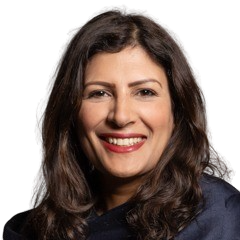
Preet Kaur Gill is the Labour and Co-operative MP for Birmingham Edgbaston, having first been elected to parliament at the 2017 general election. She is the UK’s first female Sikh MP.
In the 2024 general election, Gill won 16,599 votes, representing 44.3% of the vote. The Conservative candidate, Ashvir Sangha, received 8,231 votes (22.0%), while the Reform UK candidate, Joshua Mathews, secured 4,363 votes (11.7%). Gill was duly elected with a majority of 8,368 votes.
The Birmingham Edgbaston constituency covers western parts of the city, including Edgbaston, Harborne, Quinton, and Bartley Green. It hosts the University of Birmingham and has been represented continuously by women MPs since 1953.
Gill’s immediate predecessor as the MP for Birmingham Edgbaston was Gisela Stuart, who represented that constituency for Labour from 1997 to 2017. A prominent Brexiteer, Stuart chaired the Vote Leave campaign during the 2016 referendum on Britain’s membership of the European Union (EU). She regularly appeared alongside Boris Johnson and Michael Gove at campaign events.
Birmingham Edgbaston was held by the Conservative Party from 1898 to 1997. Former prime minister Neville Chamberlain, best known for his foreign policy of appeasement and signing of the Munich Agreement (1938), represented the seat from 1929 to 1940.
Political Career
Gill served as a parliamentary under-secretary of state for health innovation and safety in the Department of Health and Social Care from May to July 2026. Her appointment to this post was part of a targeted reshuffle designed to stabilise Keir Starmer’s position as prime minister after a series of resignations. She left government as part of the July 2026 reshuffle conducted by Andy Burnham upon his appointment as prime minister.
Gill was among the over 100 Labour MPs who signed the May 2026 joint statement insisting it was “no time for a leadership contest.”
Previously, Gill served as a parliamentary private secretary (PPS) to Liz Kendall, the secretary of state for science, innovation and technology (2025-2026). A PPS acts as an unpaid parliamentary assistant, providing a link between the senior frontbencher and backbench MPs.
Gill served as PPS to Jonathan Reynolds, the then business secretary, from July 2024 to September 2025.
Prior to the 2024 general election, which saw Labour returned to power after 14 years in opposition, Gill served in the shadow cabinet as shadow secretary of state for international development from April 2020 until September 2023, when she was shuffled downwards to become shadow minister for primary care and public health, a role she held until the 2024 election.
Before joining the shadow cabinet, Gill was shadow minister for international development from January 2018 to April 2020.
During her tenure as a parliamentarian, Gill has introduced a series of private members’ bills.
- The Public Body Ethnicity Data (Inclusion of Jewish and Sikh Categories) Bill, introduced in December 2024. Building on changes made for the 2021 census, this bill would mandate that public bodies include “Sikh” and “Jewish” as distinct ethnic group options, aiming to improve the monitoring of discrimination and the delivery of targeted public services.
- The Registration of Death (Religion) Bill, introduced in October 2024, which proposed the voluntary collection of a deceased person’s religion – with a view to helping public health bodies better understand mortality rates and health inequalities among different faith communities.
- The Firearms (3D Printing) Bill, also introduced in October 2024, sought to close a loophole in UK law by making it illegal to possess digital blueprints for creating 3D-printed firearms, often known as untraceable “ghost guns”. In February 2025, the government announced it would be taking the measures outlined in Gill’s bill forward.
- The Freehold Properties (Management Charges) Bill from June 2019. This bill aimed to tackle the “fleecehold” issue by giving freehold homeowners on managed estates the right to challenge service charges, but it failed to pass.
https://x.com/PreetKGillMP/status/1864342061563920720
Gill was a member of the home affairs committee from September 2017 to February 2018.
Gill delivered her maiden speech on 13 September 2017 during a debate on higher education. In it, she said: “Having been born and bred in one of the most diverse cities in the United Kingdom, I am so proud of the vibrant and exciting multicultural society that we live in today.
“I walk through Birmingham and see Caribbean restaurants next to Indian dress shops, gurdwaras and mosques down the road from Catholic schools, Polish accents, Irish accents and even the occasional exotic twang of an, ‘Alright, bab’ from one of our neighbours from the Black Country.”
She added: “One of Britain’s finest hours was the creation of the NHS and the welfare state in 1946 – a safety net for those who fell on hard times. To tackle issues such as alcohol and substance misuse, we need to rethink this safety net to make sure that emotional help and support is there for anyone who needs it, whenever they need it.
“It is time we treated the cause of these issues, rather than just the symptoms.”
Before entering parliament, Gill served as a Labour councillor for St Paul’s ward on Sandwell Metropolitan Borough Council from 2012 to 2018, including time as cabinet member for public health and protection.
Political views
Leadership elections and loyalty
Labour deputy leadership 2025: Gill was one of 175 Labour MPs who nominated Bridget Phillipson for the party’s deputy leadership in September 2025. The election followed the resignation of Angela Rayner, who stepped down as deputy prime minister and deputy party leader after an investigation into her tax affairs. It marked the first time since 2007 that Labour had held a deputy leadership contest while in government.
Phillipson, the serving education secretary, was widely viewed as the candidate favoured by Downing Street and the party leadership. She secured 175 nominations from the Parliamentary Labour Party (PLP), comfortably exceeding the 80 required to reach the final ballot. She was ultimately defeated by Lucy Powell.
Labour leadership 2020: Gill was one of 82 Labour MPs who nominated Keir Starmer for the party’s leadership in early 2020. The election was triggered by the resignation of Jeremy Corbyn following the party’s defeat in the 2019 general election, which resulted in Labour’s fewest seats in the House of Commons since 1935.
Starmer’s 82 nominations were the highest of any candidate. The shadow Brexit secretary won a decisive victory in the first round with 56.2% of the vote, defeating Rebecca Long-Bailey and Lisa Nandy.
In an article for LabourList, published February 2020, Gill said Starmer had “spent his life fighting against injustice”.
She wrote: “I believe that Keir has what it takes to win for the people who need a Labour government most. He has spent his life fighting against injustice; as a human rights lawyer – winning an award in recognition of his unpaid work challenging the death penalty around the world.
“And in his work taking on powerful vested interests during his time as director of public prosecutions – taking the last Labour government to court for refusing to provide benefits for asylum seekers and acting to prosecute Murdoch journalists involved in the phone-hacking scandal.
“Whoever has the honour of leading our party must be someone who can look to the future not just their navel. For Labour to win at the next election, we must not only look to the future of the Labour Party but to the future of the country and its place in the world as well.”
Factional identity and party tradition
Blue Labour: Gill identifies with the Blue Labour group in parliament. Founded by Labour peer Lord Glasman in 2009, the Blue Labour creed champions what it terms the politics of “faith, family and flag”, embracing a form of social conservatism with a progressive or left-wing economic policy. Blue Labour articulates a critique of both New Labour’s social liberalism and free-market globalisation.
In an article for the Telegraph, published January 2026, Gill wrote: “I am Labour, and I am Blue Labour because I believe politics must once again be rooted in responsibility, contribution and the courage to confront difficult truths.”
She added: “Blue Labour also insists on honesty about borders and belonging. Britain is a welcoming country, but it must also be a lawful one. Illegal migration is illegal and it matters that the public can see the law being enforced fairly and consistently.
“When housing, health and education are under strain, ignoring this reality corrodes trust in the state itself.”
The piece was titled: “Labour must go blue.”
Brexit and Europe
Brexit referendum: Gill supported the Remain campaign in the 2016 EU referendum, and therefore agreed with a majority of her constituents, 52.7% of whom also voted to Remain.
In May 2018, while serving as a shadow minister, Gill publicly backed a referendum on the final Brexit deal – in defiance of the Labour leadership’s position.
In a conversation with a student activist on Twitter (now X), Gill said she agreed that “a people’s vote on the deal is an absolute must”.
She went on to delete the post.
Left-wing ‘people’s vote’: In March 2019, Gill was among 20 signatories to a cross-party letter published in the Guardian that called for a second referendum and rubbished Brexit as a “massive assault” on working-class people.
The letter read:“We are campaigning to transform society, not for the status quo. We are against Brexit because it is a massive assault on working-class people, on the environment, on migrants and on the communities that the left aims to represent.”
Remain pledge: During the 2019 general election campaign, Gill was one of 193 Labour candidates to sign the anti-Brexit “Remain pledge”, drawn up by the campaign group Remain Labour.
It stated: “Labour is committed to a confirmatory referendum, to give you the final say on Brexit. If elected as your Labour MP, I pledge to campaign to Remain in the EU.”
Welfare
Welfare vote (July 2025): Gill voted in favour of the government’s flagship welfare bill at second reading. The vote came after ministers agreed to significant concessions to avoid defeat via a mass rebellion of Labour MPs on 1 July 2025.
Assisted dying
Gill voted against the Terminally Ill Adults (End of Life) Bill, better known as the assisted dying bill, at both second reading (November 2024) and third reading (June 2025).
In a statement setting out her position, issued ahead of the bill’s second reading, Gill said her stance had been “informed by both my personal beliefs and my concerns about the potential consequences of such a law”.
Gill wrote: “I have carefully considered the moral issues in relation to this legislation and its implications for individuals, families, and society. After much reflection, I have decided that I will vote against this bill. I would like to share with you the reasons behind my decision, informed by both my personal beliefs and my concerns about the potential consequences of such a law.
“As a practicing Sikh, my faith is rooted in the principle of the sanctity of life, which underscores my conviction that every moment of life has inherent value, regardless of circumstance or suffering. I fully recognise and sympathise with the unimaginable pain and hardship that some people endure due to terminal illnesses, I believe that assisting in ending a life conflict with my core values.”
Speaking during the bill’s third reading debate, Gill told the House: “The bill has highlighted the promise of choice. For choice to be real, there must be genuine options to choose from, but what has been highlighted is that palliative care provision is woefully inadequate, and that the worst served are also the most disadvantaged, from the most deprived communities.
“Worse, should the bill come into force, the provision of palliative care is likely to be compromised if hospices have no legal right to opt out of assisted dying. No such opt-out is proposed in the bill.”
She added: “That brings me back to our role as legislators. The question for us now is this: after all the consideration, can we be satisfied that our duties to protect people’s wellbeing and safeguard them from harm will be fulfilled if we pass the bill?
“From everything that I have seen, heard and read, the answer must be no.”
Foreign policy and security
Sanctioned (Russia): In April 2022, Gill was among the group of MPs placed on a sanctions list by the Russian government. The measure barred them from entering Russia and was presented by Moscow as a retaliatory response to the UK’s stance on the invasion of Ukraine.
Palestine
LFPME: Gill has been listed as a member of Labour Friends of Palestine and the Middle East (LFPME). The organisation’s stated aim is to promote peace and justice in the region through the application of international law and respect for human rights.
Before Politics
Born Preet Kaur Shergill in Edgbaston, Birmingham on 21 November 1972, her parents were Indian immigrants. Her father was a bus driver and long-serving president of the Smethwick Guru Nanak Gurdwara, and her mother was a seamstress.
She attended Lordswood Girls’ School and Bournville College, where she was student president. She graduated from the University of East London with a first-class BSc in sociology with social work.
After graduating, she worked as a social worker, including time spent in a kibbutz in Israel and with street children in India. She specialised in child protection, working for local authorities including Birmingham City Council as a children’s services manager until 2017.
Personal Life
Gill married Sureash Singh Chopra, a social worker, in 2009. They have two daughters.
Gill is the first female Sikh MP – something she said comes with a “huge sense of responsibility”.
In her 2017 maiden speech, Gill said: “I and many others will be asked to raise difficult issues in the House on behalf of Sikhs, on matters such as hate crime, the Jallianwala Bagh massacre, Sikh ethnic monitoring in the 2021 census and an independent public inquiry into UK involvement in the 1984 Sikh genocide.
“For many decades, Sikhs have lived in this country, paid their taxes, fought in world wars and contributed to society in every way imaginable. It is an historic moment for Sikhs in this country because Parliament is beginning to look more like the people it serves.”
Trivia
In December 2020, Gill won the overall prize at the MP of the Year Awards organised by the Patchwork Foundation, for her “consistent championing of young people, representation of the Sikh Community and initiative to tackle Fuel Poverty via a strategic campaign aimed at the UK’s biggest fuel companies.”
https://x.com/PreetKGillMP/status/1228405248928161797
Gill said at the time: “Since first being elected in 2017, I have sought to use every opportunity to speak up for our young people and empower them to take action on the issues that matter most to them.
“From running a popular mentoring and work experience programme in my constituency, to forming a youth mental health working group run by young people, for young people, and to being a champion for Sikh issues by fighting to recognise, report and reduce anti-Sikh hate crime and leading the campaign for a Sikh ethnic tick-box on the 2021 census.
“I believe it is vital that MPs use their positions to amplify the voices of the underrepresented communities they serve in parliament, and it’s that ethos that guides the work I do.”


Preet Gill: ‘Children should be chasing their dreams — not dentist appointments’
21 January 2024