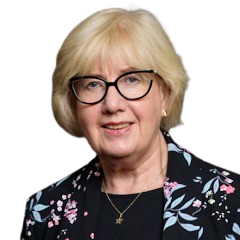
Patricia Ferguson is the Labour MP for Glasgow West, having first been elected to parliament at the 2024 general election.
In the 2024 general election, Ferguson received 18,621 votes (46.7%). The Scottish National Party (SNP) candidate, Carol Monaghan, received 12,175 votes (30.5%), while the Scottish Green Party candidate, Nick Quail, polled 3,662 votes (9.2%). Ferguson was elected with a majority of 6,446 votes.
The Glasgow West constituency was newly created ahead of the 2024 election.
Political Career
Ferguson chairs the House of Commons Scottish affairs select committee (since September 2024) – the committee responsible for scrutinising the expenditure, administration and policies of the Scotland Office and its associated bodies. The committee also examines the wider UK government, assessing policies and legislation that are relevant to Scotland.
In her election, Ferguson won the support of 237 colleagues, narrowly defeating her rival, Gregor Poynton, who secured 235 votes.
By virtue of this role, Ferguson sits on the liaison committee – the so-called “super committee” composed of the cross-party chairs of all the other commons select committees. It has a broad oversight role, but is best known for its questioning of the prime minister in sessions that take place two or three times a year.
In May 2026, Ferguson was among the over 100 Labour MPs who signed a joint statement insisting it was “no time for a leadership contest.” The letter was an intervention in the political crisis engulfing Keir Starmer’s premiership, after Labour suffered heavy losses in the 2026 local elections and devolved elections to the Scottish Parliament and Senedd Cymru. It was organised as a counterweight to a mounting rebellion that had seen high-profile figures, including some ministers, call for Starmer’s resignation.
The statement read: “Last week we had a devastatingly tough set of election results. It shows we have a hard job ahead to win back trust from the electorate.
“That job needs to start today – with all of us working together to deliver the change the country needs.
“We must focus on that. This is no time for a leadership contest.”
In January 2026, Ferguson was one of over 60 Labour MPs to sign a letter to the prime minister calling for the introduction of an Australia-style ban on social media access for children under the age of 16. Organised by Plymouth Moor View MP Fred Thomas, the initiative brought together a cross-factional coalition of backbenchers – spanning the Socialist Campaign Group, Tribune Group and Blue Labour – to demand action.
The letter called on Keir Starmer to “show leadership” by introducing a minimum age for social media access “to protect young people from the consequences of unregulated, addictive social media platforms”.
It stated: “We are all strong supporters of technology, and of this Labour government’s ambition to use tech to improve lives. But successive governments have done far too little to protect young people from the consequences of unregulated, addictive social media platforms.”
Ferguson is listed as a member of the all-party parliamentary groups (APPGs) for the Holy See and breast cancer.
Ferguson delivered her maiden speech on 2 September 2024 during a debate on technology in public services.
In it, she said: “Donald Dewar [the first first minister of Scotland] often spoke about the imbalance in the social arithmetic, and the need to rebalance the equation by reducing poverty and by giving all our children the best possible start in life and the opportunity to fulfil their potential.
“That will only be achieved by working across government, which is why I welcome the establishment of the poverty taskforce and why its mission is so important to all our constituents and to the work of this government.
“People across this country have put their belief and trust in us. It is up to us now to make sure we deliver for them.”
Before entering the parliament at Westminster, Ferguson served as a member of the Scottish Parliament (MSP). She was the MSP for Glasgow Maryhill from 1999 to 2011, and for the redrawn seat of Glasgow Maryhill and Springburn from 2011 to 2016.
During her time as an MSP, she served as deputy presiding officer of the Scottish Parliament (1999-2001) and held ministerial roles in the Scottish executive under first minister Jack McConnell, as minister for parliamentary business (2001-2004) and minister for tourism, culture and sport (2004-2007).
Ferguson was therefore the first deputy presiding officer of the Scottish Parliament that convened in 1999. She served alongside SNP MSP George Reid, deputy presiding officer from 1999 to 2003, and under former Liberal Party leader David Steel, the inaugural presiding officer of the Scottish Parliament (1999-2003).
More recently, Ferguson served as a Labour councillor on Glasgow City councilors from May 2022 until September 2024.
Ferguson unsuccessfully contested the seat of Glasgow North West in the 2019 general election.
Political Views
Leadership elections and loyalty
Labour deputy leadership 2025: Ferguson was one of 117 Labour MPs who nominated Lucy Powell for the party’s deputy leadership in September 2025. The election followed the resignation of Angela Rayner, who stepped down as deputy prime minister and deputy party leader after an investigation into her tax affairs. It marked the first time since 2007 that Labour had held a deputy leadership contest while in government.
Powell, the former leader of the House of Commons, was seen as a candidate representing the party’s “soft left”; she was supported by leading soft left figures including Ed Miliband and Andy Burnham. She secured 117 nominations from the Parliamentary Labour Party (PLP), above the 80 required, and went on to win the election – defeating Bridget Phillipson with 54.3% of the vote.
Welfare
Welfare ‘reasoned amendment’ (June 2025): Ferguson was one of the over 120 Labour MPs to sign the reasoned amendment to the government’s flagship welfare bill which aimed to reject the proposed legislation.
The amendment, in the name of senior Labour MP Dame Meg Hillier, objected to the fact that the bill had not been subject to a “formal consultation with disabled people” and that “250,000 people will be pushed into poverty” as a result of it, according to a government impact assessment.
The motion also called on the government to wait for the publication of the review into the Personal Independence Payment (Pip), helmed by minister Sir Stephen Timms, and the independent review, conducted by Sir Charlie Mayfield, into how the employment of disabled people could be boosted.
Welfare vote (July 2025): Ferguson voted in favour of the government’s flagship welfare bill at second reading. The vote came after ministers agreed to significant concessions to avoid defeat via a mass rebellion of Labour MPs on 1 July 2025.
Assisted dying
Ferguson voted against the Terminally Ill Adults (End of Life) Bill, better known as the assisted dying bill, at both second reading (November 2024) and third reading (June 2025).
Social values and conscience issues
Abortion decriminalisation (2025): Ferguson voted against a backbench amendment to the Crime and Policing Bill that sought to decriminalise abortion in England and Wales in June 2025. The amendment, which was passed by a majority of 242 votes, removed women from the threat of prosecution for ending a pregnancy at any stage. As an issue of conscience, MPs were allowed to vote according to their personal beliefs.
Ferguson was one of 25 Labour MPs to vote against the amendment.
Palestine
Palestinian recognition letter (July 2025): In July 2025, Ferguson was among the over 254 MPs to sign a cross-party letter calling for the government to immediately recognise the state of Palestine. The letter called on the prime minister and foreign secretary to recognise Palestine at the UN Conference then taking place in New York.
Before Politics
Born Patricia Josephine Ferguson on 24 September 1958 in Glasgow, she attended Garnethill Convent Secondary School in Glasgow. She subsequently attended Glasgow College of Technology.
Before entering the Scottish Parliament in 1999, Ferguson worked as an administrator in NHS Scotland for 14 years (1978-1990). She then worked as an administrator for the Scottish Trades Union Congress (STUC) from 1990 to 1994.
Personal Life
Ferguson is married to Bill Butler, who has also served in the Scottish Parliament and on Glasgow City Council.
Trivia
Ferguson is one of the few individuals to have served as a constituency representative in the Scottish Parliament, on a local council and in the parliament at Westminster.
Patricia Ferguson has not written for Politics.co.uk.