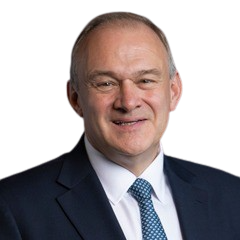
Matt Rodda is the Labour MP for Reading Central, having first been elected to parliament for the predecessor seat of Reading East at the 2017 general election.
In the 2024 general election, Rodda won 21,598 votes, representing 47.7% of the vote. The Conservative candidate, Raj Singh, received 8,961 votes (19.8%), while the Green Party candidate, Dave McElroy, secured 6,417 votes (14.2%). Rodda was duly elected with a majority of 12,637 votes.
The Reading Central constituency was newly created for the 2024 election, formed from parts of the abolished Reading East and Reading West seats in Berkshire. It covers central parts of Reading. Reading East was held by the Conservatives from 2005 until Labour gained it in 2017.
Political Career
Rodda currently serves as a parliamentary private secretary (PPS) in the office of the leader of the House of Lords. A PPS acts as an unpaid parliamentary assistant, providing a link between the senior frontbencher and backbench MPs. The role is widely regarded as the first step on the ministerial ladder. Although they cannot speak for the government in debates, a PPS is bound by collective responsibility and becomes part of the so-called “payroll vote”, expected to support the official line in all divisions. Rodda was appointed to this role in July 2026, following the Labour leadership contest and Andy Burnham’s elevation as prime minister.
Rodda served as a parliamentary private secretary in the Northern Ireland Office from July 2024 to July 2026.
Prior to the 2024 general election, which saw Labour returned to power after 14 years in opposition, Rodda held a series of shadow ministerial roles. He was shadow minister for AI and intellectual property (September 2023 – May 2024), shadow minister for pensions (January 2021 – September 2023), and shadow minister for buses (January 2018 – January 2021).
Rodda is listed as a member of the all-party parliamentary groups (APPGs) for western rail link to Heathrow.
Rodda delivered his maiden speech on 20 July 2017.
In it, he said: “Several issues loom large for our community, which is young and mobile: first and foremost, the need for properly funded public services; the desire to avoid a hard Brexit; and, as other Members have mentioned, the importance of affordable and safe housing.”
He added: “Local people rely on and, indeed, expect high-quality provision of public services, and the general election was a resounding vote against austerity and poorly funded services – that was felt and heard very loudly in our part of the world.”
Before entering parliament, Rodda served as a Labour councillor for Katesgrove ward on Reading Borough Council from 2011 to 2018.
He stood unsuccessfully as the Labour candidate for East Surrey and Reading East constituencies at the 2010 and 2015 general elections respectively.
Political views
Leadership elections and loyalty
Oppose leadership election: In May 2026, Rodda was among the over 100 Labour MPs who signed a joint statement insisting it was “no time for a leadership contest.” The letter was an intervention in the political crisis engulfing Keir Starmer’s premiership, after Labour suffered heavy losses in the 2026 local elections and devolved elections to the Scottish Parliament and Senedd Cymru. It was organised as a counterweight to a mounting rebellion that had seen high-profile figures, including some ministers, call for Starmer’s resignation.
The statement read: “Last week we had a devastatingly tough set of election results. It shows we have a hard job ahead to win back trust from the electorate.
“That job needs to start today – with all of us working together to deliver the change the country needs.
“We must focus on that. This is no time for a leadership contest.”
Labour deputy leadership 2025: Rodda was one of 175 Labour MPs who nominated Bridget Phillipson for the party’s deputy leadership in September 2025. The election followed the resignation of Angela Rayner, who stepped down as deputy prime minister and deputy party leader after an investigation into her tax affairs. It marked the first time since 2007 that Labour had held a deputy leadership contest while in government.
Phillipson, the serving education secretary, was widely viewed as the candidate favoured by Downing Street and the party leadership. She secured 175 nominations from the Parliamentary Labour Party (PLP), comfortably exceeding the 80 required to reach the final ballot. She was ultimately defeated by Lucy Powell.
Labour leadership 2020: Rodda was one of 22 Labour who nominated Emily Thornberry for the party’s leadership in early 2020. The election was triggered by the resignation of Jeremy Corbyn following the party’s defeat in the 2019 general election, which resulted in Labour’s fewest seats in the House of Commons since 1935.
Thornberry, then the shadow foreign secretary, was one of five candidates to reach the second stage of the contest. However, she was eliminated from the race on 15 February 2020 after failing to secure the required 33 nominations from Constituency Labour Parties (CLPs) or three affiliated groups. This left Keir Starmer, Rebecca Long-Bailey, and Lisa Nandy as the three candidates on the final membership ballot.
Brexit and Europe
Brexit referendum: Rodda supported Remain in the 2016 Brexit referendum, and therefore agreed with a majority of his constituents, 61.7% of whom also voted to Remain.
Remain pledge: During the 2019 general election campaign, Rodda was one of 193 Labour candidates to sign the anti-Brexit “Remain pledge”, drawn up by the campaign group Remain Labour.
It stated: “Labour is committed to a confirmatory referendum, to give you the final say on Brexit. If elected as your Labour MP, I pledge to campaign to Remain in the EU.”
Welfare
Welfare vote (July 2025): Rodda voted in favour of the government’s flagship welfare bill at second reading. The vote came after ministers agreed to significant concessions to avoid defeat via a mass rebellion of Labour MPs on 1 July 2025.
Assisted dying
Rodda voted against the Terminally Ill Adults (End of Life) Bill, better known as the assisted dying bill, at both second reading (November 2024) and third reading (June 2025).
Social values and conscience issues
Abortion decriminalisation (2025): Rodda voted in favour of a backbench amendment to the Crime and Policing Bill that sought to decriminalise abortion in England and Wales in June 2025. The amendment, which was passed by a majority of 242 votes, removed women from the threat of prosecution for ending a pregnancy at any stage. As an issue of conscience, MPs were allowed to vote according to their personal beliefs.
Foreign policy and security
Sanctioned (Russia): In April 2022, Rodda was among the group of MPs placed on a sanctions list by the Russian government. The measure barred them from entering Russia and was presented by Moscow as a retaliatory response to the UK’s stance on the invasion of Ukraine.
Before Politics
Born Matthew Richard Allen Rodda on 28 December 1966, he grew up in Wallingford, Oxfordshire. He attended Wallingford School.
Rodda studied history at the University of Sussex, graduating in 1989. He then trained as a journalist with Thomson Newspapers. He worked as a journalist for the Coventry Telegraph and the Independent, specialising in education.
He later became a civil servant in the Department for Education and worked for the Higher Education Academy.
He also worked for a period as a writer for David Blunkett when he was education secretary.
Personal Life
Rodda is married to Sarah Rodda. They have two children, a son and a daughter.
He is a survivor of the 1999 Ladbroke Grove rail crash – when two trains collided resulting in 31 people killed and over 400 people injured.
Trivia
Rodda has said that surviving the Ladbroke Grove rail crash contributed to his desire to enter public service.
Matt Rodda has not written for Politics.co.uk.